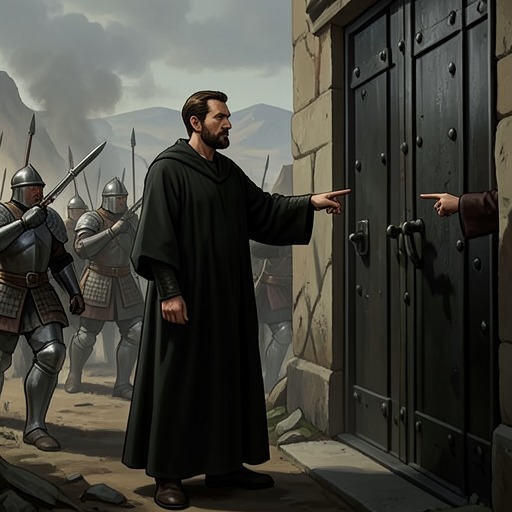
Cao Pi's invasion of Wu
The Romance of the Three KingdomsCao Pi’s invasion of Wu, also known as the Battle of Guangling, is a failed attempt to turn the Wei ruler’s military power into a crossing of the Great River. In the account, the campaign’s decisive reversal comes not from a pitched battle at the riverbank but from Xu Sheng’s overnight construction of a false wall: deceived by an immense defense, Cao Pi abandons the attack, only to face a dangerous retreat under pressure from Wu forces and a reported threat to Chang’an.
Background and preparations
After the alliance between Shu and Wu is renewed, Cao Pi responds with preparations for an immediate invasion. He orders ten large dragon boats, each more than two hundred feet long and able to carry two thousand men, as well as three thousand warships. By autumn 224, the marine and land forces together number more than three hundred thousand. The scale of the preparations establishes the campaign as an attempt to bring overwhelming force to the river frontier, not merely a limited raid.
Wu prepares to defend the Great River. With Lu Xun responsible for Jingzhou, Sun Quan appoints Xu Sheng to organize the defense there. Xu Sheng is joined by Sun Shao, the king’s nephew, who repeatedly asks permission to cross the river with three thousand men and attack the Wei troops. Xu Sheng refuses each time. His refusal makes the contrast between personal initiative and military command explicit: Sun Shao wants to carry the fight to the enemy, while Xu Sheng treats the defense of the river line and the maintenance of discipline as his immediate responsibilities.
The disagreement escalates until Xu Sheng orders Sun Shao’s execution as a warning against continued challenges to his authority. Just as the executioner raises his axe, Sun Quan arrives and stops it. Xu Sheng respectfully argues that sparing Sun Shao risks weakening military discipline; Sun Quan nevertheless pleads for his nephew’s life, while allowing Xu Sheng to dismiss him from the army. Sun Shao then crosses the river with his three thousand men despite his dismissal. Xu Sheng responds by ordering Ding Feng to cross as well and keep watch over the impulsive commander. The episode leaves the Wu defense operating under divided initiative even as the larger invasion approaches.
Cao Pi at the river
Cao Pi’s own arrival at Guangling makes the imperial presence visible on the water. When Cao Zhen reports that no enemy troops can be seen on the opposite bank, Cao Pi takes his state barge, the great dragon boat, out into the middle of the river to inspect the situation. Its flags display the dragon and phoenix, the sun and moon, and the other signs of imperial aspiration. The spectacle advertises Wei’s authority, but it does not settle the military question of whether the river can safely be crossed.
Liu Ye counsels caution when Cao Pi asks why the army should not cross. During the night, a heavy fog conceals the southern bank, and Cao Pi is told that the lack of visible lights means the enemy has withdrawn in fear. At sunrise, however, the fog reveals what Xu Sheng has arranged: an immense wall, guarded by a large force, apparently stretching for about a hundred miles. The defense has been erected overnight and is entirely false, but its appearance has the intended effect. Unable to determine its true strength, Cao Pi concludes that his army cannot overcome the numbers and skill arrayed against it and gives up the attack.
The fake wall turns uncertainty into a weapon. Xu Sheng does not need to defeat the full Wei force in a direct assault; he needs Cao Pi to believe that an advance would be too dangerous. The river, the fog, and the sudden appearance of a seemingly extensive fortification together shape the decision. The account’s emphasis falls on the difference between the immense force Cao Pi has assembled and the limited evidence available to him about the enemy’s position.
Retreat and defeat
The retreat does not restore Wei’s advantage. A rising wind threatens to sink Cao Pi’s imperial boat, and Wen Ping intervenes in time to rescue him. Then comes news that Zhao Zilong and his men have moved out from Yangping Pass and are heading toward Chang’an. Faced with the reported danger to the capital, Cao Pi has no choice but to order a withdrawal along the river.
Wu forces attack as the Wei army retreats. Sun Shao’s men strike the moving forces and nearly capture Cao Pi, while Wei loses half its men in the fighting described in the account. When Cao Pi’s troops try to leave the water for dry land, burning reeds soaked in oil block their route. Ding Feng attacks, and Cao Pi escapes only through the efforts of Zhang Liao, who is badly wounded, and Xu Huang. The sequence reverses the invasion’s opening display: the great dragon boat and the assembled fleet have not secured a crossing, and the retreat itself becomes the point at which the Wei ruler is most exposed.
The defeat is described as immense. Many Wei soldiers die, and the Wu army takes a vast quantity of loot. Zhang Liao later dies of his wounds, and Cao Pi grants him a full military funeral. His death is the clearest lasting personal consequence recorded for the campaign, while the captured goods and heavy losses mark its wider military cost.
Significance in the narrative
The episode builds its reversal through misreading and movement: Cao Pi takes the unseen southern bank to mean that Wu has fled, then mistakes a hastily constructed façade for an overwhelming defense. When the expected advance is abandoned, the campaign’s danger shifts to the retreat, where river, weather, fire, and Wu attacks constrain the Wei force. The contrast between Cao Pi’s elaborate imperial display and Xu Sheng’s deceptive wall makes appearances central to the episode’s military logic.
The account also sets ambition against command and caution. Sun Shao’s repeated demand to cross is checked by Xu Sheng, but Sun Quan’s intervention prevents the punishment Xu Sheng intends; Sun Shao then acts independently, and Xu Sheng assigns Ding Feng to monitor him. The campaign’s outcome is therefore shaped by several kinds of decision: Xu Sheng’s restraint at the river, his use of deception, Cao Pi’s choice not to attack the wall, and the order to withdraw when Chang’an is threatened. Rather than ending in a single decisive clash, the invasion fails through a chain of choices that turn Wei’s numerical superiority into vulnerability.