Cao Zhi
The Romance of the Three KingdomsCao Zhi is the poet son of Cao Cao whose literary skill saves him from execution by his brother Cao Pi, the new ruler of Wei. His defining scene turns a succession struggle into a test of language: compelled to compose under threat, he makes poetry expose the human cost of one brother destroying another. The verses move Cao Pi to tears, but Cao Zhi survives only at a reduced rank and is sent away to govern Anxiang.
Identity and Court Position
Cao Zhi is introduced as lord of Linzi and as a figure of contrasting reputations. He is known both for poetry and for drinking; he and two well-known writers, the Ding brothers, are often drunk even early in the morning. Yet his literary fame does not shield him from the dangerous politics of Cao Pi’s accession. When his brother, now king, calls him to pay homage, Cao Zhi initially refuses to respond. In a court where succession has already cost lives, that refusal makes him vulnerable.
The account places Cao Zhi among the surviving brothers after Cao Cao’s death. Cao Zhang has been brought under control, while Cao Xiong, having failed to attend the funeral, commits suicide and is buried with due honour. Cao Zhi’s fate is different: he is seized and brought before Cao Pi, where family status offers no reliable protection. His survival will depend not on a military following or a political argument, but on his ability to answer his brother’s challenge in verse.
Seizure and the Seven-Pace Test
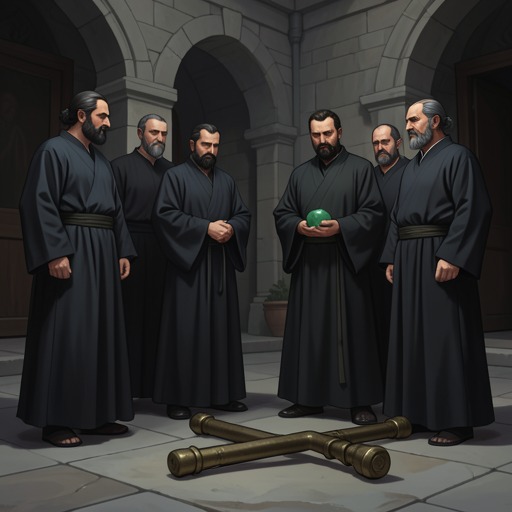
An army of three thousand men attacks and captures Cao Zhi and the Ding brothers. Cao Pi orders the Ding brothers executed immediately. Their deaths cause sadness among writers and thinkers, and sharpen the danger facing Cao Zhi: he is brought before a brother who wants him dead. Their mother pleads for compassion, but Cao Pi does not simply release him. Instead, he makes the poet’s reputation the instrument of a trial.
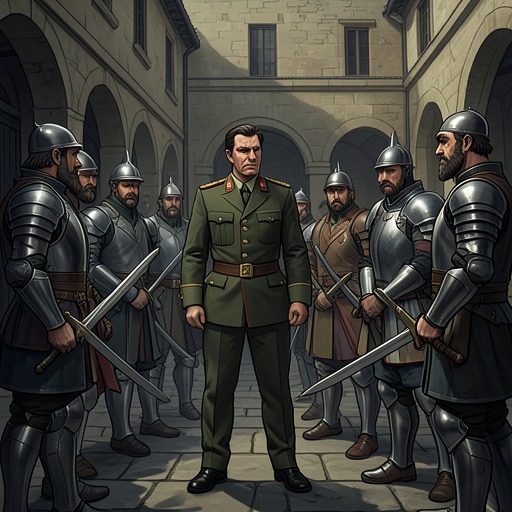
Cao Pi sets a precise constraint. Cao Zhi must walk seven paces and, before completing them, compose a poem based on a drawing of two bulls on the wall: one has died after a fight and fallen into a well. He is forbidden to state the scene plainly as two bulls fighting beside a wall, with one dying in a well. The test demands speed, invention, and restraint, while the threat of death gives its formal limits a personal force. Cao Zhi takes the seven steps and recites a new poem, meeting the challenge without merely describing the picture.
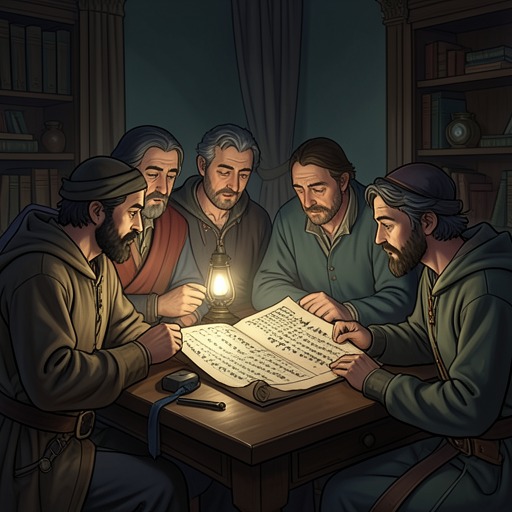
Cao Pi then imposes a second task: Cao Zhi must capture the relationship between them without using the word brother. Cao Zhi again succeeds, this time with the image of beans boiling over a fire made from their own stalk. The voice from the pot asks why, since both came from one root, one is cooking the other. The image transforms a courtly riddle into an accusation whose force comes from its indirection: the poem names the violence between the brothers without naming their kinship directly.
Relationship with Cao Pi and the Outcome
Cao Pi is moved to tears by the second poem. Their mother again pleads for Cao Zhi, and Cao Pi agrees to spare him. The reprieve does not restore Cao Zhi’s former standing: Cao Pi demotes him, and Cao Zhi accepts the lower rank gratefully before leaving to take responsibility for governing Anxiang. The outcome is therefore both a rescue and a political defeat. His words keep him alive, but they do not return him to the centre of power.
The episode also closes one visible source of rivalry for Cao Pi: with Cao Zhi demoted and sent away, the narrative says there is no further sibling rivalry. Cao Pi is then free to reshape the laws according to his own will and to exert even greater pressure on the Han emperor than Cao Cao had done. Cao Zhi’s personal reprieve thus accompanies a wider consolidation of his brother’s authority; the poem interrupts the immediate violence but does not reverse the political change around it.
Poetry as Survival and Appeal
Cao Zhi’s defining action is a performance under coercion, not an escape from politics. The seven-step limit makes the first poem’s speed visible, while the second task makes kinship itself the subject that cannot be named. Its shared-root image gives the plea for mercy a structure Cao Pi can hear: violence against Cao Zhi becomes violence against someone formed from the same source. The poem does not erase the imbalance between ruler and condemned brother, but it makes that imbalance emotionally legible to the person who controls his fate.
The account presents literary talent as effective but bounded power. Cao Zhi’s poems alter Cao Pi’s decision from execution to sparing, yet the price of survival is submission to demotion and departure. His story’s sharpest reversal lies there: a poet celebrated for invention is forced to improvise for his life, and wins not freedom or equality but continued existence. The episode makes verse an instrument of moral appeal within a succession struggle, while showing how little such eloquence can secure once political authority has passed into a brother’s hands.