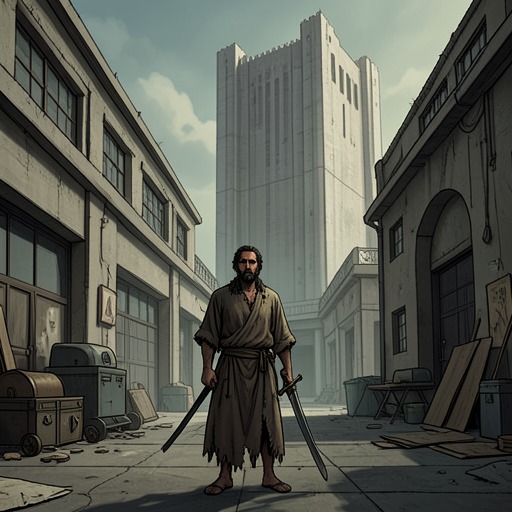
Capture of Chang'an by Ma Chao
The Romance of the Three KingdomsThe Capture of Chang'an by Ma Chao turns a bid for revenge into a strategic crisis for Cao Cao. A southern alliance proposal redirects Ma Chao’s forces toward the capital; after a siege stalls, Pang De’s staged retreat and surprise entry bring the city down. Its loss abandons the southern campaign and shifts the struggle to the Tong Pass, where a premature attack by Cao Hong helps Ma Chao seize the route.
Causes and Strategic Stakes
After the death of his father and brothers, Ma Chao vows revenge. At that moment, a message from Xuande reaches him with a proposal: Ma Chao should attack Cao Cao from the west while Xuande presses from the south. Ma Chao accepts without hesitation and gathers support from other leaders in the region. More than two hundred thousand tribal warriors march toward Chang’an.
The proposal answers an immediate strategic problem for Xuande’s side. Cao Cao fears an attack by the western tribal forces, and the alliance is intended to keep his troops from advancing south. Once the governor, Zhong Yao, reports the western attack, he moves to meet it, is defeated in the first engagement, and retreats behind Chang’an’s defenses. Ma Chao’s army then besieges the city. The contest for Chang’an is thus both a campaign of revenge and a diversion that threatens to derail Cao Cao’s plans elsewhere.
The Siege and the Ruse
The siege lasts ten days without success. Pang De, one of Ma Chao’s commanders, proposes that the besiegers withdraw and allow the city’s residents to come out and replenish their supplies. The suggestion is a trap: the apparent easing of pressure is meant to make the defenders open the gates and create an opportunity for infiltration. Ma Chao agrees, and the besieging force disappears into the distant hills.
Once Zhong Yao is sure the attackers have moved away, he opens the gates. People stream out and return over the next five days. The account notes that some entering the city had not been residents at all, a detail that points to the ruse’s practical purpose: movement through the gates gives the attackers a chance to bring people inside who can assist the assault. When the enemy is sighted returning, the gates are hurriedly closed, but the withdrawal has already made the city’s defenses vulnerable.
Entry Through the West Gate
Late that night, a fire breaks out by the west gate. Zhong Jin, the commander there and Zhong Yao’s brother, rides to investigate. Pang De comes out of the darkness, identifies himself, and kills Zhong Jin; the gate is then thrown open, allowing the Xiliang troops to pour into the city. Zhong Yao escapes and takes up a defensive position at the Tong Pass, while a message is sent urgently to Cao Cao.
The fall follows not from a successful breach during the prolonged siege but from the sequence of feigned withdrawal, reopened gates, and an attack at night. Pang De’s role links the deception outside the walls to the decisive opening inside them. With the west gate lost and the troops entering, Zhong Yao can no longer hold Chang’an and withdraws to the pass.
Aftermath at the Tong Pass
The city’s capture produces the strategic effect Xuande intended: Cao Cao abandons his southern campaign. Recognizing the importance of holding the Tong Pass, he sends ten thousand elite troops under Cao Hong and Xu Huang to reinforce its defense. Ma Chao brings his army below the pass and taunts the defenders daily, trying to draw them into battle. Xu Huang restrains Cao Hong, who is eager to descend, and favors holding position.
On the ninth day, however, Cao Hong sees the troops below resting and takes three thousand men down to attack. The strike catches Ma Chao’s forces off guard and scatters them. Xu Huang charges after Cao Hong, calling for him to return, but when the two commanders meet, Ma Chao attacks from the front while Pang De strikes from the other side. Half of Cao Hong’s men are lost; Cao Hong flees with Pang De in pursuit. Ma Chao consequently takes control of the pass. The account closes the immediate sequence with Cao Cao furious at the defeated commanders and inclined to execute Cao Hong, until others dissuade him.
Narrative Significance
The episode’s decisive reversals are built from choices about access and timing: a siege that achieves no success, a withdrawal that invites traffic through the gates, and a nighttime assault that converts that traffic into entry. Chang’an’s capture changes the campaign beyond the city walls, forcing Cao Cao to abandon his southern advance and defend a narrow strategic route. At the pass, caution initially checks Cao Hong, but his decision to attack turns a temporary advantage into a defeat. The capture and its aftermath therefore show how a local deception can redirect a larger campaign, while the effort to recover control exposes the danger of ignoring a commander’s restraint.