Chang’an
The Romance of the Three KingdomsChang’an is a repeatedly contested capital and political center in the novel: Dong Zhuo moves the Han court there from Luoyang, Cao Cao is later celebrated there after victories over Lü Bu, and the city figures in the changing geography of power that precedes the rise of the Three Kingdoms. Its story joins the violence of forced relocation to later arguments over who may claim the Han inheritance.
Capital and Forced Relocation
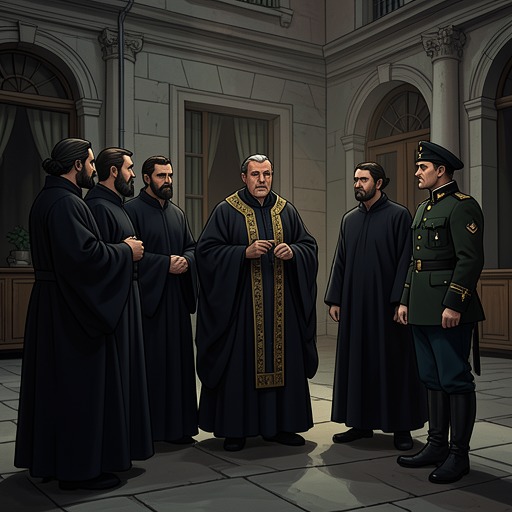
Dong Zhuo decides to move the capital to Chang’an after Li Ru interprets the division between the western and eastern Han as a sign that the court should return west. Dong Zhuo presents the move as a way to revive an imperial house he claims has lost its vigor in Luoyang. The decision is enforced against opposition: two officers who try to stop him at the city gate are executed.
The move is tied to a plan to finance Chang’an’s rebuilding by plundering Luoyang. Troops kill thousands of residents and their families, drive millions of people toward Chang’an, and loot along the route; many of the displaced die on the journey. Before leaving, Dong Zhuo orders Luoyang burned, including its palaces and ancestral shrines, and its imperial tombs and other burial places plundered. Chang’an’s new role as the destination of the court is therefore established through the destruction of the former capital and the suffering of those driven from it.
Dong Zhuo’s Seat of Power
From Chang’an, Dong Zhuo’s power is associated with increasingly extravagant displays and abuses. On hearing that Sun Jian has died and that Sun Ce is only seventeen, he concludes that he has little to fear from that quarter. He then demands to be addressed as the Most Venerable Father and behaves as though he were emperor. Outside Chang’an, he has a vast palace built by more than a quarter of a million laborers; once completed, it is filled with plunder and hundreds of women serving as attendants.
The city also anchors a court that remains exposed to violence within its own ranks. After Cao Cao’s victories over Lü Bu, the imperial court at Chang’an rewards and honors him. Yet the court is dominated by Li Jue and Guo Si, whose seizure of power leaves the emperor despairing and the officials afraid. Chang’an is thus not simply a secure center of government: the court’s presence there coexists with its subjection to rival military leaders.
A Changing Political Geography
As the novel’s conflicts widen, Chang’an marks the westward reach of political and military power. Kong Ming describes Cao Cao as ruling in the north while controlling the emperor, giving him the allegiance of many nobles; this analysis presents control of the court as a source of political leverage, not merely a matter of where the capital stands. Later, after Xuande’s forces prevail around Hanzhong and Cao Cao retreats, Cao Cao and his troops reach Chang’an and rest there. The city remains a practical destination in the movement of armies and rulers, even as control of surrounding territory changes.
Other struggles around the western regions draw Chang’an into the story’s broader map of competing authorities. Zhang Lu, alarmed by Cao Cao’s victories and the prospect of an advance against Hanzhong, considers declaring himself prince of Hanning and leading resistance; his adviser instead urges an attack on Liu Zhang’s territory in the Western Riverlands. These plans do not make Chang’an their setting, but they show the pressure radiating through the west as leaders respond to the shifting balance of power around the court and its military forces.
Imperial Succession and Significance
Chang’an’s political meaning extends beyond military occupation. When Cao Pi receives the Han emperor’s abdication and establishes the Wei dynasty, the former emperor’s announcement presents the transfer as Heaven’s sign that the Han era has ended and fortune has passed to the Cao family. In Chengdu, news of Wei’s founding and rumors about the former emperor’s fate unsettle Xuande. Kong Ming argues that Xuande, as a descendant of the Han founder, should claim the imperial title and continue the lineage. The dispute makes clear that the court’s authority and the meaning of Han continuity remain contested even after the political center of gravity has shifted.
Across these episodes, Chang’an is both a destination imposed by force and a marker of authority that successive powers seek to possess or supersede. The novel connects the relocation of the court to Luoyang’s destruction, later presents Chang’an as a place of refuge after retreat, and sets its political history against the rival claims made in the name of the Han. The city’s significance lies in this repeated conjunction of capital, coercion, and disputed legitimacy.