Chen Lin
The Romance of the Three KingdomsChen Lin is a renowned scholar and writer whose public indictment of Cao Cao becomes a weapon in Yuan Shao’s campaign against him. The episode shows how a written document can make political legitimacy a matter of public argument—and provoke the very confrontation it seeks to justify.
Identity and place in the narrative
Chen Lin appears in the novel’s account of the Han empire’s collapse, a story built on historical events but shaped through dramatic retelling. The book’s larger narrative combines historical records with material developed through oral storytelling and theatre, then gathered into the novel by an author whose identity remains debated. Chen Lin’s role is brief but pointed: his writing gives Yuan Shao’s cause a formal voice and brings its accusations directly to Cao Cao.
The denunciation of Cao Cao
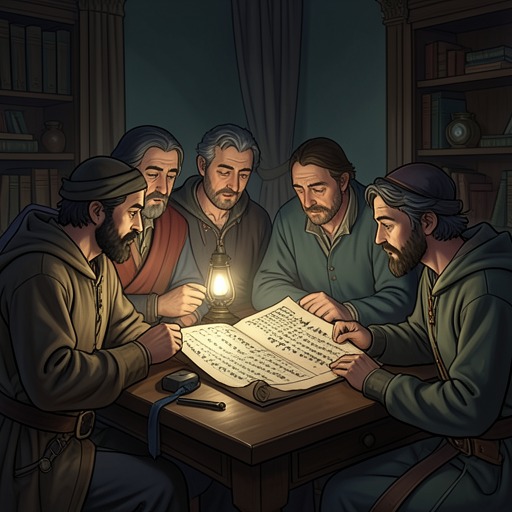
After considering Xuande’s proposal to join forces against Cao Cao, Yuan Shao is persuaded to go to war. To strengthen the moral case for the attack, he commissions Chen Lin to draft a long formal document. It begins with historical examples of the consequences of failing to speak against corruption, then presents a detailed catalogue of crimes attributed to Cao Cao.
The denunciation attacks Cao Cao’s family background as well as his conduct in power. It accuses him of moving the capital, killing officials who opposed him, looting an imperial tomb, aiding rebels, and effectively imprisoning the emperor by placing his own men around the palace. By linking these charges to the broader danger of political corruption, the document frames Yuan Shao’s proposed war not simply as a contest between rival leaders but as a response to abuses of authority.
Circulation and consequence
Copies of Chen Lin’s document are distributed throughout the country, until one reaches Cao Cao while he is ill in bed with a migraine. He rises in anger and demands to know who wrote it. On learning that the author is Chen Lin, he responds that a scholar’s pen cannot make up for Yuan Shao’s weakness in battle. Yet his dismissal does not neutralize the document: the incident instead strengthens his resolve to deal with Yuan Shao.
Cao Cao then decides to attack Yuan Shao while also sending commanders against Xuande, using the second offensive to divide his opponents. Chen Lin’s denunciation thus contributes to the escalation of the conflict even as it exposes the competing political claims behind it. Its reach—from formal commission to nationwide circulation and then to Cao Cao’s sickroom—makes writing part of the struggle for power, not merely a record of it.
Literary and political function
The episode gives Chen Lin a defined function as a publicist of Yuan Shao’s cause: his reputation as a scholar lends weight to a text designed to establish the virtue of war against Cao Cao. The force of the document lies in its accumulation of specific allegations and its appeal to historical precedent, while Cao Cao answers its moral attack by challenging the relationship between literary skill and military strength.
The novel’s presentation also reflects its layered composition. Historical events provide the framework, while dramatic storytelling gives political conflict vivid scenes and memorable confrontations. Chen Lin’s document is one such scene: an argument about corruption becomes an event in its own right, and the response to it helps propel the rival leaders toward war.