Death of Liu Bei
The Romance of the Three KingdomsXuande’s death in the spring of AD 223, at the Palace of Eternal Peace in Baidi, ends the life of the Shu ruler but not the political project he leaves unfinished. After defeat by Lu Xun, Xuande refuses to return to Chengdu, accepts responsibility for the disaster, and places his heir and kingdom in Kong Ming’s hands. His last acts make the scene both a reckoning with failed counsel and a carefully staged transfer of authority: the heir is Liu Shan, but the burden of protecting the state falls above all on Kong Ming.
Defeat and retreat to Baidi
In the summer of AD 222, Lu Xun defeats the Shu armies. When Ma Liang arrives at Baidi and finds Xuande sheltering there, he blames himself; Xuande answers that the failure was his own, because he had not listened to Kong Ming. Ashamed to return to Chengdu after such a disastrous defeat, he raises the status of his quarters and proclaims that they will henceforth be the Palace of Eternal Peace. The new name lends formal dignity to a refuge reached after military collapse, but it cannot restore the position that has been lost.
The defeat also exposes the cost of the campaign in human and political terms. Huang Quan, cut off from the Shu army, has gone over to Wei. Though advisers urge Xuande to execute Huang Quan’s entire clan, Xuande refuses to treat the general’s predicament as deliberate betrayal: he says that if anyone betrayed anyone, it was Xuande who betrayed Huang Quan. This admission gives his final retreat a moral as well as military weight. He does not answer a disastrous outcome by transferring blame to a subordinate whose circumstances he recognizes.
The final illness and vision
By late spring of AD 223, Xuande’s strength is rapidly failing in the Palace of Eternal Peace, and he takes to his bed. The account connects his decline to the shock of what has happened to his sworn brothers, as well as to a body and mind no longer able to withstand sickness. His political defeat and private grief converge in the same confined setting: the ruler who once moved through the country with an ambition to restore the Han now faces the end of his life at Baidi.
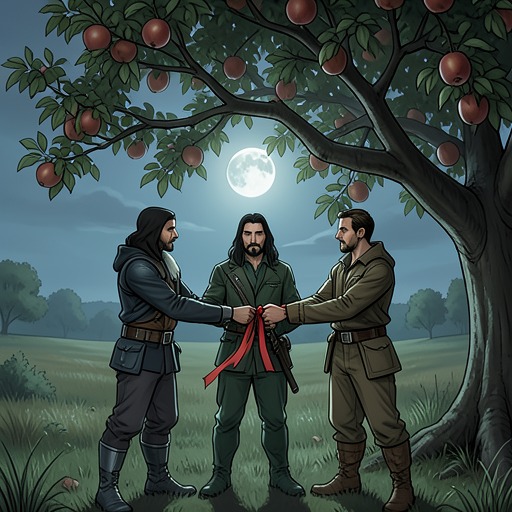
One night, alone after dismissing his attendants, Xuande senses a cold wind in the room. His candles gutter and flare, and he sees Guan Yu and Zhang Fei standing before him. At first he asks why they have come despite his order not to be disturbed; then, astonished, he greets them as alive. Guan Yu tells him that they are ghosts, and that the Supreme Lord has made them gods because they kept faith with their vow in life. He also tells Xuande that the three brothers will soon be reunited. Xuande reaches toward them, wakes, and finds that they have disappeared. The vision turns the brotherhood’s eventual reunion into a foreknowledge of death, not a reprieve from it.
After waking, Xuande calls for his servants and says that he has little time left. He orders them to bring Kong Ming from Chengdu at once. Kong Ming arrives with Xuande’s younger sons, Liu Yong and Liu Li; the heir, Liu Shan, has been left in Chengdu to hold the capital. The arrangements already distinguish the successor who will occupy the throne from the adviser summoned to shoulder the immediate work of government.
Entrusting the kingdom to Kong Ming
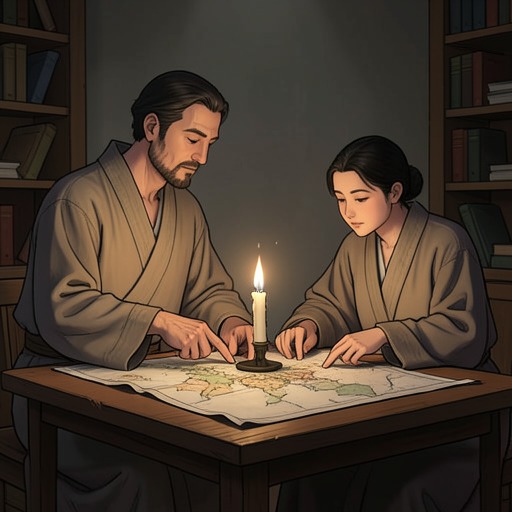
Speaking privately, Xuande tells Kong Ming that the adviser brought him success and that ignoring his counsel helped bring about the present disaster. Xuande does not recast his defeat as a mere turn of fortune: he identifies his own refusal to listen as a cause and confesses that he is dying. He describes Liu Shan as too weak to rule and places responsibility for the kingdom in Kong Ming’s hands. His confidence in the adviser is therefore accompanied by a frank judgment of the heir’s limitations.
Xuande also warns Kong Ming against advancing Ma Su, Ma Liang’s younger brother. When Kong Ming says he considers Ma Su one of their best men, Xuande sharply disagrees, describing him as empty talk and telling Kong Ming not to promote him under any circumstances. The warning is a specific piece of last-minute political counsel, delivered as part of the transfer of power rather than as a general condemnation of the court. Kong Ming is to govern and teach, but Xuande also asks him to judge the character of those who may serve the young ruler.
The testament sets out the purpose Xuande believes remains unfinished. He says that he and his companions had tried to rid the world of Cao Cao and support the House of Han, but had not reached even halfway toward that goal. He entrusts Liu Shan to Kong Ming and asks him to teach the heir well. Then Xuande goes further: if Liu Shan cannot fulfil his duties and protect the kingdom, Kong Ming must take the throne himself. Kong Ming is overcome with grief and prostrates himself repeatedly. The offer makes the succession conditional on the state’s survival and the heir’s capacity, even as the formal line of inheritance passes to Xuande’s son.
Farewells, death, and succession
Xuande calls Liu Yong and Liu Li to his bedside and commands them to serve Kong Ming as they would their own father. He gives the same instruction to his officials, ordering them to support the regent. These directives extend the private entrustment into a public settlement: Kong Ming’s authority is to be recognized not only by Liu Shan but also by the younger princes and the administration. Xuande then turns to his old comrade Zhao Zilong, recalls that they have survived much together, and asks him, for the sake of their friendship, to watch over his sons and honour his request. Zhao Zilong weeps and promises to do so.
Addressing everyone gathered, Xuande wishes them well and asks them to act in accord with what is best in themselves. He never speaks again. He dies at sixty-three in the spring of AD 223. The silence after his final farewell contrasts with the extensive instructions he has left behind: his voice ends, but his arrangements for rule, loyalty, and protection are meant to continue through those who survive him.
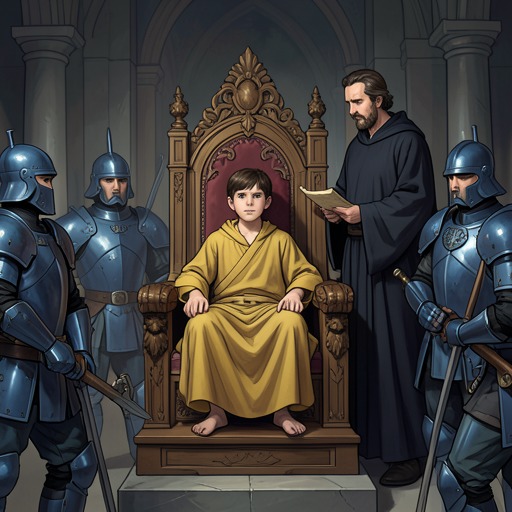
Xuande’s body is carried back to Chengdu. Formal mourning takes place, and Liu Shan is enthroned as the second ruler so that the Han lineage can continue without interruption. Xuande receives the posthumous name August Emperor Zhao Lie, meaning Reflected Glory, and is buried at Huiling. The succession thus preserves the dynasty’s claim through his son, while the testament leaves Kong Ming responsible for guarding the kingdom and, if necessary, taking power to preserve it. Xuande’s death is consequently both a personal ending and a transfer of an unfinished political struggle: the effort to support the House of Han passes from the founder to the adviser charged with protecting his heir.