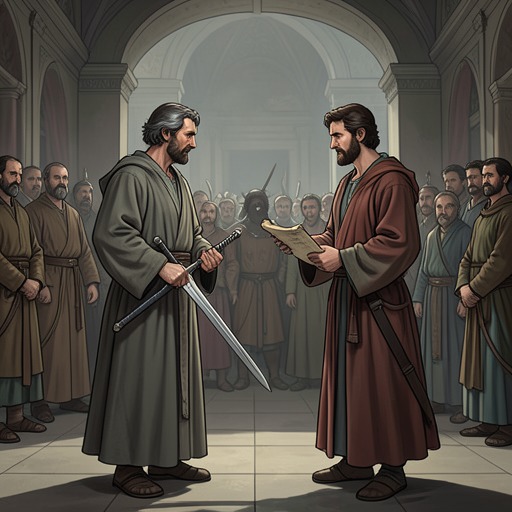
Death of Zhou Yu
The Romance of the Three KingdomsZhou Yu’s death at thirty-six closes the career of Wu’s celebrated commander at a moment when strategic rivalry has become personal and political at once. A failed expedition, a renewed wound, and Kong Ming’s sharp warning converge in his final days; his last act is to recommend Lu Su as the man fit to succeed him. The funeral scene then complicates the rivalry: Kong Ming offers public tribute to the opponent whose plans he had thwarted, and those present are left to judge the meaning of that performance.
Causes and Background
The immediate crisis follows Zhou Yu’s attempt to use a proposed western campaign to advance Wu’s interests. The plan fails when Zhao Zilong exposes its pretext and a large force led by Guan Yu, Zhang Fei, Huang Zhong, and Wei Yan appears to block the expedition. The shock of that reversal causes Zhou Yu’s wound to burst open again. His death follows soon afterward, though the account also emphasizes that he knows he is already dying; it does not reduce his end to the renewed wound alone.
The failed campaign carries a wider strategic danger. In a letter, Kong Ming rebukes Zhou Yu for putting his own soldiers at risk and warns that an expedition into the western Riverlands could leave Wu exposed to Cao Cao, who might exploit the opening to invade and destroy the state. Zhou Yu receives this warning after the plan has already been frustrated. The letter turns a military setback into a direct confrontation over judgment: the question is not only whether Zhou Yu can take territory, but whether his ambition might imperil the power he serves.
Final Days and Death
After Zhou Yu is carried to his ship, he learns that Xuande and Kong Ming watched the affair from a nearby hill, drinking and laughing. Sun Quan’s brother Sun Yu makes a last attempt to continue the expedition, but Xuande’s troops prevent it from going forward. Zhou Yu is thus confronted with both the failure of his plan and the apparent amusement of his rivals, while the remaining effort to carry on is stopped by force.
Kong Ming’s letter makes the danger explicit. It argues that Zhou Yu has endangered his men and that leaving Wu for the western campaign could invite Cao Cao’s attack. Zhou Yu writes a final letter to Sun Quan. Looking toward Heaven, he laments that Kong Ming was made as well as himself, and then dies. His final words frame the rivalry as a contest he cannot escape even at the end, while the account gives his age as thirty-six.
Succession and Funeral
When news reaches Sun Quan, he weeps openly. Zhou Yu’s final letter recommends Lu Su for supreme commander, describing him as loyal, thorough in his planning, and worthy to take his place. Sun Quan appoints Lu Su, so Zhou Yu’s death immediately brings a transfer of military responsibility as well as personal grief. His last communication is therefore not merely a farewell: it helps determine who will lead Wu after him.
Kong Ming sees a general’s star fall in the night sky and understands that Zhou Yu has died. He also interprets a gathering of stars as a sign that many able men are assembling in the east. He travels with Zhao Zilong and five hundred warriors, presenting his journey as a visit to pay respects at Zhou Yu’s coffin. The funeral becomes a scene in which the political dangers around Kong Ming remain active even while he assumes the role of mourner: he has to fend off plots against himself before he can reach the coffin.
There, Kong Ming delivers an extended eulogy. He recalls Zhou Yu’s youth and virtue, his friendship with Sun Ce, his part in creating Wu, his victories over Liu Biao, and his support for Sun Quan. He also remembers Zhou Yu’s marriage to Lady Qiao and his resistance to Cao Cao’s demands, before lamenting that a life of only thirty-six years has ended. The speech concludes by insisting that, although the living and the dead cannot meet, Zhou Yu’s fame will endure. Those gathered are astonished, and Lu Su remarks that Kong Ming seems the greater person.
That acclaim does not settle how the eulogy should be understood. As Kong Ming prepares to leave, a figure in dishevelled Daoist dress accuses him of having driven Zhou Yu to his death and calls his appearance at the funeral an insult to Wu. The accusation makes the ceremony’s ambiguity explicit: Kong Ming’s tribute can be heard as sincere recognition of Zhou Yu’s abilities, but in the context of their repeated rivalry it can also look like a display that magnifies his own standing by mourning the defeated opponent.
Significance
The episode binds private loss to the succession of states and commanders. Sun Quan’s grief and appointment of Lu Su show the immediate consequences within Wu; Kong Ming’s reading of the stars and journey to the funeral place Zhou Yu’s death within a world where political change is also read through celestial signs. Yet the event’s sharpest tension remains human and strategic: Zhou Yu’s final warning concerns the vulnerability of Wu, while his final lament names the rival whose judgment and skill have shadowed him.
The closing contrast is between a life whose fame is affirmed at the coffin and a death whose responsibility remains contested. Kong Ming’s eulogy preserves Zhou Yu’s achievements and insists on his lasting renown, but the Daoist’s accusation refuses to let the tribute erase their antagonism. Zhou Yu is mourned as a capable founder and commander, remembered by his successor’s appointment and by his rival’s praise, while the circumstances of his end continue to expose how closely admiration, competition, and political calculation have been entwined.