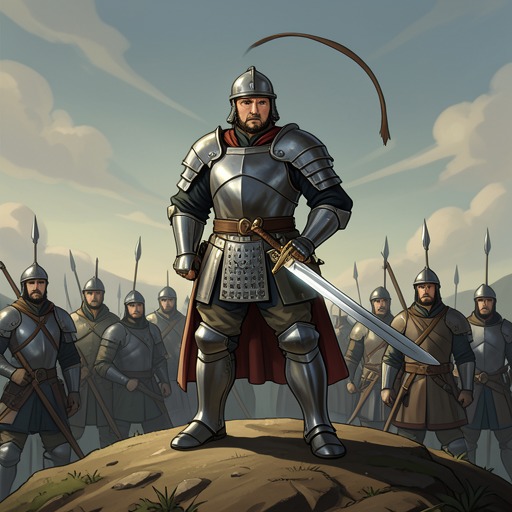
Ding Yuan
The Romance of the Three KingdomsDing Yuan is a commander who openly challenges Dong Zhuo’s attempt to depose the reigning emperor and install Prince Xie. His stand is brief but consequential: after Dong Zhuo’s emissary Li Su persuades Lü Bu to change sides, Lü Bu kills Ding Yuan, and the loss of his army’s allegiance clears the way for Dong Zhuo to press ahead with his political designs.
Identity and political resistance
At a banquet attended by the leading nobles, Dong Zhuo announces that he intends to remove the emperor and put the emperor’s brother, Prince Xie, on the throne. Ding Yuan is the only person present who speaks against the proposal, denouncing it as wrong. Dong Zhuo wants to kill him immediately, but Li Ru restrains him. Ding Yuan escapes to gather his troops, turning his objection into a direct military challenge.
The next day, Ding Yuan’s forces assemble outside the capital, and Dong Zhuo leads his own men out to fight them. The scene makes clear that Ding Yuan is not merely a dissenting courtier: he commands an army capable of confronting Dong Zhuo’s power. In Ding Yuan’s ranks is Lü Bu, whose attack sends Dong Zhuo retreating and leaves Ding Yuan’s forces with the upper hand in the encounter.
Lü Bu’s defection and Ding Yuan’s death
Dong Zhuo recognizes Lü Bu’s fighting ability and wishes to bring him over to his side. Li Su, who comes from the same village as Lü Bu, offers to persuade him with gifts, including the celebrated horse Red Hare, as well as gold and pearls. He also appeals to the idea that a capable man should choose a worthy master. The inducements work: Lü Bu leaves Ding Yuan’s service and joins Dong Zhuo.
That night Lü Bu enters Ding Yuan’s tent. Ding Yuan addresses him as his son, but Lü Bu rejects the relationship, saying that he is too important to be known as Ding Yuan’s son. When Ding Yuan asks what has happened, Lü Bu gives no explanation and kills him. The account presents the break not as a gradual estrangement but as a sudden reversal of allegiance, from subordinate who had fought Dong Zhuo to the man who eliminates Ding Yuan.
The following day Lü Bu takes Ding Yuan’s head to Dong Zhuo and asks to be accepted into his army. Dong Zhuo welcomes him and gives him valuable gifts. Ding Yuan’s soldiers then largely disappear, leaving Dong Zhuo with less opposition and Lü Bu with a new patron.
Consequences and narrative significance
Ding Yuan’s death enables Dong Zhuo and Li Ru to proceed with the forced change of emperor. At a subsequent banquet before the court, Dong Zhuo again lays out his proposal and threatens those who would oppose it. The episode thus connects Ding Yuan’s personal vulnerability to a larger political consequence: once the commander and his army are removed from the contest, resistance to Dong Zhuo’s plan is further weakened.
Ding Yuan’s part in the narrative also establishes Lü Bu’s capacity for abrupt, self-interested changes of allegiance. The contrast between their apparent father-and-son bond and Lü Bu’s rejection of it at the decisive moment gives the defection its force. Ding Yuan stands against Dong Zhuo’s seizure of authority, but the account shows how political resistance can be undone through a combination of military pressure, personal inducement, and betrayal within a commander’s own ranks.