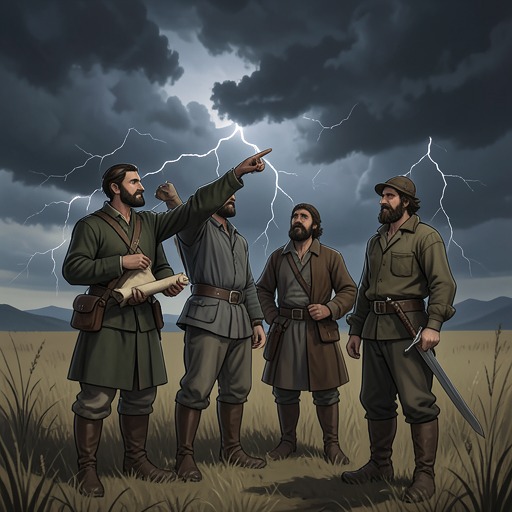
Divide and rule
The Romance of the Three KingdomsDivide and rule is a recurring strategy for breaking an opponent’s capacity to act together: rather than confront a united force on equal terms, a strategist turns rivalries, divided loyalties, or false impressions into sources of weakness. The novel applies the method in both court and battlefield politics, showing how it can secure an opening for conquest, fail when detected, or be reversed by an opponent who understands the design.
Political Rivalries and Succession
After failing to capture Jizhou, Cao Cao withdraws and turns to the rivalry between Yuan Tan and Yuan Shang. Yuan Tan resents being passed over as the elder son, leaving him vulnerable to an approach from Cao Cao. Guo Jia identifies that fracture as an opportunity: if the brothers fall out, Cao Cao can benefit from their division. The dispute is not merely personal. Yuan Shang has already given Yuan Tan too few reinforcements to withstand Cao Cao, hoping that Cao Cao will eliminate his rival for him.
Yuan Tan’s adviser Guo Tu proposes a banquet as cover for an attack on Yuan Shang. Others object that brothers should not weaken one another while facing an outside enemy, but Yuan Tan proceeds. Yuan Shang arrives with fifty thousand men, revealing that the plot has been discovered. Yuan Tan is defeated and retreats to Pingyuan; later, at Guo Tu’s urging, he seeks Cao Cao’s help. Cao Cao accepts, using the brothers’ conflict to advance into the north. Their cooperation against him remains unstable, however: Cao Cao and Yuan Tan also plot against each other, and Cao Cao eventually decides that Yuan Tan has outlived his usefulness.
The shifting balance continues when Cao Cao besieges Yuan Tan at Nanpi. At Xuande’s suggestion, Liu Biao uses forged letters to encourage each Yuan brother to believe that reconciliation with the other is necessary against Cao Cao. The maneuver exploits the brothers’ competing needs and redirects their attention toward renewed cooperation. Yet it does not end the conflict: Cao Cao treats Yuan Tan’s conduct as betrayal and attacks him. The episode presents division as an opening, not a guaranteed or permanent settlement; alliances formed under pressure can change as soon as their participants’ interests diverge.
Tactical Deception and Countermoves
The same logic works in the field, where divided information can be as important as divided loyalties. When Yuan Shu’s commander Ji Ling faces Xuande’s troops, Lü Bu sees that Yuan Shu’s side plans to use grain as a way of winning him over while withholding the gold, silk, and horses he has demanded. The intended effect is to keep Lü Bu from supporting Xuande, leaving Yuan Shu free to defeat Xuande before turning against Lü Bu. Lü Bu recognizes the design and devises his own solution to the three-way rivalry, inviting Xuande and Ji Ling separately to a banquet without telling either that the other will attend. By bringing the rivals face to face under his roof, he disrupts the assumptions on which Yuan Shu’s plan depends.
During the siege of Zhang Xiu’s city, Jia Xu applies the method to Cao Cao’s reading of the defenses. Cao Cao appears to have noticed that the southeastern wall is weak, but he has also made preparations on the northwest side that suggest a different target. Jia Xu advises Zhang Xiu to exploit the uncertainty: place elite troops out of sight near the vulnerable southeastern wall, while making ordinary people in armor appear to defend the northwest. The plan aims to draw Cao Cao toward the apparent weakness and then trap his men. Here, dividing and manipulating the enemy’s information is the means of dividing his force.
Kong Ming’s plan at Xinye likewise assigns separate roles to create confusion and delay. Mi Fang and Liu Feng place troops under blue and red banners at Xi Wei Slope and are ordered to retreat in opposite directions when the enemy appears. The divergent movements are intended to confuse pursuit and buy time for an ambush after the fires rise at Xinye. Rather than rely on a single clash, the plan coordinates separate forces, movements, and signals so that the enemy cannot easily interpret what it sees.
The method also appears in a reversal of apparent strength. In the fog near the northern shore, Cao Cao orders ten thousand archers and crossbowmen to fire toward the noise of boats that seem to signal an attack. Kong Ming has sent the boats to draw that response: arrows strike the straw bales carried aboard, and the vessels return with the arrows that Cao Cao’s own force has expended. The deception works by inducing a mistaken estimate of the danger and making the opponent’s response serve the other side’s needs.
Limits and Strategic Significance
Divide and rule succeeds only when a strategist can identify a real point of fracture or make a false picture seem credible. Cao Cao’s effort to benefit from the Yuan brothers’ feud helps open the north to his advance, but his arrangements with Yuan Tan remain vulnerable to mutual distrust. Lü Bu, by contrast, sees through Yuan Shu’s attempt to isolate Xuande and acts before the intended division can take effect. The contrast makes awareness central to the method: an opponent who recognizes the design can frustrate it or redirect its consequences.
Across these episodes, the strategy connects political manipulation to battlefield deception. It can target succession grievances, the terms of an alliance, a commander’s expectations about terrain, or an army’s interpretation of movement and noise. Its recurring importance lies in the novel’s portrayal of conflict as a contest not only of numbers and weapons, but of cohesion and judgment: a divided enemy may be easier to overcome, while a strategist who mistakes the opponent’s intentions risks being caught in a scheme of his own making.