Dong Zhuo
The Romance of the Three KingdomsDong Zhuo’s intervention in the Han court’s succession crisis transforms political disorder into military rule. Invited to Luoyang under the claim that he would protect the dynasty, he seizes control of the capital, deposes the reigning emperor, and installs Prince Xie, later known as Emperor Xian. His rule culminates in the destruction of Luoyang and his assassination by Lü Bu, while the larger collapse of Han authority continues beyond his death.
Entry into the Capital
Dong Zhuo answers He Jin’s call for troops during the struggle against the Ten Imperial Attendants. He petitions to enter Luoyang, presenting himself as a defender of the dynasty. Lu Zhi warns that Dong Zhuo conceals the nature of a wolf beneath an innocent appearance and advises keeping him outside the capital. He Jin ignores the warning. After He Jin is killed in the palace, Dong Zhuo’s troops run riot in Luoyang, and his arrival intensifies the turmoil surrounding the court.
The episode establishes Dong Zhuo’s power as military rather than consensual: he enters amid a crisis of court authority and soon acts without regard for ordinary palace protocol. The capital’s missing Jade Seal adds to the instability, while Dong Zhuo and his assistant Li Ru begin planning to replace the emperor.
Deposition and Rule
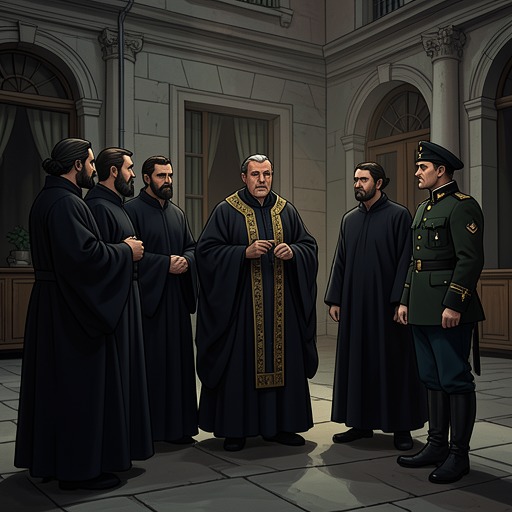
At a grand feast before the nobles, Dong Zhuo announces that the reigning emperor lacks the gravitas required of the Son of Heaven and proposes replacing him with his brother, Prince Xie. Ding Yuan is the only person who openly objects. Dong Zhuo wants him killed on the spot, but Li Ru restrains him. The public challenge reveals that Dong Zhuo treats the succession not as a matter for deliberation but as a decision to be imposed by force.
Dong Zhuo’s actions give the succession crisis a new political shape. The throne remains central to claims of authority, but the decisive power lies with the general who controls the capital and can determine who occupies it. Later, Kong Ming identifies Dong Zhuo as the point at which the Han court’s corruption and seizure of authority began, placing his coup at the start of the political sequence that Xuande hopes to reverse.
Destruction of Luoyang
Dong Zhuo’s rule brings mass killing and forced displacement to Luoyang. On Li Ru’s proposal to finance the rebuilding of Chang’an by taking wealth from people associated with Yuan Shao, Dong Zhuo sends five thousand troops into the city. They kill thousands, including nobles, wealthy merchants, and their families, and drive millions of residents toward Chang’an. Many die along the way as the soldiers plunder and abuse the displaced population.
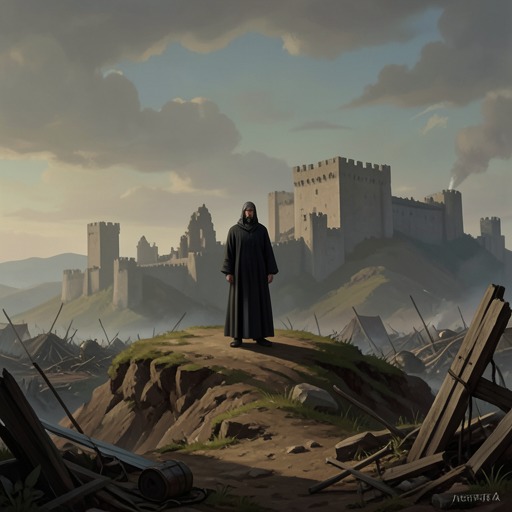
Before leaving, Dong Zhuo orders Luoyang burned, including its palaces and ancestral shrines. Imperial tombs are broken open, and the treasures of emperors and empresses are scattered; soldiers also enter the tombs of nobles and the wealthy. When Xuande and his companions later reach the area, they encounter devastation stretching for hundreds of miles. The destruction is not merely the loss of a capital: it turns the imperial center into evidence of how thoroughly Dong Zhuo’s military rule has displaced the court’s claim to protect the people and the dynasty.
Assassination and Political Afterlife
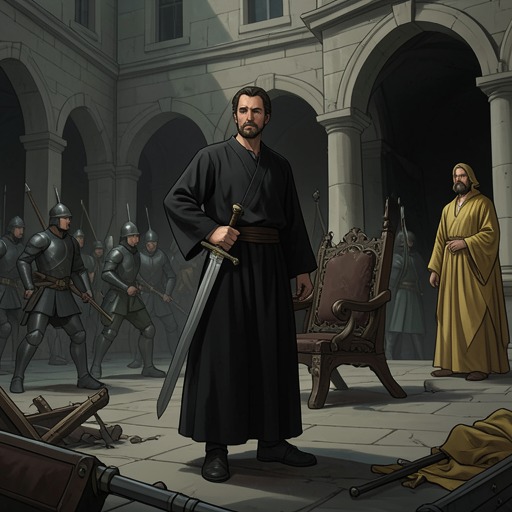
Dong Zhuo is killed in a palace plot involving Wang Yun and Lü Bu. He enters the Reception Hall without his breastplate, and armed men attack him. When he calls for his son, Lü Bu appears with a supposed decree authorizing Dong Zhuo’s death and strikes him with a halberd. Li Su displays Dong Zhuo’s head, and Lü Bu declares that the order applies to Dong Zhuo alone. The officials respond with relief, but the killing unleashes a wider wave of retaliation: Li Ru is executed, and Dong Zhuo’s body is displayed in the marketplace.
Dong Zhuo’s death ends his personal rule but does not undo the damage to the Han state. The novel’s later argument over succession returns to the question his coup made unavoidable: who may legitimately hold imperial authority? The abdication that establishes Cao Pi as emperor of Wei invokes Heaven’s signs, the people’s wishes, and the Han’s supposed transfer of fortune to the Cao family. In Chengdu, Kong Ming treats that change as the usurpation of the Han and urges Xuande to continue its line. Dong Zhuo’s seizure of the succession thus precedes a lasting struggle in which political power and dynastic legitimacy repeatedly diverge.