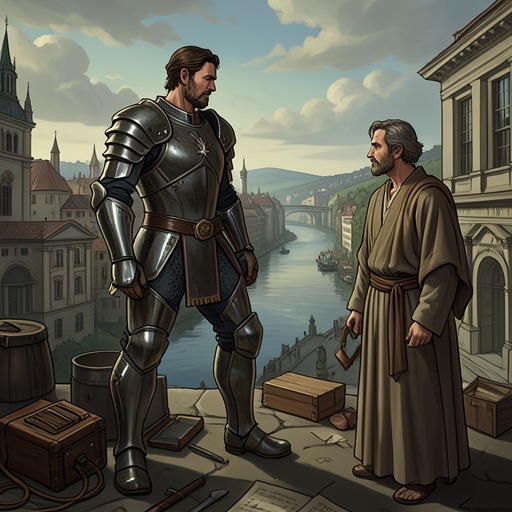
Dong Zhuo deposes the emperor and installs a new one
The Romance of the Three KingdomsDong Zhuo deposes the fifteen-year-old Emperor Shao and places his younger brother, Prince Xie, on the throne, inaugurating the reign of Emperor Xian. The change is more than a palace succession: it makes visible that the Han court can no longer control its own emperors. Dong Zhuo presents the deposition as a remedy for an unfit ruler, but his armed power determines the outcome, and the new emperor’s authority remains subordinate to the man who installed him.
Background and Seizure of Authority
The succession crisis unfolds amid the collapse of imperial control. The court has been weakened by eunuch domination and the failures of earlier emperors; after the Ten Imperial Attendants take power, rebellion spreads across the empire. Dong Zhuo arrives in the capital with a large army and intervenes in the unsettled court. When he encounters the frightened emperor and the composed Prince Xie, he is impressed by the prince’s bearing. The meeting gives him a candidate for replacement, and he begins to plan the removal of Emperor Shao.
Dong Zhuo’s proposal is delivered at a grand feast before the leading nobles. He argues that the emperor lacks the gravitas required of the Son of Heaven, whereas his brother possesses it, and asks whether anyone will object to replacing him. The language invokes the obligations of imperial rule, but the circumstances expose the coercive force beneath it: Dong Zhuo is the dominant commander in the capital, and the nobles are being asked to approve a decision he has already resolved to make.
The Deposition and Installation of Emperor Xian
Ding Yuan is the first to oppose the proposal, denouncing it as wrong. Dong Zhuo moves against him, but Li Ru restrains him; Ding Yuan escapes to gather his troops. Lu Zhi, the former teacher, also speaks against the deposition and is likewise in danger. Their objections show that the transfer is contested, though resistance is isolated and cannot prevent Dong Zhuo from proceeding.
In late summer of 189, Dong Zhuo formally announces the plan in the Hall of Worthy Virtue before Emperor Shao and the powerful officials. With his sword in hand, he declares the young ruler unfit. Li Ru reads the proclamation, which contrasts the former emperor’s supposed failures with Prince Xie’s virtue and dignity, and cites the distress of Heaven and Earth as support for the change. Emperor Shao is deposed and reduced to the status of Prince of Hongnong; his mother and consort are confined with him. Prince Xie is enthroned as Emperor Xian, aged nine. Dong Zhuo becomes prime minister, yet observes none of the customary respect due to the emperor.
The Former Emperor’s Death
The deposition does not leave Emperor Shao safely outside politics. Confined with his mother and consort, he is deprived of adequate food and remains under Dong Zhuo’s control. When a poem he writes in captivity is reported to Dong Zhuo, the new regime treats the former emperor’s words as a danger. Dong Zhuo orders Li Ru to kill him and his family.
Li Ru brings poisoned wine to the prisoners. The former emperor recognizes that they are to die, but the episode ends not with a negotiated settlement or a protected retirement: Li Ru kills the former emperor’s mother and consort and forces the wine on Shao. The killing closes the succession crisis by eliminating the displaced ruler and those closest to him. It also demonstrates how completely the nominal transfer of authority has become a tool of Dong Zhuo’s rule.
Legitimacy and the Larger Political Arc
The episode stages a conflict between the language of legitimate kingship and the force that controls the court. Dong Zhuo claims that Emperor Shao lacks the virtue required to rule and that Prince Xie deserves the throne. Yet the emperor is selected, installed, and later protected or endangered according to Dong Zhuo’s decisions. The proclamation’s appeal to Heaven and virtue cannot disguise that the court’s succession procedure has been overtaken by military power.
The novel places this seizure within a longer pattern of division and reunification: empires fracture under bad rule, and a new power eventually gathers authority from the old order’s remains. Later, Kong Ming describes Cao Cao as controlling the emperor and using that position to command the allegiance of nobles; Xuande, in turn, is urged to claim imperial status in the name of the Han lineage and the people. When Cao Pi later receives the abdication of Emperor Xian, the change is again framed through Heaven’s signs and the precedent of Yao’s virtuous surrender of power. Against those later claims, Dong Zhuo’s installation of Emperor Xian stands as an early, coercive precedent: the throne retains its symbolic force, but the power to decide who occupies it has passed into a warlord’s hands.