Dong Zhuo's Destruction of Luoyang
The Romance of the Three KingdomsDong Zhuo's Destruction of Luoyang joins the forced transfer of the Han court to Chang’an with the looting and burning of the old capital. Dong Zhuo frames relocation as a remedy for a weakened dynasty, yet its execution brings executions, mass dispossession, a deadly march, and the destruction of palaces, shrines, and tombs. In the aftermath, the approaching forces of Xuande and Sun Jian encounter not a recovered seat of government but a landscape emptied and desecrated by the regime’s departure.
Background and justification
Li Ru interprets the political situation through a cycle of Han rule: the western Han had once held its court at Chang’an, while the later eastern Han had ruled from Luoyang. He argues that Heaven’s cycle has come full circle and that returning the court westward would leave nothing to fear. Dong Zhuo accepts this interpretation and decides to move the capital to Chang’an. The language of dynastic renewal gives the transfer an appearance of historical and cosmic order, although the events that follow make clear how little the decision protects the people or institutions supposedly being renewed.
Dong Zhuo summons the officials and announces that after two centuries in Luoyang the imperial family has lost its inspiration and drive. Moving it to Chang’an, he claims, will revive it. The public rationale recasts a seizure of power as service to the dynasty: the court is to be moved not because Dong Zhuo’s rule is contested, but because the old capital is said to have become exhausted. Yet opposition meets immediate force. Two officers try to prevent the departure at the city gate, and Dong Zhuo has them beheaded there. Their fate establishes the terms of the relocation before the court has even left: the policy is imposed, and dissent is punished rather than answered.
Plunder and forced departure
The rebuilding of Chang’an presents a practical problem. Li Ru knows that the virtually deserted city, left desolate after a rebellion two hundred years earlier, will require substantial resources. He proposes identifying people in Luoyang associated with Yuan Shao, killing them, and taking their property. The plan turns political association into a pretext for confiscation, making the transfer of wealth part of the transfer of the capital.
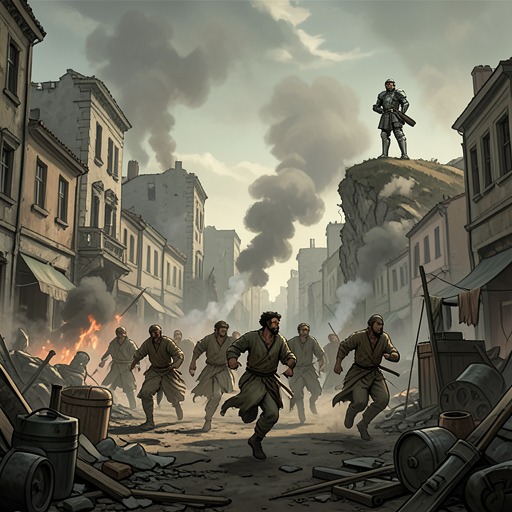
Five thousand troops are sent into Luoyang to carry out the plan. Thousands are killed, including leading nobles and wealthy merchants and their families. The violence is therefore not confined to rivals who might pose a military threat; households are swept into the punishment. At the same time, millions of residents are driven out on the long road toward Chang’an. Many die during the journey, while the soldiers exploit their power to rape and pillage. The relocation thus displaces the city’s population as well as its court, and the promised revival of the dynasty is purchased through devastation imposed on those with no part in the decision.
Destruction of the old capital
As Dong Zhuo prepares to leave, he orders the whole city burned, including its ancestral shrines and palaces. The order extends the destruction beyond ordinary buildings: the sites of imperial memory and ritual are also erased. On his command, the imperial tombs are broken open and the treasures of emperors and empresses scattered. Soldiers then enter the tombs of nobles and wealthy people as well. The departure that was presented as a dynastic restoration ends by desecrating the material traces of the dynasty and stripping the dead and the living of their property.
When Xuande, his sworn brothers, and their men break through the pass, Sun Jian rides toward Luoyang. The account emphasizes what they find: for hundreds of miles, desecration; no bird or animal can be seen or heard, and no people remain in view. This image of absence registers the cost of Dong Zhuo’s policy more forcefully than the official explanation of a revived court. The capital has not simply changed hands or been abandoned; its social and sacred landscape has been shattered.
Aftermath and significance
The destruction makes Luoyang a visible emblem of a wider political fracture. The Han dynasty is already described as dying amid warlords’ competing power, and the removal of its court does not restore authority. Instead, the emperor and imperial household are moved at Dong Zhuo’s command, while the capital’s officials, residents, and ancestral sites are subjected to his violence. The episode shows how a claim to preserve the dynasty can coexist with the destruction of the places and people through which dynastic rule has meaning.
The ruined city also becomes part of the changing balance among the forces contesting the Han world. Xuande’s men and Sun Jian arrive after the devastation, while Cao Cao wants to pursue Dong Zhuo’s retreating army. Yuan Shao disagrees; Cao Cao then takes ten thousand men and sets off in pursuit on his own. The retreat therefore leads directly into renewed military pursuit rather than political repair. Luoyang’s destruction marks both the brutal end of the capital’s former role and the opening of another stage in the struggle among the emerging powers that will carve kingdoms from the weakened Han realm.