Dynastic cycle
The Romance of the Three KingdomsThe Dynastic cycle is the recurring pattern of empire rising from disorder and falling back into it. In The Romance of the Three Kingdoms, the Han’s collapse is not simply the end of one ruling house: it becomes a lens through which the novel connects political breakdown, competing claims to rule, war, and the suffering of ordinary people. The emergence of the Three Kingdoms repeats an older sequence of fragmentation and reunification, while also showing how a dynasty’s promise of order can be undone by the conduct of those who govern in its name.
Definition and Historical Pattern
The account opens its historical frame with the idea that empires arise from chaos and eventually collapse back into chaos. It traces that recurrence through earlier Chinese history: the Zhou gave way to a struggle among kingdoms, Qin reunified the realm but fell after a short reign, and the competing forces of Chu and Han fought until the Han prevailed and restored unity. Later, an uprising again divided the empire, before Emperor Guang Wu restored it. The Han’s eventual division into three kingdoms therefore belongs to a cycle already visible across earlier changes of dynasty, not an unprecedented break in history.
That recurrence is not presented as an impersonal sequence alone. The novel’s account associates the late Han crisis with failed emperors, an unrestrained court faction, and the loss of effective government. Emperor Huan favoured eunuchs over men of distinction; Emperor Ling failed to support a palace conspiracy against them, and its instigators were executed. The Ten Imperial Attendants then gained control of the court, led by Zhang Rang, while warnings from loyal ministers went unheeded. As court authority weakened, rebellion spread beyond the palace. Political failure at the centre thus helps turn a succession of abuses into empire-wide disorder.
Collapse and the Cost of Disorder
The cycle has a human cost that the grand narrative of rulers and kingdoms can obscure. An opening poem laments ordinary people whose lives are broken by civil war and the collapse of government, people rarely heard in official histories. The novel gives that lament historical scale: the Han is a well-recorded dynasty and, for many Chinese, a model of what a dynasty ought to be, so its fall becomes a particularly potent account of the destruction of political order.
The return of the court to Luoyang makes the consequences concrete. The palaces have burned; weeds and brambles cover the city, and the remaining structures are collapsed roofs and crumbling walls. The emperor lives in a small building, while the court meets among the ruins. Famine compounds the ruin: a few hundred families remain, surviving on bark and roots, and people die beside their homes. The episode makes dynastic collapse more than a change of rulers. The state’s inability to secure food or protect its capital is registered in the lives of those left among the wreckage.
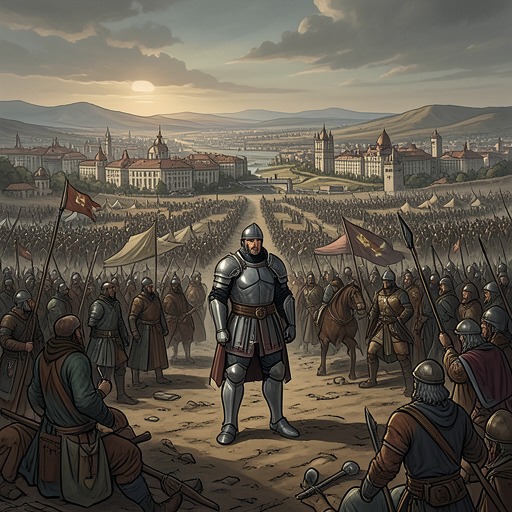
The same vulnerability appears in the military contests that follow. At Guandu, Cao Cao has only a fraction of Yuan Shao’s forces and knows that his limited supplies cannot sustain a prolonged campaign. Intelligence about a coming grain convoy offers an opportunity to strike; the attack destroys the convoy, while the rival armies’ food supplies grow short. The episode shows the cycle operating through material conditions as well as political ambition: armies depend on food, and the struggle for power exposes the weakness of rulers whose resources cannot support their designs.
New Powers and Competing Legitimacies
Out of the failing Han order emerge three leaders who carve kingdoms from its territory: Xuande, Cao Cao, and Sun Quan. Their ascent marks the transition from one empire to a divided political landscape, but it does not settle the question of rightful rule. The novel repeatedly makes legitimacy a contested part of the cycle: holding power, inheriting a claim, serving the Han, and possessing the support of the people are not interchangeable grounds for authority.
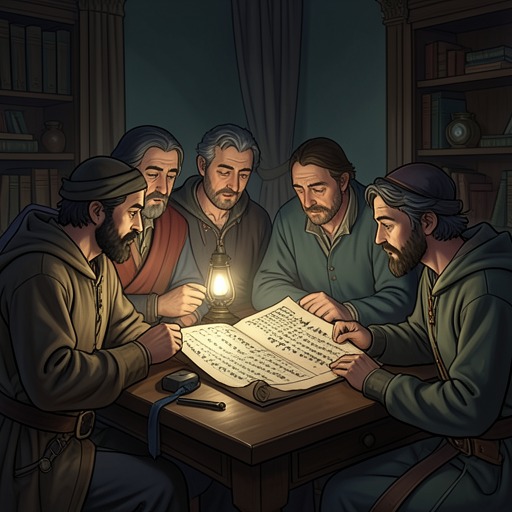
Kong Ming’s counsel to Xuande sets out the strategic shape of this new order. Cao Cao controls the emperor and commands the allegiance of many nobles, making him too powerful to confront directly; Sun Quan, whose family has ruled in the south for three generations, has the people’s support and is therefore a possible ally. Kong Ming identifies Jingzhou as the territory on which the future will turn. His assessment joins military calculation to competing claims about the Mandate of Heaven: a collapsing central authority leaves room for new rulers, but those rulers must still account for the grounds on which they claim to govern.
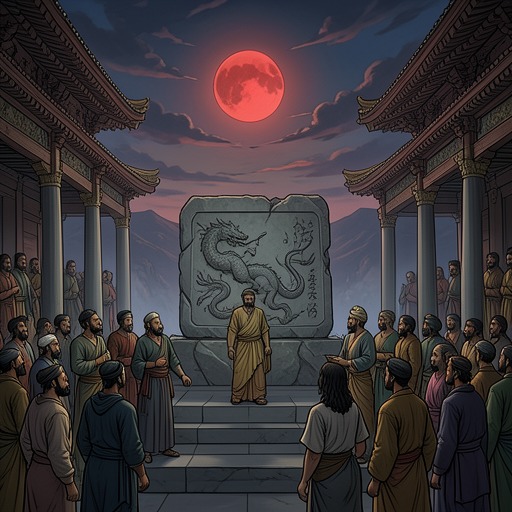
That tension becomes explicit when Cao Pi receives the throne through an abdication presented as a transfer of Heaven’s favor. The announcement declares that the Han era has ended and that fortune has moved to the Cao family, invoking the precedent of Yao’s abdication. Yet in Chengdu, the news prompts a different response. Kong Ming argues that Cao Pi has usurped the Han and that Xuande, as a descendant of the House of Liu, should continue its lineage by becoming emperor. The same transition can therefore be framed as orderly succession or usurpation, depending on which political inheritance is being defended.
Recurrence as Warning
The novel treats the fall of the Han as an enduring warning about excessive ambition and the decay of justice, morality, stability, and wise government. Its account of the cycle gathers together court intrigue, abuse of authority, military competition, and the ambitions of powerful men; yet the effects are measured not only by who wins territory but by whether ordinary people receive peace and security. When territory around Hanzhong falls to Xuande’s forces, some communities surrender because they expect him to ensure peace and security. Kong Ming later urges Xuande to accept the imperial title, arguing that his benevolence has restored peace in the region and that officials and people long for a true emperor. Political legitimacy is thus linked in the narrative to the practical promise of protection.
The warning remains applicable beyond the Han’s fall. In Wu, Lü Kai tells Sun Hao that poverty afflicts the people while the treasury is empty, that the officials’ demands cannot be met, and that the harem has grown from fewer than one hundred women under Sun Quan to more than a thousand. He urges the ruler to reduce demands for military, labour, and other service, limit the palace, and choose good ministers. Sun Hao instead becomes more extravagant, building vast palaces and pressing ahead with plans to invade Jin. The contrast restages the cycle’s central danger: the institutions and resources of a state can be consumed by the ruler’s conduct, while warnings about the consequences go unheeded.
Dynastic change, in this account, does not guarantee lasting repair. The Han’s collapse supplies the novel with a recurring structure for reading later regimes: disorder creates openings for new powers, and claims of righteous rule are tested by what rulers do with authority. The cycle’s most durable measure is therefore not the mere transfer of a throne, but the fate of the people and the government entrusted with their security.