Famine during the imperial court's flight and return
The Romance of the Three KingdomsFamine during the imperial court's flight and return is a recurring condition of the Han court’s displacement, exposing the gap between imperial authority and the ability to provide basic sustenance. As the emperor and empress flee amid military conflict, they depend on a handful of attendants, improvised transport, and food that is scarce or unfit to eat. Their return to Luoyang does not end the crisis: the capital is ruined, its remaining residents are starving, and people die beside their homes. Hunger thus follows the court from the road into the old capital, making the collapse of political order tangible in the lives of rulers and ordinary people alike.
Flight and Immediate Deprivation
After Li Jue and Guo Si defeat the White Wave troops and seize Hongnong, the emperor is forced to flee north with the empress. Li Yue finds a small boat to carry the imperial couple across the Yellow River, but the crossing offers only temporary safety. The court has been reduced to a few servants, with Li Yue and Yang Feng among those trying to care for the couple.
Yang Feng commandeers a farm wagon to take them to Dayang. There is nothing there for them to eat. Onward travel brings no relief: they spend a night in a rough farm hut, where local peasants offer food so coarse that the imperial couple cannot eat it. The journey presents hunger not as a single shortage that can be solved by reaching shelter, but as a condition that accompanies the court from place to place.
A Court Without Provision or Protection
The procession eventually reaches Anyi, where the imperial couple rest in a simple, one-storey hut rather than a palace. The bare accommodation reflects the court’s diminished circumstances, but the political crisis within it makes its vulnerability more than symbolic. Li Yue begins bullying courtiers and denouncing people before the throne without cause. He also provides the emperor with deliberately poor food and pressures him to appoint other White Wave leaders to positions of authority.
An effort to reconcile Li Jue and Guo Si, undertaken to protect the emperor, eventually succeeds, allowing governors from across China to send supplies. Yet the arrival of assistance does not mean the famine is over: the account continues to characterize the period as one of terrible famine. Supply depends on distant governors and an unstable political settlement, while the emperor remains exposed to the conduct of armed men around him.
Return to Ruined Luoyang
Yang Feng and Dong Cheng decide to take the emperor back to Luoyang, despite Li Yue’s opposition. When Li Yue turns traitor and attempts to seize the party on the way, Yang Feng and Dong Cheng hurry ahead with the imperial couple. Yang Feng exposes Li Yue’s claim that Li Jue and Guo Si are backing him; Xu Huang then kills Li Yue, and the White Wave force scatters. The route to the old capital is clear, but safe passage does not restore the conditions necessary for survival.
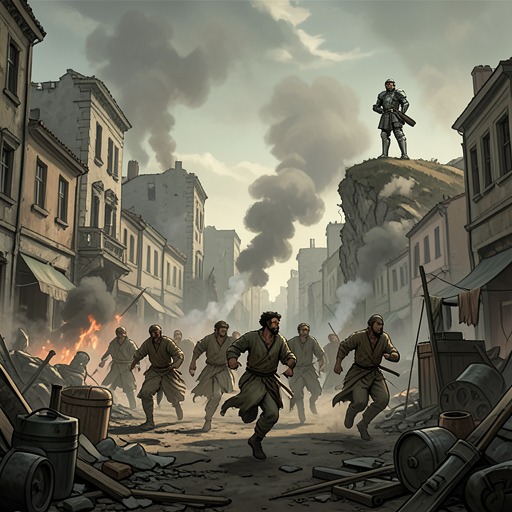
The emperor returns to find Luoyang devastated. Its palaces and halls have been burned, the streets are overgrown, and only one building remains partly intact. The court lives in that modest structure while meeting among the overgrown ruins. In this setting, famine is again explicit: even the few hundred families still in the city survive on bark and roots, and people lie down and die beside the ruins of their homes. The emperor’s return restores the court’s presence in its former capital, not the capital’s capacity to sustain its people.
Political Meaning and Consequences
The account links famine to the breakdown of government across several levels. On the road, the court cannot secure adequate food for the emperor and empress; in Anyi, its care is subject to a military leader who deliberately worsens their provisions; in Luoyang, neither the court nor the remaining residents have enough to eat. The court’s dependence on provincial supplies offers relief only amid continuing scarcity, while the ruined capital turns the consequences of earlier disorder into a daily condition.
This deprivation also sharpens the contrast between political status and practical power. The emperor remains the sovereign at the center of the court’s movements, yet he travels in a farm wagon, rests in a humble hut, and returns to a capital where residents eat bark and roots. Famine is therefore not merely an episode alongside the struggle for control of the court: it is one of the clearest signs that imperial authority has become unable to protect or provide for the people gathered under it.