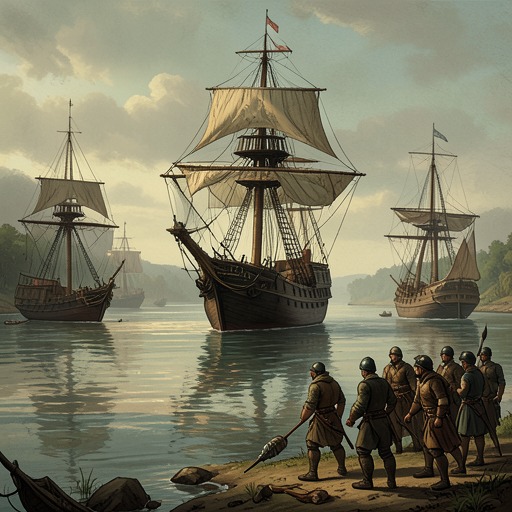
Great River
The Romance of the Three KingdomsThe Great River is the broad geographic reference point for the southern lands in the novel’s account of the Three Kingdoms. It marks a political and strategic divide: leaders seek allies beyond it, and campaigns are planned around the territories and routes it separates. The river’s importance lies not in one isolated crossing or battle, but in how its southern region becomes a base from which power and alliances can be organized.
Geographic and Political Setting
As the Han empire fragments, three leaders—Xuande, Cao Cao, and Sun Quan—establish kingdoms from its former territories. The Great River helps distinguish the southern sphere from the northern contests for power. When Yuan Shao seeks a new alliance against Cao Cao, his adviser Guo Tu proposes reaching south to Sun Ce, whose position beyond the Great River offers a potential partner in a wider political and military contest.
The river’s regional significance is also apparent in the distinction between northern and southern warriors: when Xuande leaves Yuan Shao’s territory, a verse contrasts the departing warrior from the north with the warrior from the south now being sought. The Great River thus functions as a marker of separate political arenas, while the search for an alliance attempts to bridge them.
Strategic Uses of Space
Military decisions in the narrative repeatedly turn on terrain, access, and supply rather than numbers alone. At Guandu, Cao Cao faces Yuan Shao’s much larger force with only about a tenth as many troops. His adviser urges an immediate attack because Cao Cao’s veterans may prevail, but their supplies are too limited for a prolonged campaign. The episode makes clear how resources and the time required to move and sustain armies constrain strategy across the contested regions.
Other campaigns likewise show how control of routes and defensible positions can decide outcomes. At Bowang, Kong Ming places forces in the surrounding hills and valleys, directs attacks on the enemy’s rear and supplies, and arranges a fire ambush in the ravine through which the advancing army must pass. At Jieting, Ma Su’s choice to hold a hill rather than the road leaves his troops without water when the enemy cuts them off. These episodes do not identify the Great River as the site of those actions, but they illuminate the work of geography throughout the book: terrain shapes movement, supply, concealment, and the risks of command.
The Southern Theater
The southern region associated with the Great River also contains politically distinct powers and communities. Zhang Lu rules Hanzhong through a locally rooted religious and administrative tradition, while the neighboring governor Liu Zhang controls Yizhou. In response to Cao Cao’s growing power, Zhang Lu considers declaring himself prince of Hanning; his adviser Yan Pu instead urges him to seize the western territories and establish independence. His argument rests on the region’s population, wealth, grain, and natural defenses, showing how geography can support a bid for autonomous rule.
The Great River’s southern setting is also connected to the planning of the campaign against Cao Cao. Kong Ming tells Zhou Yu that defeating Cao Cao will require fire and a southeasterly wind. Zhou Yu authorizes the construction of the Altar of the Seven Stars on Nanping Mountain, and Kong Ming travels there with workers and banner carriers to build it. The episode makes the southern landscape part of a larger strategy, linking a military objective to a specific place and the conditions needed for the plan.
Narrative Significance
Across these episodes, the Great River signifies both separation and connection. It divides the political map into regions with distinct leaders and resources, yet alliances and campaigns repeatedly reach across those divisions. The southern territories offer prospective partners, local defenses, and strategic positions; their importance grows as the old imperial order gives way to competing kingdoms. The river is therefore a geographic frame for political change, not merely a backdrop to it.