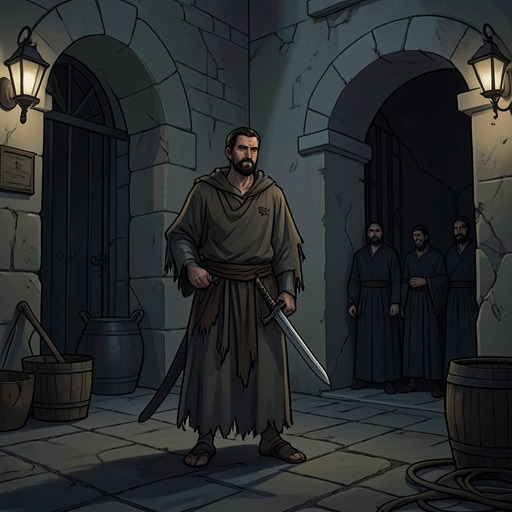
Guan Lu
The Romance of the Three KingdomsGuan Lu is a diviner whose forecasts place the uncertain future of the empire alongside the practical decisions of its rulers and commanders. His appearance connects earlier signs of Heaven’s displeasure and later dynastic portents to particular political and military outcomes. Yet his insight is not presented as unlimited: he restrains what he tells Cao Cao, and his predictions prompt caution without removing the risks of human judgment.
Identity and Reputation
Guan Lu enters Cao Cao’s story after the ruler is shaken by an apparition of the dead. An imperial astrologer recommends him as an astonishing diviner, while warning that he is ugly, rude, and fond of wine. The account emphasizes that his reputation rests on more than a single prediction: he has made a particular study of the Book of Changes and has developed skill in reading fortunes from people’s faces.
Stories told about Guan Lu establish the breadth of his claimed abilities. He can debate scholars on the meaning of the Book of Changes and is known as an exorcist. In one account, two lame brothers ask him to explain their condition. He identifies a murdered female relative’s ghost as the cause, tracing the haunting to an old dispute over rice and the concealment of her body in a well; his disclosure leads the brothers to confess to the murder. In another, he explains the fainting of a governor’s wife and the heart trouble of her son by discovering two bodies buried partly inside and partly outside a hall wall. Once the bodies are removed and buried elsewhere, the family’s troubles cease. These embedded stories establish Guan Lu as an interpreter of misfortune who links hidden causes, the dead, and present affliction.
Reading Signs and Limiting Knowledge
Cao Cao summons Guan Lu to explain the disturbing apparition of the dead. Guan Lu describes it as a trick of dark magic and tells Cao Cao not to be afraid; Cao Cao revives. The ruler then asks him to determine the fortunes of the empire, his lineage, and himself. Guan Lu does not give a full account. The narration says he is careful not to offend Heaven by revealing too much, making restraint part of his practice rather than a failure of perception.
His prediction for the empire is compressed into a riddle: “Three and eight run across; a yellow pig meets the tiger; the expedition to the south loses you a limb.” The phrasing offers no straightforward explanation at the moment it is delivered. Instead, the episode gives prophecy the form of a warning whose meaning must be considered against subsequent events. Guan Lu’s words make the future legible only in fragments, preserving both his authority as a diviner and the uncertainty surrounding what his signs mean.
Forecasts and Political Consequences
Asked about the prospects of Shu and Wu, Guan Lu says that the south has lost its chief and that the west has gone on the attack. Cao Cao does not believe him. News soon arrives that Lu Su has died and that Xuande has sent Zhang Fei and Ma Chao to seize Xiabian Pass. The juxtaposition gives Guan Lu’s pronouncement an apparent confirmation: his brief description of loss in the south and movement from the west is followed by reports corresponding to both parts of it.
Cao Cao asks what action to take. Guan Lu urges caution, adding that a terrible fire will strike the city the following spring. Cao Cao responds by staying where he is and strengthening the city’s defenses: he sends Cao Hong to defend the east and orders thirty thousand additional troops under Xiahou Dun to increase patrols. The forecast therefore enters the political narrative not merely as an omen but as advice that affects the ruler’s deployment of forces. Guan Lu does not offer a detailed campaign plan; his role is to warn, and Cao Cao’s response is to prepare.
Prophecy, Command, and the Limits of Certainty
The prediction about a senior commander later shapes a military decision at Hanzhong. As Cao Hong, Zhang He, and Xiahou Yuan secure the area against Ma Chao, skirmishes occur and one of Ma Chao’s commanders is killed. Ma Chao takes refuge in Xiabian and will not be drawn out; Cao Hong, meanwhile, retreats rather than advancing. When Zhang He asks why, Cao Hong admits that Guan Lu’s prophecy of a senior commander’s death has alarmed him.
Zhang He rejects the prediction as the muttering of a fortune teller and asks to advance toward Baxi, believing that its capture will open the way for further gains. Cao Hong points out that Zhang Fei defends the area, but Zhang He dismisses the danger and agrees to accept military punishment if he fails. The contrast is consequential: Cao Hong’s caution is influenced by a forecast, while Zhang He treats confidence and experience as more reliable grounds for action. The account thus places divination beside the ordinary pressures of command—uncertain intelligence, risk, terrain, and confidence—without making a forecast a substitute for military judgment.
Narrative Role and Significance
Guan Lu’s predictions belong to a broader pattern in which signs and rituals are used to discuss political legitimacy and the fortunes of ruling houses. When Hua Xin presents astrologers’ interpretations as evidence that Heaven has transferred the mandate from the Han to Wei, celestial signs become arguments in a public struggle over succession. At Cao Pi’s ceremony to worship Heaven and Earth, a violent storm interrupts the ritual; the episode presents the portent as a sign of Heaven’s displeasure, and Cao Pi is left shaken. These events extend the association between political change and supernatural warning that makes Guan Lu’s divinations matter beyond the fortunes of individuals.
His function is not to control that history but to make its uncertainty visible. He helps Cao Cao recover from fear, offers predictions whose apparent fulfillment arrives through later reports, and advises caution when the ruler asks what to do. At Hanzhong, however, the same prophetic authority unsettles Cao Hong while Zhang He refuses to be guided by it. Guan Lu therefore stands between revelation and action: the future may leave signs, but rulers and commanders must still decide how to respond, and neither belief nor disbelief guarantees safety.