He Jin's Assassination and the Palace Purge
The Romance of the Three KingdomsHe Jin's Assassination and the Palace Purge marks the collapse of an attempt to dislodge the Ten Imperial Attendants through court politics, turning a dispute over imperial succession into a violent rupture at the center of the Han state. He Jin’s death is followed by Yuan Shao and Cao Cao’s assault on the palace, the deaths of eunuchs, a fire, and the flight of the young emperors. The episode shows how a campaign ostensibly undertaken to protect the dynasty instead opens the court to armed intervention and further disorder.
Succession Crisis and the Call for Force
The crisis begins as Emperor Ling approaches death, leaving rival claims to the throne. Empress He’s son, Prince Bian, is the heir favored by her side; Prince Xie, son of the late Wang the Beautiful, has been raised by Empress Dong. He Jin, the grand administrator, is caught between these claims as both the empress’s brother and Prince Bian’s uncle. The succession question therefore coincides with a broader struggle over the Ten Imperial Attendants, who continue to promote unworthy officials and eliminate opponents while presenting themselves as loyal servants of the court.
He Jin calls on outside forces to help eliminate the attendants. Among those who respond is Dong Zhuo, who petitions to enter Luoyang under the stated aim of protecting the dynasty. Lu Zhi warns that admitting him risks disaster, but He Jin disregards the warning. The decision brings a powerful military actor into an already unstable court at the moment when the struggle against the eunuchs is reaching its decisive point.
He Jin’s Killing and the Palace Assault
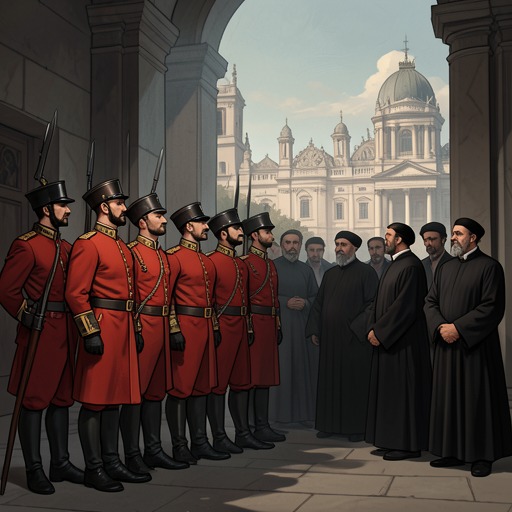
Yuan Shao and Cao Cao favor attacking the palace and destroying the Ten Imperial Attendants. He Jin, however, misreads the danger: summoned by his sister, Empress He, he enters the inner court alone while the two men wait outside. The summons proves to be a trap. He Jin is killed by the attendants’ supporters, and when Yuan Shao calls to ask whether he is ready to leave, He Jin’s head is thrown over the palace gate.
The killing turns the proposed campaign against the attendants into an immediate armed assault. Furious, Yuan Shao and Cao Cao force their way through the palace gates and kill four of the Ten Imperial Attendants. In the ensuing confusion, the palace catches fire. Some surviving eunuchs try to shield themselves by using the emperor, Prince Xie, and the empress, but the attempt fails and the eunuchs are killed. The purge thus destroys members of the group it targeted while also bringing violence and fire into the imperial residence.
The Emperors’ Flight and the Aftermath
Zhang Rang, the leading eunuch, and Duan Gui escape with the fifteen-year-old Emperor Shao and his nine-year-old brother, Prince Xie. Their flight takes them to nearby hills, where soldiers recognize Zhang Rang and call the fugitives traitors. Zhang Rang throws himself into a stream and drowns; Duan Gui is seized. The two young rulers, separated from the security of the palace and unsure who intends to protect them, hide and later move on together.
The immediate outcome is the destruction of the eunuchs’ hold within the palace, but not the restoration of stable government. He Jin’s death removes a leading court official; the palace assault brings armed commanders directly into the succession crisis; and the emperor and his brother are left vulnerable during their escape. In the larger account of the late Han, the episode forms a hinge between court intrigue and the open contest for power among military leaders. The dynasty’s authority survives in name, but the disorder surrounding its rulers makes the court increasingly susceptible to domination by force.