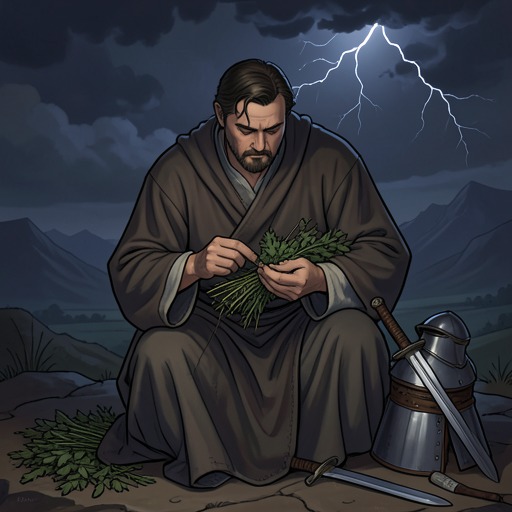
Hua Tuo
The Romance of the Three KingdomsHua Tuo’s fame as a physician does not save him from the suspicions of political power: summoned to treat Cao Cao’s unbearable head pain, he is imprisoned after proposing an operation on the skull and dies soon afterward. His death also extinguishes the knowledge preserved in the Black Bag Book, a manuscript entrusted to the prison warden and accidentally burned by the warden’s wife.
Identity and Medical Reputation
The narrative presents Hua Tuo as a celebrated doctor, known to Cao Cao’s adviser Hua Xin as the physician who had cured Zhou Tai. His reputation rests on an almost comprehensive command of medicine: the account says he knew cures for all illnesses and had written them down. A poem commemorating him describes him as able to discern a person’s very spirit, giving his medical insight an extraordinary, nearly uncanny scope.
Summoned to Treat Cao Cao
Hua Xin recommends calling Hua Tuo when Cao Cao’s severe head pain cannot be relieved by the doctors already summoned. Hua Tuo explains that treatment will require opening Cao Cao’s skull. In describing his methods, he mentions that he had cured Guan Yu, and that detail changes the encounter: Cao Cao becomes convinced that the physician has come to avenge Guan Yu rather than to treat him. He has Hua Tuo imprisoned before the proposed operation can take place.
The episode sets medical expertise against a ruler’s fear. Hua Tuo arrives with a treatment that depends on opening the body, but Cao Cao reads the proposed procedure through the political and personal grievance surrounding Guan Yu. The physician’s reputation, which should establish his authority, instead makes his words dangerous in a court where suspicion overrules trust.
Imprisonment and the Lost Book
Although the prison warden treats Hua Tuo kindly and tries to help him, Hua Tuo dies shortly after his imprisonment. Before his death, he has the warden bring the Black Bag Book and gives the precious manuscript to him. The book contains the cures Hua Tuo had recorded, making it a material legacy of the knowledge that his death would otherwise take from the world.
That legacy is lost through an ordinary domestic act: the warden’s wife uses the manuscript to light a fire. The narration laments that almost none of Hua Tuo’s cures have survived as a result. The stark contrast between the book’s value and the carelessness of its destruction gives his ending a second tragedy: the physician is killed by mistrust, and his written knowledge disappears without ceremony. The account’s refrain, “The Black Bag Book is burned; we cannot get it back,” makes irretrievability the episode’s final emphasis.
Narrative Significance
Hua Tuo’s brief appearance connects personal misfortune to the larger collapse of authority in the late Han world. At the same time that rulers and advisers debate the transfer of imperial power in the language of virtue, Heaven, and popular will, Cao Cao’s suspicion prevents a renowned physician from carrying out his work. The story places political fear beside the destruction of practical knowledge: neither Hua Tuo’s skill nor the warden’s kindness can reverse the consequences once the book has burned.
The poem’s praise and the blunt report of the manuscript’s loss frame Hua Tuo as more than a doctor who fails to cure one powerful patient. He becomes the figure through whom the narrative measures what violence and arbitrary suspicion can erase: a life, a body of medical learning, and the possibility that its remedies might have reached later generations.