Hua Xin
The Romance of the Three KingdomsHua Xin is a senior official and close associate of Cao Pi whose most consequential role is to make the Han emperor’s abdication serve as the formal beginning of Wei rule. He carries a decree that advances Cao Pi’s succession after Cao Cao’s death, leads the delegation pressing Emperor Xian to surrender the throne, and helps shape a transfer presented as a virtuous abdication but enforced through intimidation. Later, his advice also contributes to Sima Yi’s removal from military command, showing how Hua Xin’s influence extends from dynastic ceremony to the dangerous management of court suspicion.
Identity and Political Position
Hua Xin appears in the account as one of Cao Pi’s closest associates and a court figure with enough standing to lead official delegations and intervene in questions of succession and military command. His power is exercised not through a battlefield role but through access to the emperor, control of official messaging, and the ability to make a contested decision appear administratively settled.
The political landscape around him is defined by rival claims to legitimacy. Cao Cao’s ascendancy has left the Han emperor constrained, while Liu Bei’s camp insists that the Han lineage and its claim to rule remain alive. Kong Ming describes Cao Cao as possessing the emperor’s authority and the allegiance that follows from controlling the Son of Heaven. Later, after Cao Pi takes the throne, Kong Ming urges Liu Bei to claim the emperorship as a continuation of the Han line. Hua Xin’s actions belong to the opposing project: transferring imperial authority to Cao Pi and securing acceptance of the new dynasty.
Cao Pi’s Succession
When Cao Cao dies in AD 220, Cao Pi faces both grief and the immediate danger that one of his brothers might challenge his position. In this unsettled moment, Hua Xin arrives at speed from Xuchang carrying an imperial decree. The account says that he had drawn up the decree himself and forced the emperor to sign it; it confirms Cao Pi as King of Wei, prime minister, and governor of Jizhou. The document therefore does more than recognize a successor: it gives Cao Pi a cluster of high offices at a moment when control of power is not yet secure.
The decree establishes a pattern that recurs in Hua Xin’s later conduct. Official language and imperial authorization are presented as the basis of rule, but the narrative makes clear that the emperor’s signature is not freely obtained. The practical need to secure Cao Pi’s position is converted into a document that can be invoked as lawful authority, foreshadowing the still larger attempt to secure the throne itself through the forms of abdication.
The Abdication of Emperor Xian
After court officials and astrologers interpret auspicious signs as evidence that the Han’s Mandate has ended and passed to the Cao family, a delegation led by Hua Xin goes to Emperor Xian to request his resignation. The delegation invokes the precedent of Yao and Shun, whose transfer of rule was held up as an exemplary act of succession. It argues that the Han era has run its course and that handing the empire to the King of Wei would accord with Heaven and the people. The historical precedent lends the demand an appearance of moral continuity, even though the emperor remains under the power of the officials making it.
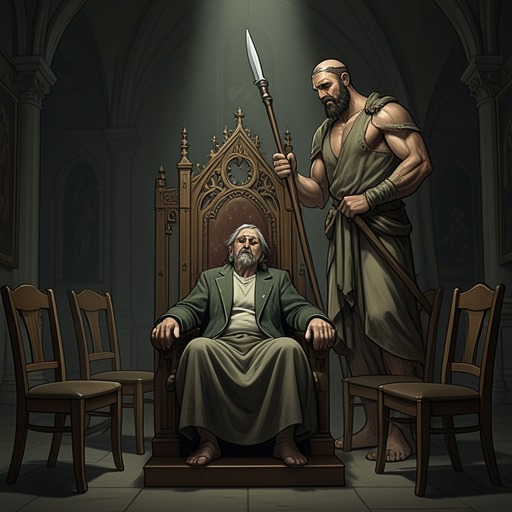
Hua Xin speaks directly to Emperor Xian in court, disregarding imperial protocol. When the emperor resists, Hua Xin warns that refusal could bring disaster and argues that the emperor has already lost Heaven’s favor. He also claims that Cao Cao had protected him from death, turning the former ruler’s power over the court into a debt of gratitude that supposedly supports the transfer. When the emperor rises in anger and fear, Hua Xin seizes his dragon robe and demands an answer. The scene makes the coercive reality difficult to confuse with the language of voluntary abdication: the official who presents the new order as Heaven’s choice physically presses the old ruler to comply.
The keeper of the regalia, Zu Bi, is then ordered to hand over the imperial jade seal. Zu Bi refuses and is killed while continuing to protest. His fate makes the transfer’s material stakes explicit: the dynasty’s authority is not only described in petitions and decrees but embodied in the seal, whose surrender is demanded along with the emperor’s resignation. The ensuing abdication announcement, written in the emperor’s name, describes the Han fire as ended and the Cao family’s fortune as ascendant, and again invokes Yao as precedent. Hua Xin’s role is central to this transformation of forced submission into a public document of consent.
Ceremony, Legitimacy, and Its Limits
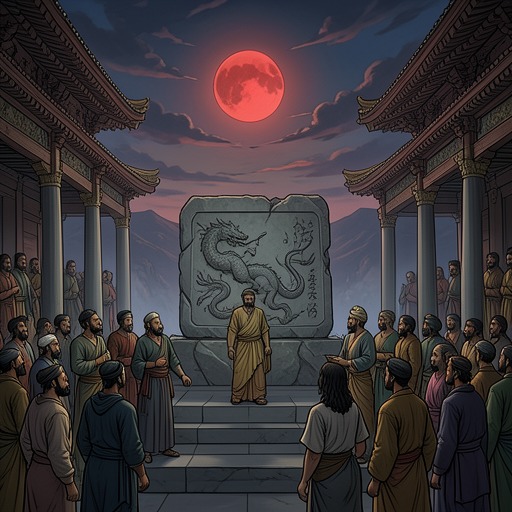
Cao Pi is advised by Sima Yi to hesitate before accepting the abdication, and eventually an Altar of Abdication is built for the formal transfer. Before a vast gathering of officials and soldiers, Emperor Xian hands over the jade seal and Cao Pi accepts the throne. The former emperor is reduced to the governorship of Shanyang and ordered to leave. Hua Xin’s work thus helps turn a political seizure into an official ceremony whose language stresses virtue, Heaven’s will, and the precedent of an earlier abdication.
Yet the narrative places troubling signs beside that claim of rightful succession. When Cao Pi subsequently performs a ritual to worship Heaven and Earth, a violent storm disrupts the ceremony; the account presents it as a portent of Heaven’s displeasure. The contrast does not erase the formal transfer, but it unsettles its own justification: the court can declare that Heaven has moved the Mandate, while the storm makes the ceremony seem anything but secure. Hua Xin’s political method is therefore shown in two registers at once: effective in producing the documents and rituals that establish the new regime, but inseparable from force and exposed to signs that complicate its moral legitimacy.
Court Suspicion and Sima Yi
Hua Xin remains influential after Wei is established. When a fabricated proclamation appears at Yecheng, falsely claiming that Cao Cao intended Cao Zhi to succeed him and calling for Sima Yi to overthrow Cao Rui, Hua Xin recalls Cao Cao’s warning that Sima Yi had the eyes of an eagle and the stare of a wolf and could endanger the dynasty if given power. The false document provokes disagreement at court: some urge immediate action, while others suspect that Shu or Wu has planted the story to destabilize Wei.
Cao Rui travels with a large army to Anyi, where Sima Yi comes to receive him with thousands of troops. Sima Yi denies rebellion and orders his army to withdraw, but Hua Xin advises Cao Rui to strip him of his post. Sima Yi is sent back to his ancestral village, and Hua Xin takes over his army. The episode extends Hua Xin’s influence beyond the founding ceremony: he helps convert a contested accusation into a decisive change in the distribution of military power. In both crises, his importance lies in mediating between political fear and official action, with documents, precedent, and counsel providing the means to reshape who rules.