Jin Dynasty period
The Romance of the Three KingdomsThe Jin dynasty enters the novel’s political horizon as the power rising beyond the Three Kingdoms, a future that makes the apparent victories of Cao Cao’s family provisional. Its emergence is foreshadowed in a poem about three horses feeding from one trough and becomes historically legible when the Han gives way to Wei and Xuande’s court asserts a rival claim to the Han inheritance. The episode ties dynastic change to both political maneuver and the novel’s recurring sense that empires rise from disorder only to fall into it again.
Foreshadowing in the Three-Horse Poem
During Cao Cao’s final years, he dreams of three horses eating from the same trough. Jia Xu interprets the dream as a sign of good fortune, but the poem that follows supplies a darker meaning: the three horses trouble Cao Cao, yet he does not perceive the approaching Jin dynasty. The image therefore works through dramatic irony. What seems to the character a reassuring omen becomes, for the reader, a sign that power is gathering beyond his understanding.
The poem turns Cao Cao’s triumphs into a question of historical scale. His victories have made him the center of his own world, but the closing image places Sima on the rise. Jin is thus introduced not through an account of its institutions or its founding ruler, but through a contrast between immediate success and a successor power already implicit in the story’s signs.
From Han Collapse to Wei Succession
The larger frame is the repeated division and reunification of empire. The novel recalls how rival states followed the collapse of the Zhou, how Qin reunited them before itself giving way to the competing forces of Chu and Han, and how unity was restored again after a later uprising. Under Emperor Xian, the Han once more divides, this time into the three kingdoms. In this historical pattern, a new dynasty is not an isolated occurrence but the next outcome of a recurring political cycle.
The story makes the Han’s breakdown a matter of political failure as well as battlefield change. Emperor Huan’s preference for eunuchs and Emperor Ling’s failure to sustain a palace effort against them leave the Ten Imperial Attendants in control of the court. Warnings and omens accumulate, while authority retreats behind palace walls. Later, famine leaves people in the ruined former capital of Luoyang surviving on bark and roots. The court’s weakened capacity to govern forms the background against which military leaders can claim power and succession becomes a question of who can command the empire.
Legitimacy and the Transfer to Wei
The contest over legitimate rule continues as Xuande seeks advice from Kong Ming. Kong Ming describes Cao Cao as too powerful to oppose directly: he has a vast army and controls the emperor, giving him the allegiance of many nobles. Sun Quan, by contrast, has popular support in the south and should be treated as a potential ally. This analysis makes political legitimacy practical as well as genealogical: control of the emperor, military strength, and the support of the people all shape what a claimant can do.
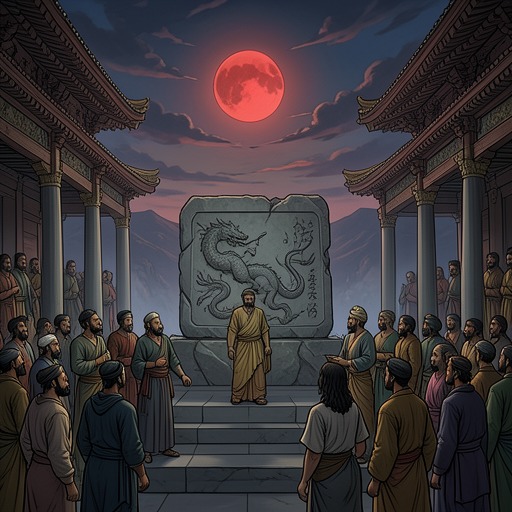
After Cao Cao’s death, the emperor’s abdication announcement declares that the Han era has ended and that fortune has moved to the Cao family. The document invokes the example of Yao, who did not favor his own son, and presents abdication as a selfless act for the empire. But the circumstances complicate its language of voluntary transfer: Sima Yi advises Cao Pi to refuse the throne at first, then maneuvers the emperor into ordering an Altar of Abdication. There the emperor hands over the jade seal, and Cao Pi accepts the throne as Wei’s first emperor. The ceremony gives a formal shape to a transfer whose coercive political context the narrative does not conceal.
The account also distinguishes Cao Pi’s new regime from an uncontested restoration of order. During the ceremony to worship Heaven and Earth, a violent storm disrupts the rite; Cao Pi is carried away and later orders a new palace built at Luoyang. The portent unsettles the ceremony’s claim to divine approval, while the move toward the old capital links the new regime to a city already marked by ruin and imperial displacement.
Rival Claims and the Coming Dynasty
In Chengdu, Xuande becomes ill as news of Wei’s establishment and rumors about the former emperor reach him. Kong Ming proposes that Xuande take the imperial title, reasoning that Cao Pi has usurped the Han and that Xuande, as a descendant of the House of Liu, should continue its lineage. Xuande recoils from the suggestion as rebellious and disloyal; Kong Ming answers that taking the throne would instead be a duty to recover control from the usurper. The dispute shows that the same language of loyalty can sustain competing claims: Wei presents succession as abdication, while Xuande’s court presents its own accession as the continuation of Han legitimacy.
Against this succession struggle, the Jin dynasty remains the future named by the three-horse poem rather than a regime fully described in the supplied episodes. Its significance lies in the gap between the ruling house’s triumph and the next change of power: Wei’s establishment settles one transfer of sovereignty, but the poem has already warned that the rise of the Sima will make Cao’s achievements temporary. The dynasty therefore functions as the anticipated next stage in the novel’s cycle of fragmentation, succession, and reunification.