Jin's Conquest of Wu and Unification of the Three Kingdoms
The Romance of the Three KingdomsJin’s Conquest of Wu and Unification of the Three Kingdoms brings the era of three rival kingdoms to a close: after a coordinated invasion breaks Wu’s military resistance and captures its capital, Sun Hao surrenders and the empire is reunited under Jin. The event turns the book’s recurring pattern of dynastic division and reunification into its final political outcome, while linking Wu’s defeat to the deterioration of its rule and to the practical consequences of Jin’s victory for the population.
Background and decision to invade
By the time Sima Yan considers war, Wu is governed by Sun Hao, whose conduct has grown increasingly oppressive. The account emphasizes the terror produced by his punishments and the fear that governs the state. Yet Sima Yan hesitates: advisers’ objections repeatedly cause him to change his mind. The decision comes only after Du Yu submits a memorial arguing that Jin must strike before the south can invade. Sima Yan finally commits to war, giving the campaign a clear strategic premise: delay is presented not as safety, but as a danger to Jin.
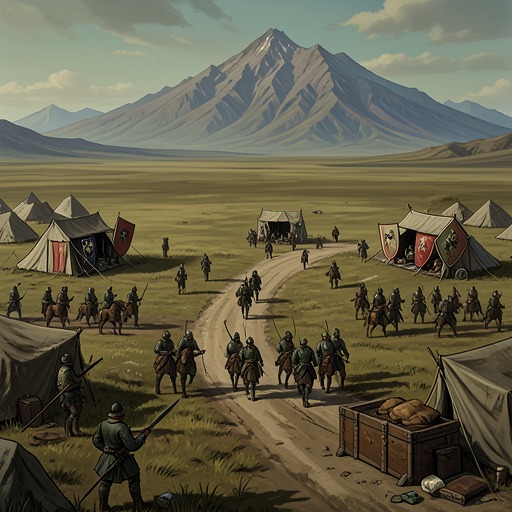
Du Yu is introduced as a commander with a striking attachment to the Spring and Autumn Annals, which he reads daily and carries when riding. That detail places a habit of study beside the military role he is about to assume. The campaign itself is organized on multiple fronts rather than entrusted to a single advance. Du Yu is assigned to Jiangling, Sima Zhou to Tuzhong, Wang Hun to Hengjiang, Wang Rong to Wuchang, and Hu Fen to Xiakou; Admiral Wang Jun leads the river fleet, while Yang Ji holds overall command from Xiangyang. The distribution of targets makes the invasion a coordinated effort against Wu’s cities and waterways.
Wu’s defenses and the campaign’s turning points
News of the invasion alarms Sun Hao, who orders resistance. His eunuch favorite Cen Hun proposes a defensive scheme aimed specifically at the Jin fleet: iron is gathered across the country, forged into massive chains stretched across the river, and supplemented by large iron spikes dropped into the channel to obstruct ships. Wu’s plan converts the river into a barrier, but it cannot compensate for the broader collapse of confidence that follows the campaign’s early reversals.
The first land engagement turns decisively in Jin’s favor. Jin forces feign retreat, drawing Wu’s troops into an ambush that nearly destroys them. Du Yu then uses the retreating soldiers as cover: eight hundred of his men mingle with the fugitives, enter Xiakou, and set fires inside the city. Its capture quickly damages Wu morale. Lu Jing, commander of the Wu navy, is killed while trying to escape ashore; the commander of Jiangling abandons his city and is later executed by Du Yu for cowardice. As cities and regions surrender, the campaign becomes a race toward Jianye rather than a contest over isolated strongholds.
Wang Jun’s fleet faces the obstacle Cen Hun has placed in the river. Once informed of the chains and submerged spikes, Wang Jun orders large fire ships prepared. They are set alight before reaching the obstruction; the heat melts the chains and disables the spikes, clearing the route for the fleet. The defense intended to stop the invasion is thus overcome by an attack designed against its materials, and the river route remains open to Jin.
Inside Wu, senior commanders Zhuge Xing and Shen Rong and Prime Minister Zhang Ti consider surrender. Zhang Ti argues that allowing the kingdom to fall without fighting would dishonor it; persuaded, they return to their forces and prepare for battle. Their decision makes the resistance a conscious stand rather than a mistaken belief that Wu can still win. In the ensuing fighting, Jin troops break through, and both Shen Rong and Zhang Ti are killed. With their deaths, the Wu army disintegrates.
Wu’s collapse and the surrender of Jianye
As the scale of defeat becomes undeniable, Sun Hao asks why his troops will not fight. Officials blame Cen Hun’s corruption and demand that he be killed before they will go out to battle. Sun Hao fails to recognize the larger crisis, questioning whether a single eunuch could destroy an entire kingdom. The officials act without him and kill Cen Hun, but removing the accused favorite does not restore Wu’s command or its capacity to resist.
A storm then brings down the remaining soldiers’ banners. Many interpret the fallen standards as an ill omen and desert, leaving only a few brigades between Jin and victory. This is a final image of a state losing its forces not only through battle but through fear and the collapse of confidence in its fortunes.
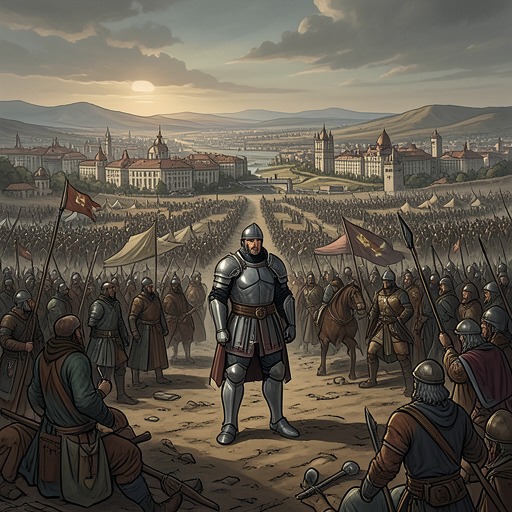
Wang Jun presses toward Shitou, intent on taking the city himself. Zhang Xiang’s surrender changes the situation: Wang Jun tests his new allegiance by ordering him to lead the vanguard. When the defenders see Zhang Xiang’s side has changed, they open the gates to him and the Jin army. The city’s surrender removes the last major obstacle described in the account and brings Jin forces into Wu’s final stronghold.
Sun Hao initially considers suicide but is persuaded to surrender, following the precedent of Liu Shan. Wang Jun receives him as an honored guest and prince. The transition is therefore presented not only as a military defeat but as a formal change of political allegiance, with the defeated ruler spared and granted a place in the new order.
Reunification and its meaning
After Wu falls, Du Yu opens the grain stores, and ordinary people at last have enough to eat; they welcome the new rulers. That consequence gives the conquest a civil dimension beyond the transfer of power: the new administration’s opening of supplies directly addresses hunger. The account also notes that Wu’s treasures, wealth, and people are gathered under one ruler, underscoring the scale of what has been reunited.
At the Jin victory feast, Sima Yan weeps and says the day belongs to Yang Hu, wishing that he had lived to witness it. The moment recognizes an absent figure in the triumph. Sun Hao, brought before Sima Yan, answers the ruler’s joke with humor of his own and is given a minor role. Generosity extends to the families and descendants of Wu officials, including the family of the slain Zhang Ti. The settlement thus preserves a place for the defeated court’s honored servants even as their state disappears.
The ending completes the book’s larger account of an empire repeatedly breaking into rival powers and returning to unity. Its opening frame identifies the Three Kingdoms as the kingdoms carved out of the failing Han; this last conquest makes them one again under Jin. The outcome resolves the political division without erasing the losses that produced it: commanders have died, Wu’s resistance has collapsed, and a defeated ruler has surrendered. Reunification is both the restoration of a single political order and the final reversal of the age of three kingdoms.