Kingdom of Wei
The Romance of the Three KingdomsThe Kingdom of Wei is the northern of the three states that emerge from the collapse of the Han empire, and the political power against which Xuande’s claim to restore the Han takes shape. Founded by Cao Cao’s family, Wei turns the leverage of military strength and imperial-court control into a dynasty: Cao Cao holds the last Han emperor in his power, and Cao Pi ultimately takes the throne after the emperor’s formal abdication. The transition is presented not simply as a change of rulers but as a struggle over who may speak for the empire and inherit its authority.
Origins in a Fragmenting Empire
The novel frames the rise of Wei within a recurring history of division and reunification. Earlier dynasties fall when rival states fight for supremacy; the Han itself is restored after a previous uprising, only to fracture again under Emperor Xian. The court’s weakness has a political prehistory: Emperor Huan favors eunuchs over men of distinction, and Emperor Ling fails to sustain a palace conspiracy against them. After the conspirators are executed, the Ten Imperial Attendants dominate the court, while warnings from loyal ministers go unheeded. Rebellion spreads across the empire. Wei’s eventual emergence thus belongs to a crisis already marked by an incapacitated court and the breakdown of central authority.
Cao Cao becomes one of the three leaders who carve kingdoms from the dying Han empire. Unlike Xuande, who grounds his claim in descent from the imperial house and loyalty to the Han, Cao Cao builds influence through command of the north and control of the reigning emperor. His political position demonstrates how the old imperial office can retain symbolic force even when the ruler himself cannot govern independently.
Cao Cao’s Power and the Northern Realm
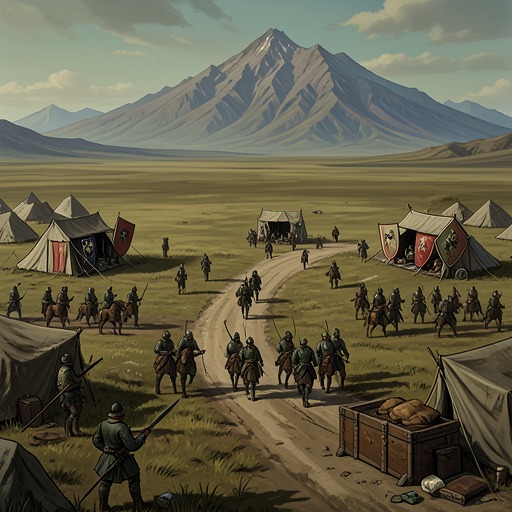
Cao Cao holds Emperor Xian under elaborate house arrest and makes him a puppet. Possession of the Son of Heaven gives Cao Cao more than a title: as Kong Ming explains to Xuande, it brings the allegiance of many nobles. Cao Cao is said to command a vast army of more than a million, and Kong Ming warns that Xuande cannot oppose him directly. The combination of military force and imperial sanction makes the northern power formidable even before it formally becomes a dynasty.
Wei’s strength is also conveyed through the growing reputation of its ruler. After Cao Cao’s northern army returns to Xuchang, the emperor honors him and grants him special distinctions; from then on, Cao Cao’s fearsome reputation continues to grow. The title he later takes as king of Wei refers to the empire’s entire northern region. His authority is therefore both territorial and court-centered: it rests on control of a large military power and on his ability to act in the emperor’s name.
The novel also places Wei’s expansion in relation to neighboring regimes and contested frontiers. News of Cao Cao’s western victory alarms Zhang Lu in Hanzhong, who fears that Cao Cao will next move against him. Zhang Lu’s adviser Yan Pu proposes seizing the forty-one departments of the Western Riverlands and declaring independence; Zhang Lu responds by summoning his army. The prospect of Cao Cao’s advance thus helps provoke political and military realignment beyond the northern heartland.
Abdication and the Founding of the Dynasty
Cao Cao dies in 220 without himself becoming emperor. His son Cao Pi compels Emperor Xian, the last Han ruler, to abdicate, thereby founding the Wei dynasty. The abdication announcement presents the transfer as an answer to Heaven and the people: it declares that the Han era has ended, that fortune has moved to the Cao family, and that the emperor follows the precedent of Yao by yielding the throne. Its language makes dynastic replacement appear not as seizure but as a morally and cosmically sanctioned handover.
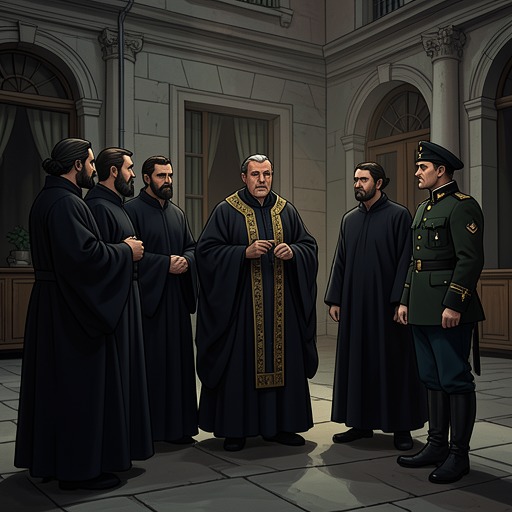
The ceremony makes the political transfer concrete. Cao Pi initially refuses the throne on Sima Yi’s advice, then refuses a further appeal before maneuvering the emperor into ordering an Altar of Abdication. Before officials and soldiers, Emperor Xian hands over the jade seal of authority; Cao Pi accepts it and begins his reign as Wei emperor. The former ruler is demoted to governor of Shanyang and ordered to leave. The ritual stages continuity even as it marks the Han’s displacement.
That staged legitimacy is shadowed by an ominous counter-sign. After taking the throne, Cao Pi begins the customary worship of Heaven and Earth, but a violent storm scatters dust and stones, darkens the sky, and blows over the ritual lanterns. Terrified, Cao Pi collapses and is carried away; he remains unable to act for days and later believes the palace is haunted, ordering a new palace to be built at Luoyang. The storm does not prevent Wei’s establishment, but it unsettles the ceremony’s claim that Heaven has approved the transfer.
Contested Legitimacy and Narrative Significance
In Chengdu, reports of Wei’s new dynasty—and rumors that the former emperor has been assassinated—make Xuande so ill that he hands day-to-day government to Kong Ming. Kong Ming argues that Cao Pi has usurped the Han and proposes that Xuande, a descendant of the Han founder, become emperor to continue the lineage. Xuande is horrified at first, fearing that such an act would make him a rebel; Kong Ming answers that taking the throne is a duty to recover what Cao Pi has seized. The formation of Wei therefore gives renewed urgency to the rival Han claim: its authority depends on the very abdication that Xuande’s camp rejects as usurpation.
Wei’s political meaning is not confined to the transfer of the throne. It is the northern state in a three-way division led by Cao Cao, Xuande, and Sun Quan, each of whom establishes a kingdom from the disintegrating Han. Its founding gives institutional form to the empire’s fragmentation, while the dispute over its legitimacy keeps the question of Han restoration alive. The novel’s larger historical pattern—empires rising from chaos and collapsing back into it—frames Wei as both the successful successor to Han authority in the north and one part of a divided realm.