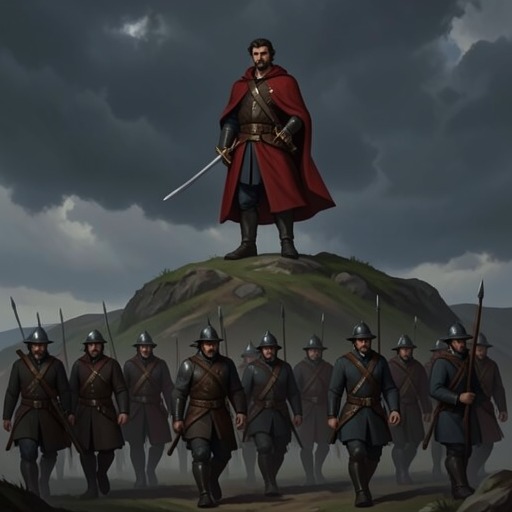
Kong Ming's southern campaign
The Romance of the Three KingdomsKong Ming’s southern campaign begins as a response to a large-scale revolt and ends with a settlement that makes victory more than the defeat of an enemy army. In AD 225, Meng Huo and three local governors rise against Shu, while Kong Ming’s expedition combines military pressure, intelligence, deception, and repeated acts of clemency. Meng Huo finally submits, is appointed ruler over the conquered lands, and returns to govern under Shu’s authority. The campaign’s defining movement is from force to accommodation: Kong Ming seeks to secure the south by changing the political relationship, not simply by winning battles.
Causes and preparations
In Chengdu, Kong Ming has assumed responsibility for the affairs of state, and the account describes Shu as peaceful, prosperous, and willing to share public burdens. That stability is interrupted in AD 225, when Meng Huo, king of the southern Man tribes, invades with one hundred thousand men. Three local governors join the revolt: Yong Kai of Jianning, Zhu Bao of Zangge, and Gao Ding of Yuesui. They besiege Yongchang, whose governor, Wang Kang, sends an urgent appeal for help.
The second ruler is uneasy when Kong Ming proposes going south in person. Shu already faces threats from Wei to the north and Wu to the south, and a major expedition could leave its other borders exposed. Kong Ming reassures him that capable commanders have been assigned to protect the country, then sets out with trusted officers including Zhao Zilong, Wei Yan, Wang Ping, and Zhang Yi. On the journey, they meet Guan Suo, Guan Yu’s third son, whom Kong Ming appoints to lead the vanguard. The army is well provisioned, a practical detail that matters in a campaign moving away from the capital into difficult southern territory.
Defeating the revolt’s governors
The three governors first send E Huan, a formidable commander, against the advancing Shu forces. Wei Yan pretends to retreat, drawing E Huan into a trap. When the captive is brought before Kong Ming, he is treated respectfully and given a chance to return to Gao Ding with a message: Kong Ming considers Gao Ding loyal but misled by Yong Kai, and will accept his surrender. The encounter shows the expedition’s method in miniature: military advantage creates an opening, but the defeated commander is then used to encourage a political realignment.
Kong Ming next exploits the divisions among the rebels. He tells Gao Ding that Zhu Bao has accused him of plotting to defect, then says that Zhu Bao’s death would prove Gao Ding’s loyalty. Gao Ding and E Huan act on the accusation; E Huan kills Zhu Bao, and Zhu Bao’s troops submit. With the governors’ revolt broken, Kong Ming appoints Gao Ding governor over all three territories and makes E Huan commander of Gao Ding’s troops. Rather than remove the local administration wholesale, he brings a former insurgent leader into Shu’s governing structure and entrusts him with the newly pacified districts.
The struggle with Meng Huo
The governor revolt’s defeat prompts Meng Huo to seek a broader alliance. He calls together three valley chieftains, each bringing about fifty thousand men, and assigns them separate positions in a coordinated attack. Kong Ming appears to slight his experienced commanders Zhao Zilong and Wei Yan, appointing the younger Wang Ping and Ma Zhong instead. The older officers, affronted, gather information from captured local people and devise a separate plan. They lead five thousand elite troops in a night attack: Zhao Zilong kills Jinhuansanjie, and the two commanders then split their forces to strike the other camps. The episode makes local intelligence and initiative part of the campaign’s military texture, even as Kong Ming’s apparent insult helps set the action in motion.
The fighting repeatedly gives way to negotiation, release, and renewed resistance. After captured leaders are delivered to Kong Ming, the tribes scatter to their homelands, and Yang Feng brings the prisoners in, receiving a reward. Kong Ming again asks Meng Huo to submit, but Meng Huo refuses, insisting that his capture resulted from betrayal by his own people rather than defeat by Kong Ming. His refusal sustains the campaign: each apparent victory must be followed by another encounter before military success can become political acceptance.
In the later advance, Shu’s army replenishes its water after wells are dug and prayers are offered for fresh water. The soldiers travel only in the afternoon after chewing an herb, and eventually reach the edge of Bald Dragon ravine. Meng Huo and King Duosi, astonished by reports of the advance, decide they must fight on. In the next major confrontation, King Mulu’s supernatural reputation and command over wild animals become part of the threat. Kong Ming prepares red wagons containing large carved animal figures, with steel teeth and claws, packed with gunpowder. At the front, dressed in Daoist robes and carrying his feather fan, he faces the storm King Mulu summons. Kong Ming’s fan turns the storm back toward the Man army; the burning figures then frighten the animals into flight, and their retreat disrupts and defeats the force behind them. King Mulu is killed, while only a fraction of his army escapes.
The victory does not immediately secure Meng Huo’s submission. A relative presents Meng Huo and his family as captives, but Kong Ming suspects that the apparent surrender is a plan to assassinate him. He has Zhang Ni and Ma Zhong conceal troops near his tent; when the party arrives, the hidden weapons carried by its men confirm his suspicion, and the attempt is stopped. Kong Ming then invokes Meng Huo’s earlier promise to submit if captured in his own lands. Meng Huo nevertheless continues to resist, distinguishing capture from genuine defeat and refusing to let another’s actions decide his allegiance.
Submission and the terms of victory
At last, Meng Huo acknowledges that Heaven has ensured the southerners will not rebel again. When Kong Ming asks whether he will now submit, Meng Huo weeps and says that his people will remain grateful for generations because Kong Ming spared them. His acceptance marks a different conclusion from the capture-and-release episodes: submission now comes in response to clemency as well as military defeat. Kong Ming and Meng Huo celebrate together, and Kong Ming appoints him ruler over all the lands conquered by Shu. The Man people rejoice, while the former opponent becomes the authority through whom Shu’s rule is maintained.
The expedition’s return also includes an acknowledgment of the human cost. After crossing a river associated with the deaths of Shu and Man soldiers, the army hears reports that the dead are troubling the area and that human sacrifice is thought necessary. Kong Ming rejects that response. He orders forty-nine imitation heads, made from dough stuffed with meat, and performs a nighttime ceremony in Daoist robes, reading a formal proclamation that apologizes for the deaths he has caused. At the ceremony’s climax, his anguished cry moves the army; the reported ghostly shapes disperse, and the troops cross safely the next day. After many months away, they reach Chengdu.
The second ruler rides beyond the city walls to welcome Kong Ming and the returning army. The homecoming is followed by a wider political acknowledgment: more than two hundred foreign cities send tribute. The ruler also fulfills Kong Ming’s request that the families of those killed in the campaign be cared for. These consequences qualify the expedition’s triumph. Its outcome is not merely the extension of Shu’s reach, but a settlement accompanied by recognition of local authority, public rejoicing, and support for bereaved families.
Narrative significance
The campaign’s structure repeatedly contrasts military subjugation with voluntary allegiance. Kong Ming uses ambushes, political deception, local intelligence, and prepared weapons, yet the narrative gives special weight to what follows victory: captured leaders are released or restored to office, and Meng Huo is asked to submit again and again rather than simply being removed. His final statement grounds submission in gratitude for being spared, and his appointment turns that personal reconciliation into a governing arrangement.
The expedition also places Shu’s claim to rule in a practical setting. The threat from the south is treated as both a military danger and a challenge to the security of the state; Kong Ming reassures the ruler that the northern and southern borders remain protected while he leads the army himself. The final tribute from more than two hundred cities and the provision for families of the dead extend the consequences beyond the battlefield. In this account, the campaign’s decisive achievement is that force ends the revolt while clemency and political incorporation are presented as the means of making that ending hold.