Kong Ming's borrowing of arrows with straw boats
The Romance of the Three KingdomsKong Ming’s borrowing of arrows with straw boats is a celebrated stratagem in which a demand designed to bring about his execution becomes the means of displaying his command of timing, deception, and the enemy’s habits. Ordered by Zhou Yu to provide one hundred thousand arrows for the coming fight on the Great River, Kong Ming meets the deadline not by making arrows but by turning Cao Cao’s archers into their unwitting suppliers. The episode converts a dangerous contest within the allied command into a public measure of Kong Ming’s foresight, while exposing Cao Cao to another costly deception.
A lethal test within the alliance
The episode begins with Zhou Yu’s determination to destroy Kong Ming. Lu Su has let slip that Kong Ming understood the trick Zhou had played on Cao Cao; rather than setting aside their rivalry, Zhou responds by summoning his commanders and presenting Kong Ming with a seemingly practical military problem. The coming battle on the Great River will require bows and arrows, Zhou says, but the force lacks enough. He asks Kong Ming to supply one hundred thousand.
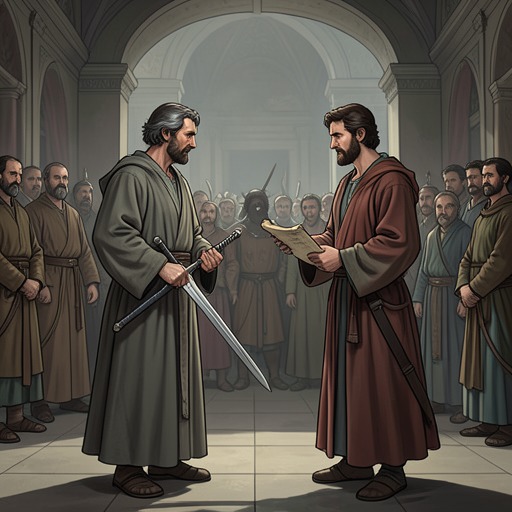
Kong Ming accepts without protest and asks when the arrows must be ready. Zhou sets a ten-day deadline. Kong Ming replies that ten days is too long, since an attack may come sooner, and proposes to deliver them in three. Zhou warns him not to make fun of him. Kong Ming answers that he is entirely serious and binds himself to military law: if he fails, he will accept the prescribed punishment. Because that punishment means execution, the exchange is more than a boastful challenge. Zhou has made a military requirement into a trap, and Kong Ming’s willingness to stake his life appears to seal it.
He further fixes the arrangement by telling Zhou to send five hundred men to the river on the third day to collect the arrows. The confident schedule leaves Zhou astonished, then pleased by what he assumes is Kong Ming’s impending failure. The scene’s reversal is prepared through the gap between what Zhou thinks the assignment requires—producing a vast supply in almost no time—and what Kong Ming has actually promised: a delivery, without saying that the arrows will be made by his own side.
Boats, straw, and fog
After the agreement, Kong Ming seeks Lu Su’s help, though Lu Su is troubled and points out that the danger is partly of Kong Ming’s own making. Kong Ming asks him to lend twenty boats, each carrying thirty men, together with one thousand bales of straw covered in black cloth. He insists that Lu Su tell Zhou nothing, since secrecy is essential to the plan. Lu Su provides the requested equipment, but Kong Ming does nothing on either of the first two days. The delay makes the deadline appear more desperate even as the preparations are already in place.
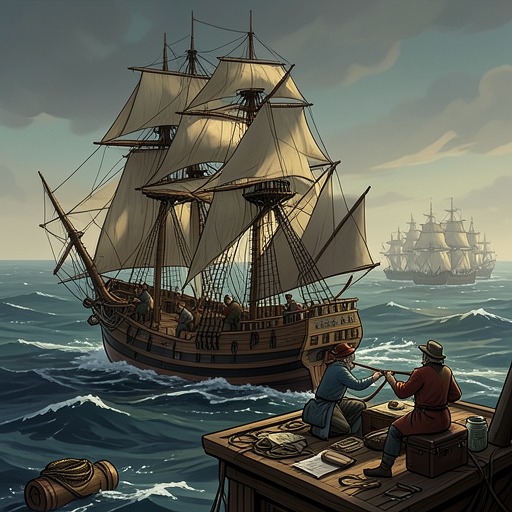
At the fourth watch of the third night, Kong Ming summons Lu Su and takes him aboard one of the boats. The vessels carry the oddly concealed straw bales and head toward Cao Cao’s encampment on the north shore. The timing depends on a dense fog: visibility is so poor that a person standing immediately in front of another cannot be seen. Kong Ming sends the boats into it, using the conditions to conceal their small force and make its approach difficult to judge.
As the boats near the north shore at the fifth watch, Kong Ming orders the sailors to beat drums and shout as if a large invading force were advancing. Lu Su fears the enemy may attack them. Kong Ming’s plan relies on the opposite calculation: in such fog, he expects Cao Cao’s men to avoid venturing out and to defend themselves from a distance. The boats thus present a threat that is convincing enough to provoke a response, but remain concealed enough to reduce the danger of a direct encounter.
Cao Cao hears the noise and orders his men to fire into the fog. Eager to meet what seems to be a surprise landing, he commits the archers and crossbowmen to the defense; soon ten thousand are shooting toward the sounds. Their arrows fall in such numbers that the passage compares them to a rainstorm. Kong Ming meanwhile urges the sailors to bring the boats as close to shore as they can. Arrows thud into the straw barriers, turning the enemy’s defensive fire into a supply gathering operation.
A delivery, and a verdict on foresight
As daylight rises and the fog begins to lift, Kong Ming orders the boats to turn back. Every one of the thousand straw bales is bristling with arrows. The withdrawal is as essential as the approach: Kong Ming leaves before Cao Cao’s men can mount a counterattack. As the boats depart, he calls out a thanks to Cao Cao for sending the arrows. The taunt makes the deception unmistakable, but only after the arrows have already been taken beyond the enemy’s reach. Cao Cao is left to recognize that he has been fooled once again.
Kong Ming tells Lu Su that each boat has collected roughly five to six thousand arrows. By his calculation, the haul exceeds the one hundred thousand Zhou demanded, and it has cost the southern force nothing. He even remarks that they can return the arrows to the enemy the next day. The five hundred men Zhou ordered to collect the delivery reach the shore as the boats return, completing the terms of the challenge in full view of its sponsor. Lu Su explains the stratagem to Zhou; Zhou can only sigh with a mixture of admiration and regret.
When Lu Su asks how Kong Ming knew fog would form, Kong Ming answers by describing the commander’s need to understand both Heaven’s patterns and those on Earth, as well as the movement of yin and yang and the disposition of forces. He says he calculated the fog three days earlier, which is why he named a three-day deadline when Zhou had offered ten. His explanation joins practical calculation to the novel’s language of celestial knowledge and the Mandate of Heaven: his success is presented both as a reading of conditions and as proof that Zhou cannot defeat him by setting a trap.
Strategic and narrative significance
The stratagem works through a sequence of controlled misreadings. Zhou mistakes a promise of delivery for a promise to manufacture arrows; Cao Cao mistakes concealed boats and noise in the fog for a large assault; and Lu Su, though trusted with the equipment and taken along on the night voyage, does not learn the method until the action is underway. Each deception has a distinct function. Zhou’s assignment threatens Kong Ming with execution, Cao Cao’s response supplies the weapons, and the public delivery makes the outcome impossible for Zhou to dismiss as a private boast.
The episode also presents command as the ability to coordinate material means with information and timing. The twenty boats, their crews, the black-wrapped straw, the river approach, the fog, the drums, and the enemy’s abundant archers all matter to the result. Kong Ming does not overcome Cao Cao by superior numbers or a direct clash; he predicts how Cao Cao will respond to an apparent attack and shapes the encounter so that the response serves his own purpose. The abundance of arrows on the far shore becomes a liability because the commander directing it has accepted the false appearance as truth.
Within the alliance, the successful delivery changes the terms of the rivalry without ending it. Zhou’s attempt to place Kong Ming under a death sentence instead gives Kong Ming an opportunity to establish his superiority before the commanders, and Zhou’s final admiration is inseparable from regret at having failed to eliminate him. For Lu Su, the venture moves from anxious uncertainty to astonishment and delight. For Cao Cao, it repeats the humiliating pattern of being deceived by the opposing side. The closing image is not a battle’s wreckage but a fleet returning through the thinning fog, its straw loads transformed into bristling stores of arrows—a compact emblem of Kong Ming’s power to make an enemy’s force yield the instrument of its own undoing.