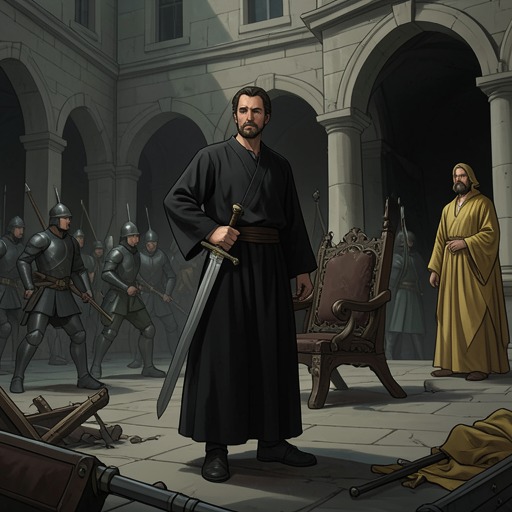
Lü Boshe
The Romance of the Three KingdomsLü Boshe is a trusted old companion of Cao Cao’s father whose attempt to shelter Cao Cao and Chen Gong ends in the deaths of eight people in his household and his own killing. His brief appearance turns a flight from political danger into a defining moral rupture: the first deaths arise from a fatal misunderstanding, but Cao Cao kills Lü Boshe knowingly, and Chen Gong recognizes the difference.
Identity and Circumstances
Cao Cao describes Lü Boshe as one of his father’s sworn companions and compares him to an uncle. The two fugitives have been traveling in disguise after Cao Cao’s unsuccessful opposition to Dong Zhuo, and Lü Boshe offers them a place of safety near Chenggao. His connection to Cao Cao’s family makes the welcome an act of personal trust, not merely a stranger’s hospitality.
Lü Boshe explains that soldiers sent by the court have been intimidating Cao Cao’s father in an effort to discover where Cao Cao is hiding. He nonetheless makes the travelers comfortable. When he realizes that he has run out of wine, he leaves for a nearby village to buy more and tells his guests to rest while he is gone. His preparations to host them, including arranging for a pig to be slaughtered, are later confirmed by his own explanation on returning.
The Household Killing
While Lü Boshe is away, Cao Cao and Chen Gong hear voices in the back yard and the sound of knives being sharpened. Cao Cao suspects that their host has gone to betray them, and they creep around the house to listen. A voice says that they should bind someone before killing him. Taking this as confirmation of their fears, the two men rush in with drawn swords and kill eight people, men and women alike.
Only after searching the house do they discover that the people had been preparing to slaughter a pig. The apparent threat was not an attempt to capture the guests: the household’s activity belonged to the meal Lü Boshe had planned for them. Chen Gong identifies the victims as innocent and is horrified by what they have done. The revelation comes too late to prevent the deaths, but it makes clear that the household was preparing to receive the fugitives rather than betray them.
Lü Boshe’s Return and Cao Cao’s Decision
After fleeing the house, Cao Cao and Chen Gong have gone only about half a mile when they meet Lü Boshe riding back from the village. Surprised to find his guests leaving, he asks them to stay. He explains that he has ordered a pig slaughtered for their meal and acknowledges that hunted men may not be able to remain long in one place, while assuring them they would at least be safe for the night.
Cao Cao passes him without answering. When Lü Boshe calls after him to turn back, Cao Cao does so, draws his sword, and kills his host. This second killing has none of the first incident’s mistaken identification: Cao Cao knows Lü Boshe has offered them shelter, yet decides that allowing him to return home could expose what happened. Chen Gong calls the killing cold-blooded and asks why Cao Cao would do it. Cao Cao’s explanation is that Lü Boshe, upon discovering the household’s fate, would raise an alarm and bring a pursuing crowd against them. The perceived danger is future exposure, not a present act of betrayal.
Consequence and Narrative Significance
Chen Gong distinguishes the two acts sharply: the household’s deaths were a terrible accident, while Lü Boshe’s death was deliberate. That distinction breaks the moral ground on which the two fugitives had been traveling together. Lü Boshe himself has little time in the story, but his hospitality and return expose the consequences of Cao Cao’s governing calculation: survival takes precedence over trust and innocent life, even when the danger exists only in what another person might do afterward.
The episode also shows how the novel makes a brief encounter carry ethical weight. Its broader account combines historical events with traditions of storytelling and theatrical drama, using dramatic scenes to shape the reader’s understanding of its central figures. Lü Boshe’s offer of wine and a meal, followed by his return with the promised hospitality, supplies the concrete contrast that makes the scene’s reversal legible: those who came seeking refuge destroy the household that welcomed them, and then Cao Cao kills the host who would have sheltered them.