Lü Bu
The Romance of the Three KingdomsLü Bu is a celebrated fighter whose military strength repeatedly makes him valuable to powerful leaders, but whose changes of allegiance make him a figure of distrust. He first appears serving Ding Yuan, then turns to Dong Zhuo after Li Su offers him a more advantageous master. The pattern continues: after Dong Zhuo’s own rule ends in assassination, Lü Bu seeks refuge with Xuande, whose protection both eases a siege and provokes Zhang Fei’s hostility.
Identity and Rise
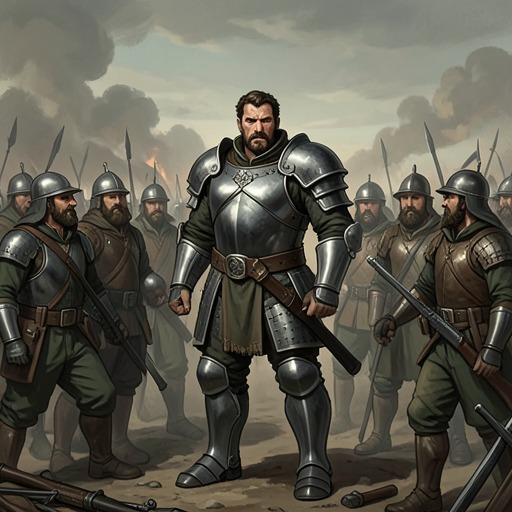
Lü Bu enters the narrative as a young warrior in Ding Yuan’s army, distinguished by his ornate clothing and weapons. When the armies face each other, he charges at Dong Zhuo, who retreats; the strength of this attack prompts Dong Zhuo to wish aloud that Lü Bu were on his side. His prowess is thus established not through an account of his origins, but through the immediate effect he has on a battlefield and on the calculations of rival commanders.
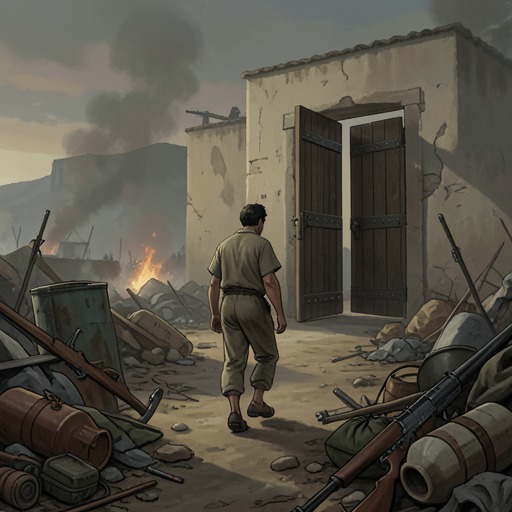
Li Su approaches Lü Bu in Ding Yuan’s camp and appeals to the idea that a capable servant should choose his master wisely. He reinforces the persuasion with treasures, including the horse Red Hare. Lü Bu then rejects Ding Yuan’s claim on him as a son and kills him, after which Ding Yuan’s soldiers disperse. The next day Lü Bu brings Ding Yuan’s head to Dong Zhuo and asks to join his army. Dong Zhuo welcomes him with valuable gifts. The episode makes Lü Bu’s military value inseparable from a willingness to abandon and betray a patron when a more powerful alliance presents itself.
Allegiance and Political Conflict
Lü Bu’s service to Dong Zhuo gives their relationship the language of father and son, but that bond proves no more secure than his earlier tie to Ding Yuan. When Wang Yun’s plot against Dong Zhuo reaches its climax, Lü Bu appears beside the exposed ruler and announces that he has a decree to kill the traitor. He strikes Dong Zhuo, while Li Su takes Dong Zhuo’s head and Lü Bu produces the supposed decree, declaring that it orders Dong Zhuo’s death and spares everyone else. The officials then acclaim the emperor, and Dong Zhuo’s death unleashes broader retaliation against his regime.
The succession from Ding Yuan to Dong Zhuo and then to the assassination of Dong Zhuo links Lü Bu’s personal choices to the collapse and contest of political authority. His actions help secure the removal of two powerful figures, but the evidence also presents his ties to them as fragile: the titles of son and father do not restrain him when he chooses a different course. In a story where rival leaders invoke loyalty to the Han and the right to rule, Lü Bu’s strength serves immediate political ends without resolving the question of legitimate authority.
Refuge with Xuande
Later, when Lü Bu is in desperation, he first asks Yuan Shao for help. Yuan Shao refuses and instead supports Cao Cao, so Lü Bu turns to Xuande. Xuande grants him sanctuary because Lü Bu’s attack on Cao Cao’s army had lifted the siege of Xuzhou. The decision is practical and reciprocal: an earlier military action has helped Xuande, and Xuande now offers protection when Lü Bu lacks support.
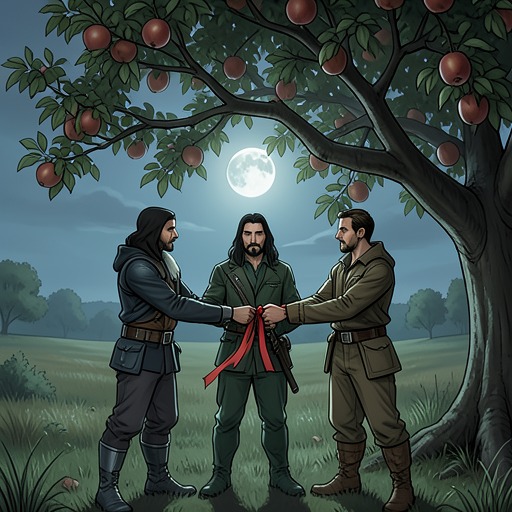
That welcome does not produce harmony within Xuande’s camp. At a banquet held by Lü Bu to thank Xuande, Zhang Fei takes offense at the way Lü Bu addresses their leader and challenges him to a duel. Xuande orders Zhang Fei to stop, and Guan Yu pushes him from the room. Zhang Fei challenges Lü Bu again later, forcing Xuande to reprimand him personally; Zhang Fei remains unapologetic and intensely hostile. Lü Bu’s reception therefore tests the sworn brothers’ discipline and Xuande’s capacity to manage an uneasy alliance. Zhang Fei’s anger also underscores the cost of sheltering a powerful man whose past makes trust difficult.
Reputation and Narrative Role
The narrative places Lü Bu among the consequential figures of the age in which the Han empire fragments and three leaders—Xuande, Cao Cao, and Sun Quan—eventually establish separate kingdoms. Lü Bu is not identified as one of those founding rulers; his significance lies instead in the force he brings to other leaders’ struggles and in the instability of his own allegiances.
His career draws a sharp contrast between martial effectiveness and relational fidelity. Li Su’s appeal to choosing a master, the betrayal of Ding Yuan, the killing of Dong Zhuo, and Xuande’s later offer of sanctuary form a sequence in which military power repeatedly opens political possibilities, while personal loyalty remains contested. Lü Bu’s story also touches the Han’s claim to authority: later, Kong Ming argues that Cao Cao controls the emperor and cannot be opposed directly, while Xuande is urged to rule in the name of restoring just government. Against that larger contest over who may legitimately rule, Lü Bu appears as a powerful but shifting participant rather than a stable source of political order.