Lü Bu's Defection and Assassination of Ding Yuan
The Romance of the Three KingdomsLü Bu's Defection and Assassination of Ding Yuan is the episode in which Dong Zhuo wins Lü Bu from Ding Yuan by offering him Red Hare and precious gifts, and Lü Bu seals the transfer of allegiance by murdering his former lord. Its decisive consequence is political as well as personal: Dong Zhuo gains a formidable fighter, while the killing clears the way for him to press his plans against the imperial court. The episode makes allegiance look less like a bond than a prize to be purchased—and shows the blood price that purchase exacts.
The battlefield encounter
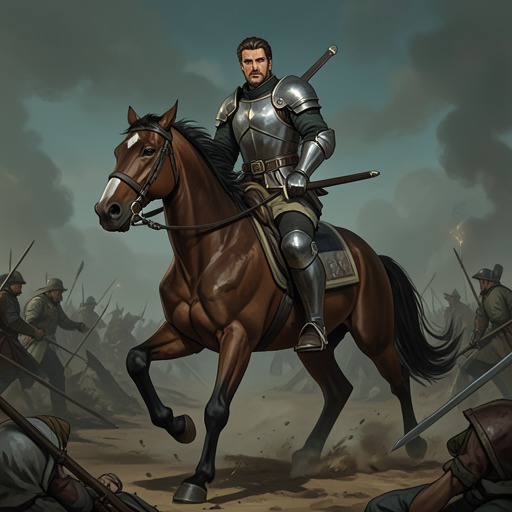
The reversal begins when Ding Yuan leads his troops outside the city to oppose Dong Zhuo. Lü Bu stands among Ding Yuan’s forces, conspicuous in a golden crown and richly coloured robe, his sword decorated with lions and snakes. When the armies meet, he charges directly at Dong Zhuo. Dong Zhuo turns and flees, and Ding Yuan’s army overwhelms the opposing force, compelling Dong Zhuo to withdraw and establish a camp.
The spectacle changes Dong Zhuo’s calculation. Rather than treat Lü Bu only as an enemy who has routed his men, he recognizes the value of bringing such a fighter into his own ranks. He remarks on Lü Bu’s prowess and imagines what it would mean if the young warrior fought on his side. That wish becomes the immediate cause of the defection: Dong Zhuo’s response to defeat is to try to acquire the force that produced it.
The offer of a new allegiance
Li Su, who comes from the same village as Lü Bu, proposes to turn him with gifts. His offer names Red Hare, Dong Zhuo’s celebrated horse, alongside gold and pearls. The attraction is presented not as an abstract negotiation but as an appeal made possible by personal familiarity and material splendour: Li Su can approach Lü Bu as a fellow villager, while the treasures give his words tangible weight.
Li Su makes the case in the language of choosing a master. He tells Lü Bu that he deserves a fine lord and invokes the maxim that a wise bird chooses its branch and a wise servant chooses his master. The appeal recasts betrayal as discernment: Ding Yuan is no longer a father to whom Lü Bu owes loyalty, but a master who can be left for a more rewarding one. Silken persuasion and valuable gifts accomplish what force on the battlefield could not. Lü Bu changes sides, and Red Hare becomes the most striking emblem of the bargain.
Murder in Ding Yuan’s tent
That night Lü Bu enters Ding Yuan’s tent. Ding Yuan is quietly reading; when he looks up and addresses Lü Bu as his son, the language of their existing bond collides with the new identity Lü Bu has asserted for himself. Lü Bu rejects the filial designation, declaring that he is a man of importance and asking why he would want to be known as Ding Yuan’s son. Ding Yuan, bewildered, asks what has made him speak this way.
Lü Bu gives no explanation. He raises his sword and beheads Ding Yuan with a single blow. The refusal to answer makes the murder starkly final: the relationship is rejected in words and severed in action, without a debate or a negotiated departure. Ding Yuan’s soldiers then fade away into the night, leaving the murder not only the end of Ding Yuan’s personal authority but the dissolution of the force that had fought under him.
The political return on treachery
The following day Lü Bu takes Ding Yuan’s head to Dong Zhuo. Dong Zhuo is delighted, bows to the young warrior, and welcomes him into his army. Lü Bu bows in return and asks to be accepted. Dong Zhuo answers with valuable gifts, completing the exchange that began with Li Su’s offer: the defector receives a new place and further rewards, while his new patron gains the service of the fighter who had just routed him.
The consequences extend beyond the two men. Emboldened by Lü Bu’s presence, Dong Zhuo and Li Ru press ahead with forcing the emperor to abdicate and raising his brother to the throne. At a grand banquet attended by the court, Dong Zhuo presents his proposals through appeals to historical precedent while threatening death to anyone who opposes him. The episode therefore links Lü Bu’s private act of betrayal to a fresh escalation in public coercion. A murder in a tent strengthens the armed power behind Dong Zhuo’s attempt to reorder the Han court.
Loyalty, power, and the episode’s place in the larger struggle
The episode stages two sharply opposed meanings of loyalty. Ding Yuan addresses Lü Bu through the intimate language of father and son; Li Su redirects him with the political language of selecting a worthy master. Lü Bu’s response chooses the latter, but the choice is made irreversible by killing the former. The scene offers no evidence that Lü Bu weighs a competing duty or seeks a peaceful separation: his silence, followed by the sword stroke, leaves the change of allegiance inseparable from violence.
That violence helps establish the wider world of the Three Kingdoms, in which the Han empire is breaking apart and rival leaders carve kingdoms from its weakening authority. Here the immediate advantage falls to Dong Zhuo, whose strengthened position lets him pursue a forced change of emperor. The episode’s sharpest irony is that the fighter who first appears as the defender of Ding Yuan’s side becomes, through gifts and a promise of a better master, the instrument by which Dong Zhuo increases his power. The transfer is swift; its consequences reach straight into the court.