Late Han period
The Romance of the Three KingdomsThe Late Han period is the crisis era in which the Han empire fractured and the Three Kingdoms emerged. Its significance lies not only in the rise of rival rulers, but in the collapse of the institutions that might have contained them: an emperor isolated within his palace, a court dominated by eunuchs, and a countryside increasingly drawn into rebellion. The struggle over who could claim legitimate rule continued even after the Han’s authority had become largely nominal.
Imperial breakdown and rebellion
The narrative places the Han’s division within a longer cycle of unity and disintegration. Earlier empires had broken into competing states before one power restored unity; under Emperor Xian, the Han again split into three kingdoms. The account traces this crisis to the reigns of Emperor Huan and his successor Emperor Ling. Emperor Huan favored eunuchs over distinguished and capable officials, while Emperor Ling failed to support a palace conspiracy against them. After the conspirators were executed, the eunuchs gained control of the court, and opposition could not restrain them.
Warnings and portents accompany this political decline. During Emperor Ling’s reign, reports included a green snake appearing around the throne, destructive storms and an earthquake, floods, unusual clouds, and other unsettling occurrences. Loyal ministers warned the emperor, but he withdrew into the palace. The Ten Imperial Attendants, led by Zhang Rang, then dominated the court. As imperial authority weakened, popular discontent spread and rebellion became a force across the empire.
The uprising led by Zhang Jue and his brothers Zhang Bao and Zhang Liang gives the crisis a further dimension: rebellion is represented not simply as military opposition, but as a movement claiming a mandate to speak for Heaven. Zhang Jue, after failing the imperial examination, received a three-volume book from a mysterious old master and was charged with spreading its teachings. The account thus connects a failing court, popular unrest, and claims of supernatural authorization without suggesting that these forces were identical.
A court unable to protect the realm
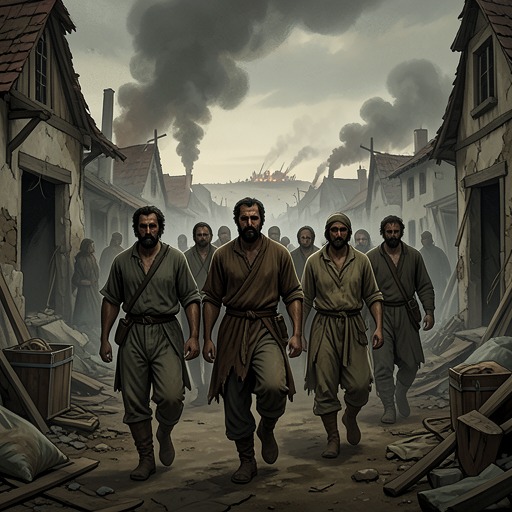
The emperor’s return to Luoyang exposes how little of the imperial center remains capable of sustaining rule. The city has been devastated: its palaces and halls are burned, streets are overgrown, and the court must meet amid ruins. Famine compounds the destruction. The remaining families survive on bark and roots, while people die near their homes. The emperor’s restoration to the old capital therefore does not restore the state’s practical power; the court is back in its historic seat but cannot reliably provide food or security.
The crisis also makes the emperor dependent on military strongmen. Yang Biao proposes calling on Cao Cao because he commands the strongest army. When rumors of an advance by Li Jue and Guo Si send the court into retreat, Cao Cao’s troops appear near the city; his forces then defeat the attackers, who flee into the mountains. The sequence shows how imperial survival increasingly depends on commanders whose military capacity exceeds that of the court itself. Summoning a protector gives the emperor immediate relief, but deepens the political conditions in which a warlord can dominate the throne.
War, supplies, and rival power
The period’s conflicts are shaped by material capacity as well as claims of legitimacy. At Guandu, Yuan Shao brings a force vastly larger than Cao Cao’s, while Cao Cao can muster only about a tenth as many men. Cao Cao’s adviser Xun You urges him to attack before the army’s limited supplies run out. The prolonged confrontation leaves both sides short of food, making supply routes decisive rather than incidental.
A captured spy reveals that Yuan Shao expects a large grain convoy led by Han Meng. Cao Cao sends Xu Huang with an elite force to destroy it; the attack succeeds, and Han Meng flees. The episode makes the mechanics of political survival concrete: armies may be numerous, but they cannot sustain a campaign without grain. It also echoes the wider Late Han pattern, in which fragmented authority turns access to troops and provisions into a foundation of power.
The contest is also conducted through competing accusations of treason and rival claims to imperial authority. At Guandu, Cao Cao says that Yuan Shao has rebelled despite receiving authority from the emperor. Yuan Shao counters that Cao Cao is the traitor and invokes a secret imperial command. Their dispute reveals that the Han court remains a potent source of political language even as its ability to command events has eroded: both sides appeal to imperial legitimacy while fighting for supremacy.
The Han’s end and the Three Kingdoms
The collapse of the Han does not immediately settle the question of rightful rule. Lu Su advises Sun Quan that the Han’s time is over, that Cao Cao controls the court, and that Sun Quan should strengthen his hold in the south and prepare to establish a new dynasty. In a different political argument, Kong Ming tells Xuande that Cao Cao cannot readily be opposed because he commands a great army and controls the emperor, while Sun Quan should be treated as a potential ally. Kong Ming presents Jingzhou as the place on which the future will turn and frames Xuande’s claim in terms of the Will of Heaven.
The story later dramatizes the transition from Han to Wei through an abdication announcement issued in Emperor Xian’s name. It declares that the Han era has ended and that fortune has passed to the Cao family, presenting the transfer as an act modeled on the ancient abdication of Yao. Cao Pi accepts the throne, while the former emperor is reduced to the position of governor of Shanyang. The ritual presents dynastic change as orderly and Heaven-sanctioned, even as the transfer follows the accumulation of power by Cao Cao and his house.
Xuande’s response preserves a rival account of legitimacy. News that Cao Pi has taken the throne prompts the proposal that Xuande, as a descendant of the Han founder, should become emperor and continue the dynasty. He initially rejects the idea as rebellion; Kong Ming argues that Cao Pi has already usurped the Han and that Xuande’s lineage gives him a duty to restore it. The Late Han period therefore ends not with a single accepted interpretation of its collapse, but with competing claims grounded in imperial descent, political control, public virtue, and Heaven’s will. From that breakdown emerge the three powers identified as the defining outcome of the age: Liu Bei’s, Cao Cao’s, and Sun Quan’s.