Li Jue
The Romance of the Three KingdomsLi Jue is a former general under Dong Zhuo who becomes one of the principal rebel leaders after Dong Zhuo’s death. His rise shows how the collapse of the Dong Zhuo regime fails to restore order: Wang Yun’s refusal to pardon the former generals turns them into enemies, and Li Jue’s struggle with Guo Si leaves the Han emperor captive amid continuing warfare.
Revolt Against Wang Yun
After Dong Zhuo’s death, his former generals fear that Wang Yun will punish them and ask him for forgiveness. Wang Yun rejects their pleas, helping drive them into rebellion. Li Jue and Guo Si lead their advance toward the capital, while Lü Bu rides out with Li Su to confront them. The rebels repeatedly attack and withdraw, wearing down Lü Bu’s forces as he pursues them in the countryside. By the time he learns that the capital is under attack, the rebels have surrounded the city and Dong Zhuo’s surviving supporters have risen inside it.
Li Jue’s advance is part of a broader collapse of authority rather than a simple transfer of power. Wang Yun remains in the besieged capital and urges Lü Bu to go east to join Yuan Shu, while the rebel forces press their advantage. The struggle that began over the generals’ fear of punishment soon threatens the emperor and the court itself.
The Emperor as a Prize of Factional War
The rivalry between Li Jue and Guo Si becomes especially dangerous when their troops clash. During the fighting, Li Jue orders his nephew Li Xian to seize the emperor and empress by surprise and take them to his camp. Guo Si then captures the palace, discovers that the imperial couple have been taken, imprisons the remaining court officials, and burns the palace. Li Jue’s seizure of the sovereign thus does not restore a functioning court; it makes the emperor a captive in the competition between rival commanders.
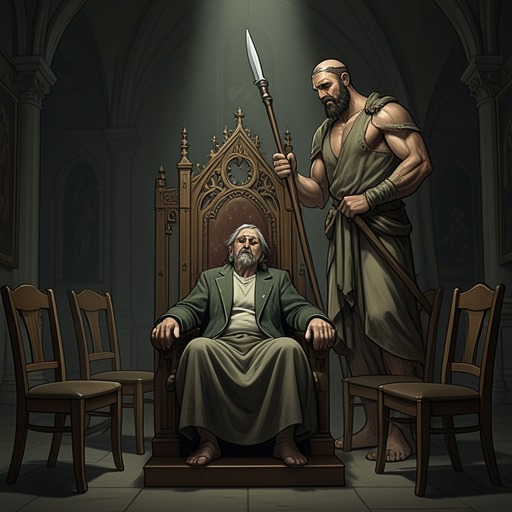
At Meiwu, Li Xian dismisses almost all the imperial couple’s staff and reduces them to severe poverty, leaving them barely enough food to survive. Guo Si and Li Jue’s forces fight for two months. Efforts to mediate, including attempts to secure the couple’s release, achieve nothing, and the conflict produces continued bloodshed rather than a settlement.
Pursuit and Wider Consequences
Li Jue and Guo Si later cooperate again when they fear that Zhang Ji’s position at Chang’an and Yang Feng’s movement toward Hongnong could leave them powerless. They ride toward Hongnong intending to kill the emperor. On the way, their forces overtake the imperial convoy at Dongjian, where Yang Feng and Dong Cheng are resting with the emperor and empress. The loyal troops cannot hold the rebels back; Yang Feng and Dong Cheng manage to get the imperial couple out before the city is overrun, while the rest of the convoy is captured. Dongjian is looted and destroyed, and the emperor escapes to Shanbei with Li Jue and Guo Si close behind.
The flight forces the emperor’s defenders to seek support beyond the established court. Yang Feng and Dong Cheng try both to pacify the two rebel leaders and to assemble an army against them, approaching the White Wave rebels for aid. Li Jue’s campaign therefore helps turn the imperial household’s survival into a matter of improvised alliances, as the court’s authority is repeatedly displaced by military power.
Political Significance
Li Jue’s rebellion contributes to the fragmentation of the Han empire described as the prelude to the Three Kingdoms: competing warlords carve power from a weakening state, while the emperor’s presence can be used to claim authority even when he is unable to govern freely. Later, Kong Ming describes Cao Cao’s control of the Son of Heaven as a source of allegiance from many nobles, illustrating the lasting political value of possession of the emperor. Li Jue’s seizure of the imperial couple is an earlier, more openly coercive instance of that same contest over who can command the symbols and institutions of the Han.