Liu Qi
The Romance of the Three KingdomsLiu Qi is the eldest son of Liu Biao and the threatened heir to Jingzhou whose survival shapes the political stakes of Xuande’s flight and alliance against Cao Cao. Initially endangered by his stepmother, Lady Cai, he finds protection at Jiangxia through Kong Ming’s advice; later he brings military support to Xuande, and his death turns the question of who may claim Jingzhou into an immediate crisis.
Identity and succession
Liu Qi’s position is defined by a divided household and an unsettled succession. Liu Biao’s second wife, Lady Cai, favors her own son and regards her stepson as a danger. When Liu Biao falls ill, he entrusts Xuande with responsibility and gives the right to rule to Liu Qi, his eldest son from his first wife. Lady Cai opposes this arrangement and orders the city gates closed so Liu Qi cannot enter Jingzhou.
The conflict is not merely personal. Liu Qi’s claim derives from his place in Liu Biao’s family, while Lady Cai’s effort to advance her own son threatens to redirect the province’s leadership. His presence or absence therefore matters to the neighboring forces gathering around Jingzhou: the succession determines who can plausibly speak for the territory.
Seeking protection at Jiangxia
Before Liu Biao’s final illness, Liu Qi approaches Xuande and Kong Ming, telling them that his life is in danger because Lady Cai wants him killed. Xuande and Kong Ming initially try to avoid taking on the unwelcome request. Liu Qi persists, however, and Kong Ming advises him to leave the reach of his stepmother and her son by asking to be sent to Jiangxia to protect the area after the death of Huang Zu.
When Liu Biao asks Xuande whether Liu Qi should go, Xuande supports the proposal. Liu Qi is thus able to leave the court’s immediate intrigues and take up a post at Jiangxia. The posting protects him while also placing him in a strategic position: he is away from Lady Cai’s influence, but close enough to matter when Cao Cao’s advance forces Xuande’s followers to seek support.
From endangered heir to military ally
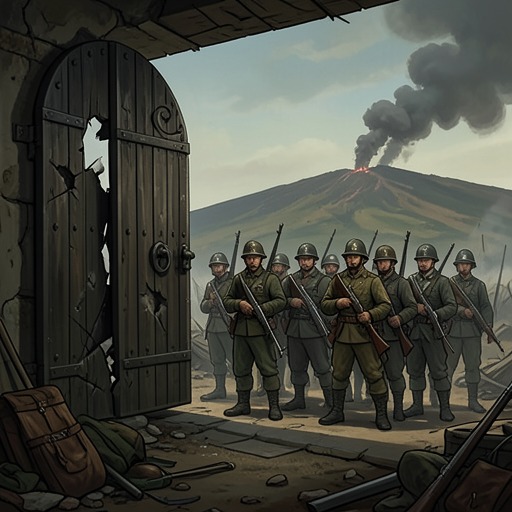
After Liu Biao dies, Liu Qi hears of his father’s condition and leaves Jiangxia for Jingzhou. He arrives at the city gate but finds Cai Mao, Lady Cai’s brother and an opponent of his, barring entry. Cai Mao insists that Liu Qi was assigned to protect Jiangxia and should return there. The episode makes clear that Liu Qi’s formal position as eldest son does not guarantee access to his father or control of the succession: Lady Cai’s side can use the city’s gates and officials to enforce its advantage.
As Xuande travels with the people fleeing Cao Cao, he sends Guan Yu to seek reinforcements from Liu Qi at Jiangxia. Liu Qi later arrives by ship at the river crossing, leading a fleet from the south. He lands, bows to Xuande, and offers support to his imperial uncle. His arrival changes the immediate balance of the escape: Xuande’s party gains a place of refuge and a military ally, rather than remaining exposed between Cao Cao’s forces and the river.
Kong Ming uses the strength of Liu Qi’s men in his case for an alliance with Sun Quan. He argues that Guan Yu still commands ten thousand men and that Liu Qi’s force is about the same size. Set against Cao Cao’s exhausted troops, unfamiliarity with naval warfare, and the prospect of Xuande and Sun Quan joining forces, these soldiers help make a southern resistance credible. Liu Qi’s support thus contributes not only to Xuande’s survival but also to the strategic argument for a three-part balance among the north, Jingzhou, and the south.
Jingzhou, legitimacy, and political leverage
The question of Liu Qi’s whereabouts becomes a point of dispute when Lu Su presses Kong Ming over the southern claim to lands taken from Liu Biao’s domain. Kong Ming argues that Liu Biao’s son is still alive and that Xuande, as Liu Biao’s uncle, has a reason to care for his nephew and the province. When Lu Su replies that the son is absent in Jiangxia, Kong Ming has Liu Qi brought out from behind a screen. Liu Qi appears so ill that two assistants have to help him, and he apologizes for being unable to offer the customary greeting. His brief appearance demonstrates that the heir exists, but it also presents him as physically weak and unable to govern or negotiate directly in that encounter.
When Lu Su asks what would happen if Liu Qi were to die, Kong Ming answers that the question of what follows could then be discussed. Liu Qi’s existence therefore serves as both a family claim and a political restraint: while he lives, Xuande can defend his position through Liu Biao’s succession; if he dies, the argument changes. The strategy depends on Liu Qi’s status even when he is not the person conducting the negotiations.
Death and aftermath
After news arrives that Sun Quan has been defeated, Kong Ming tells Xuande that he had interpreted a shooting star falling in the northwest as an omen that a member of the imperial family had died. A messenger then confirms Liu Qi’s death. Xuande is overcome with grief, and Kong Ming urges him to arrange the funeral and appoint someone to take control of the city. They decide that Guan Yu should take over Xiangyang.
Liu Qi’s death closes the succession question that had protected his claim to Jingzhou, while immediately reopening the territorial question between Xuande’s side and the south. Xuande raises the prospect that the southerners may now claim the city, as Kong Ming had previously discussed. The story has already shown Liu Qi as an endangered son, a displaced heir, a military supporter, and a legal-political basis for Xuande’s position; his death gathers those roles into a single consequence. A private struggle over a father’s succession becomes a public contest over who may possess Jingzhou.