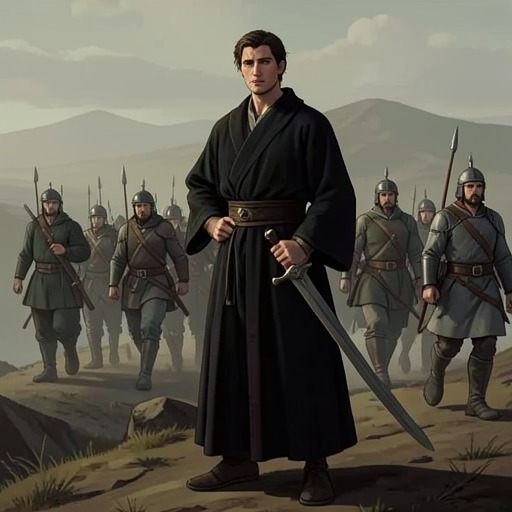
Liu Yao
The Romance of the Three KingdomsLiu Yao is a prefect and member of the imperial family whose treatment of Sun Ce’s family draws him into conflict with Sun Ce. His military resistance is weakened by a decisive reversal: Taishi Ci, sent out against Liu Yao’s judgment to challenge Sun Ce, later changes allegiance and brings thousands of Liu Yao’s troops into Sun Ce’s army.
Position and Conflict
Liu Yao is identified as a member of the imperial family and a prefect. The immediate cause of his confrontation with Sun Ce is the news that Sun Ce has learned of the ill treatment of his family, who are in Liu Yao’s custody. Expecting an attack, Liu Yao prepares his defences and sends troops to protect the river crossing at Niuzhu. They are defeated with heavy losses, allowing Sun Ce to advance and confront Liu Yao’s main army.
The conflict is personal as well as military: Sun Ce seeks to protect his family and avenge his father’s murder. He has obtained three thousand infantry and five hundred cavalry from Yuan Shu by leaving the Imperial Seal as a token of trust, then sets out against Liu Yao. The account thus places Liu Yao’s campaign within a wider struggle over family security and political independence.
The Encounter with Sun Ce
During the confrontation, Sun Ce dreams that the founder of the Later Han summons him to a temple. He goes there with only twelve guards, despite his advisers’ warnings. Liu Yao’s men spot him, but Liu Yao suspects the apparent exposure is a ruse designed to draw his forces into an ambush. His caution keeps him from acting on the opportunity.
Taishi Ci, however, is eager to fight and disregards Liu Yao’s pleas to hold back. With one other commander, he rides out to challenge Sun Ce. The two warriors fight for fifty rounds without either gaining the advantage. Taishi Ci then lures Sun Ce away from his guards by feigning retreat, and their struggle continues until soldiers from both sides arrive and separate them. Liu Yao’s misgivings about a possible trap do not prevent the duel; instead, his inability to restrain Taishi Ci exposes the difference between his cautious command and his subordinate’s appetite for combat.
Defeat and the Loss of His Troops
The duel becomes the beginning of a bitter feud that shapes the battles between the two armies. Subterfuge continues on both sides, and Taishi Ci is eventually captured and brought before Sun Ce. Rather than treating him simply as an enemy, Sun Ce welcomes him as a hero and invites him to dine. Taishi Ci is moved by this reception and offers to bring over Liu Yao’s discouraged and divided troops.
Sun Ce trusts him, and Taishi Ci recruits thousands of the enemy soldiers to join Sun Ce’s side. This transfer of men is a consequential loss for Liu Yao: his force is not only challenged in battle but weakened from within when a prominent warrior can persuade its soldiers to change allegiance. Liu Yao’s story in this episode is therefore defined less by a recorded personal fate than by the progressive collapse of his military position.
Narrative Significance
Liu Yao’s role provides the setting for Sun Ce’s rise in the south and for the reversal in Taishi Ci’s relationship with Sun Ce. His initial response to the threat is to prepare defences at a key crossing, while his suspicion of a trap prevents him from exploiting Sun Ce’s vulnerable visit to the temple. The account then gives the decisive personal encounter to Taishi Ci, whose independent action and eventual change of allegiance shape the campaign more than Liu Yao’s own decisions.
The episode contrasts command based on caution with the force of individual initiative, but its outcome turns on trust as well as battlefield strength: Sun Ce trusts the captured Taishi Ci, and Taishi Ci uses that trust to draw thousands of Liu Yao’s soldiers across. Liu Yao’s imperial lineage establishes his status, yet the narrative’s emphasis falls on the loss of control over his army as Sun Ce advances.