Liu Zhang
The Romance of the Three KingdomsLiu Zhang is the ruler of Yizhou whose appeal for assistance against Cao Cao and Zhang Lu becomes the opening through which Xuande acquires his territory. His story turns on a fraught gap between legitimate kinship and effective rule: he is of the House of Han, yet Kong Ming describes him as too weak to govern a rich province, and Xuande’s rise leaves him with a choice between resistance and sparing the people further war.
Identity and Rule
Liu Zhang is identified as a member of the imperial family and governor of Yizhou, a broad, wealthy territory whose strategic importance makes it central to the struggle for power. Kong Ming’s assessment is severe: despite the region’s wealth and capable population, Liu Zhang is too foolish and weak to control it, while its people long for a wiser ruler. In Kong Ming’s account, Yizhou is also favored by Heaven and carries the historical prestige of having been the base from which the founder of the Han emerged. Its resources and symbolic association with the dynasty make the question of who governs it more than a local dispute.
Cao Cao’s judgment of Liu Zhang is blunter still. When Xuande names him among possible rivals, Cao Cao dismisses him as a royal kinsman reduced to a gatekeeping dog. The insult anticipates the political position Liu Zhang will occupy: his bloodline gives him standing, but his inability to command events leaves him vulnerable to stronger leaders who can claim to protect, inherit, or replace him.
Xuande’s Invitation
Liu Zhang’s government faces danger from Zhang Lu, his longstanding enemy. After Cao Cao’s victories in the west and Ma Chao’s retreat, Zhang Lu considers declaring himself prince of Hanning and leading resistance. His adviser Yan Pu instead urges him to seize Yizhou’s forty-one departments, arguing that the region has more than one hundred thousand households, substantial wealth and grain, and natural defenses on four sides. Liu Zhang, aware of the threat, has already garrisoned Baxi near Hanzhong under Pang Xi.
Zhang Song proposes that Liu Zhang seek help from Xuande, presenting him as a virtuous imperial kinsman who can assist against both Cao Cao and Zhang Lu. Liu Zhang is pleased with the recommendation and readily agrees to send an embassy. Some of his advisers foresee the danger: they warn that Xuande may overrun the country. Their objection does not stop the plan. Liu Zhang sends Fa Zheng toward Jingzhou, setting in motion the invitation that will bring Xuande’s army into Yizhou.
The irony lies in the mismatch between the request and its consequences. Liu Zhang hopes to secure an ally against two enemies; Xuande’s arrival supplies him with both a rival inside his territory and a force capable of taking it. Yet the invitation is not simply an act of foolishness. Liu Zhang faces a real threat from Zhang Lu, and he accepts the counsel of men who represent Xuande as a protector. The narrative makes his vulnerability consequential precisely because it is exploited through the language of assistance and kinship.
The Welcome at Fucheng
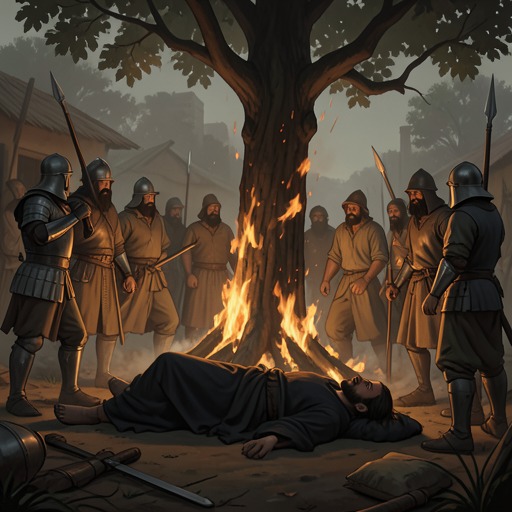
When Xuande enters Shu with an army of fifty thousand, he leaves Kong Ming in Jingzhou with Guan Yu, Zhang Fei, and Zhao Zilong, and brings Pang Tong, Huang Zhong, and Wei Yan with him. Liu Zhang decides to meet him at Fucheng. His advisers try urgently to prevent the visit: Huang Quan grips Liu Zhang’s clothes in his teeth, while Wang Lei makes a final, public protest by hanging upside down above the city gate, holding a letter in one hand and a sword in the other. Wang Lei threatens to cut the rope if Liu Zhang proceeds. Liu Zhang is furious at what he regards as an insult to his intended welcome of a benevolent and just man. Wang Lei cuts the rope and falls to his death; Liu Zhang continues on his journey.
Liu Zhang’s reception of Xuande is warm. At their meeting, he casts caution aside, even as his advisers warn that Xuande’s gentleness conceals an iron hand. After the banquet, Pang Tong proposes using a second invitation to kill Liu Zhang: a hundred men could be hidden near the wall, and Xuande could signal the attack by dropping a cup. Xuande refuses, saying that Liu Zhang is his kinsman and that such a killing would not be forgiven by Heaven or the people. His refusal does not end the conflict, but it distinguishes the course he takes from the immediate assassination Pang Tong recommends.
Xuande’s forces continue through Shu under strict instructions not to take goods or harm the inhabitants. That restraint coexists with a growing contest for the province. The welcome at Fucheng has not prevented the advisers’ fears from materializing; it has placed Xuande and his soldiers within reach of the territory Liu Zhang must defend.
From Resistance to Surrender
After Xuande’s forces reach Luocheng, Liu Zhang’s son Liu Xun escapes through the opposite gate and carries news to Chengdu. A letter from Fa Zheng reaches Liu Zhang, advising him to submit to Xuande. Instead of persuading him, it enrages him: he tears it up and plans a counterattack, desperate enough to seek help from Zhang Lu, his other enemy.
The position changes when Ma Chao joins Xuande. As the combined forces approach Chengdu, Liu Zhang seals the city and prepares for a siege. Ma Chao and Ma Dai call for him to appear on the wall and speak. Hearing Ma Chao explain in person that he has joined Xuande, Liu Zhang understands that further resistance is futile. His decision is shaped not only by defeat but by concern for the inhabitants: he orders the gates opened because he genuinely wishes to spare them additional suffering. A soothsayer’s declaration that the stars show a bright new ruler confirms his inclination to surrender.
Xuande enters Chengdu to public rejoicing and forbids retaliation against opponents such as Huang Quan and Liu Ba, even though they have resisted him. Their surrender follows. Xuande initially wants Liu Zhang to remain in the city out of respect, but Kong Ming argues that two lords cannot share it and that Liu Zhang’s indecision has cost him his right to rule. Liu Zhang is therefore sent to Jingzhou, where he is placed under what amounts to comfortable house arrest and given an honorific title.
Loss of Territory and Narrative Significance
Liu Zhang’s surrender transfers Yizhou to Xuande without the further devastation a prolonged defense of Chengdu would have brought. Xuande rewards those who joined him, but Zhao Zilong opposes a proposed redistribution of the newly conquered land to Xuande’s followers, warning that the people have suffered enough and that generosity will secure future support. Laws are revised, corrupt or excessively harsh local governors are restrained, and the territory is settled. These changes mark the difference between Liu Zhang’s personal loss of power and the larger political reorganization of the province under its new ruler.
The narrative presents Liu Zhang as both a weak sovereign and a consequential decision-maker. Others repeatedly define his deficiencies, and his advisers’ warnings expose how much they distrust his judgment. Nevertheless, at the decisive moment in Chengdu he chooses surrender to protect the population from further suffering. That act does not preserve his rule: Xuande takes the province, and Liu Zhang leaves for Jingzhou. It does, however, make the ending more complex than a simple conquest. The man judged unfit to govern yields the territory, while the incoming ruler’s prohibition on vengeance and subsequent attention to land and law frame the transfer as an opportunity to claim benevolent rule.