Longzhong Plan
The Romance of the Three KingdomsThe Longzhong Plan is Kong Ming’s answer to Xuande’s appeal for guidance: a map-based strategy for surviving the divided political landscape and building the power to restore just rule. Its decisive move is to distinguish the territories that Xuande should oppose, ally with, and seek to control, making Jingzhou the foundation for a larger campaign and setting the direction of their partnership.
The request for counsel
When Kong Ming finally receives Xuande, he apologizes for having kept him waiting and acknowledges that he has read Xuande’s earlier note. He praises the depth of Xuande’s concern for the country and its people, yet describes himself as young, ignorant, and merely a farmer. Kong Ming’s self-effacing answer initially leaves the burden on Xuande: Xuande must explain why this secluded man should enter public life.
Xuande says that the Han is collapsing and that its authority has been usurped by evil ministers. Though he considers himself weak and has failed so far, he wants the land governed justly and asks Kong Ming to teach him how to achieve that end. The consultation is therefore not simply a request for a campaign plan. Xuande presents political restoration as an obligation toward the people, while Kong Ming’s response tests whether that ambition can be matched to the actual distribution of power.
A map of powers and opportunities
Kong Ming begins with the north. Cao Cao, he argues, has overcome Yuan Shao through cunning and now commands a vast army while controlling the emperor. That control brings the allegiance of many nobles as well as an immense political advantage; Xuande cannot successfully oppose him directly. The assessment treats imperial authority and military strength as linked sources of power, not separate problems.
To the south, Kong Ming identifies Sun Quan as a different kind of power. Sun Quan is not as strong as Cao Cao, but his family has ruled the region for three generations and he has the support of its people. Kong Ming consequently advises Xuande to regard him as a potential ally rather than an enemy. This distinction gives the strategy its political shape: strength alone does not determine whom Xuande should confront, and local support makes alliance preferable to an unnecessary second front.
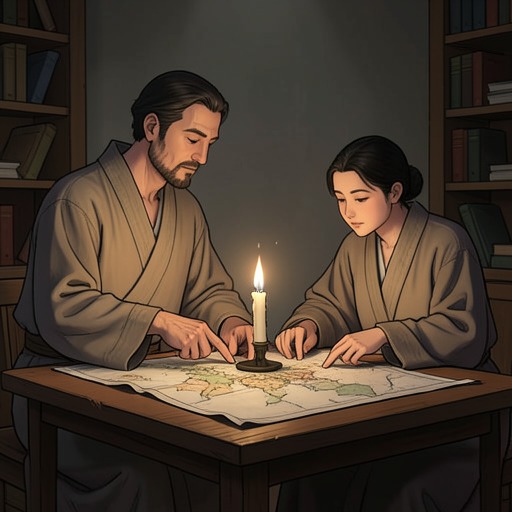
Kong Ming makes Jingzhou, ruled by Liu Biao, the immediate priority. He calls it the place where the future will be decided and says that the Will of Heaven has assigned it to Xuande, though Xuande has not recognized or acted on that opportunity. The plan does not present Jingzhou as an incidental prize. It is the necessary base from which Xuande can move forward, and Kong Ming uses a map to show how its position fits the larger design.
Yizhou supplies the next major opportunity. Kong Ming describes it as vast and prosperous, favored by Heaven, and historically associated with the founder of the Han. Its ruler, Liu Zhang, is weak and unable to govern his wealthy and capable population effectively; Kong Ming says the people long for a wise ruler. Xuande’s imperial-family reputation, proven valor, following of heroes, and respect for sages, he argues, could make it possible for him to take control there. The plan thus joins territory to a claim of political fitness: Yizhou matters both for its resources and because Kong Ming sees a path by which Xuande could be accepted as a better ruler.
Strategy, legitimacy, and consent
The Longzhong Plan rests on a sequence rather than a single conquest. Kong Ming identifies Cao Cao as an opponent not yet to be challenged directly, Sun Quan as a potential partner, Jingzhou as the strategic base, and Yizhou as a later expansion. He then presents the arrangement as a route to becoming the hero of ordinary people. The map makes the argument concrete: political ambitions must be translated into control of particular places and relations with the powers around them.
Xuande raises a moral difficulty. Liu Biao and Liu Zhang are both members of the imperial House of Han, so attacking or usurping them would mean acting against relatives. Kong Ming answers that Liu Biao has little time left and that Liu Zhang lacks ambition and may be willing to work under Xuande. These reassurances do not erase the tension between kinship and expansion; they show how the plan tries to make territorial change compatible with Xuande’s professed commitment to the Han house.
The consultation also depends on personal trust. After hearing the plan, Xuande again asks Kong Ming to join him. Kong Ming refuses, preferring rural solitude. Xuande then breaks into tears and asks what will become of the people. Faced with that sincerity, Kong Ming agrees to serve. The strategic design becomes actionable only when its author accepts a place within Xuande’s enterprise.
From counsel to partnership
Kong Ming’s agreement changes the consultation from a private exchange into a working political partnership. The plan gives Xuande a framework for choosing enemies and allies and for treating territorial opportunity as part of a larger project of just rule. Its emphasis on Jingzhou as a base also makes geography central to the strategy: the proposed future depends on securing a position from which further action can be organized.
The Longzhong Plan is therefore both a territorial design and a statement of political purpose. It acknowledges Cao Cao’s immediate superiority, makes cooperation with Sun Quan preferable to conflict, and argues for expansion through Jingzhou and Yizhou. At the same time, it answers Xuande’s appeal to restore justice by insisting that the people and the legitimacy of rule matter alongside military calculation. Kong Ming’s consent closes the scene, but the plan’s significance lies in the durable order it gives to Xuande’s ambitions: a reading of the divided realm converted into a course of action.