Man schemes, but Heaven decides!
The Romance of the Three Kingdoms“Man schemes, but Heaven decides!” is Kong Ming’s response when torrential rain extinguishes the fire that has trapped Sima Yi and his sons in a valley. The expression crystallizes a recurring tension in the novel: commanders can read terrain, mislead opponents, and arrange forces with great skill, yet success may still hinge on an event beyond their control. In this scene, the weather does not merely interrupt a plan; it reverses the expected outcome and gives strategic uncertainty the force of a judgment from Heaven.
The Saying in the Valley
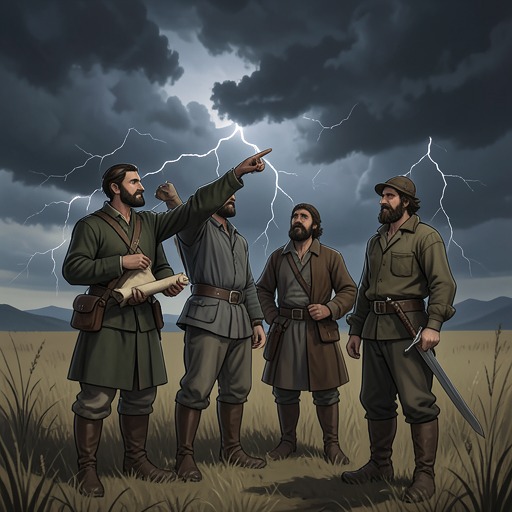
Kong Ming expects to remain in the Qishan mountains for an extended campaign, and his men settle among the local population and plant crops to be shared equally. Meanwhile, Sima Yi and his sons grow alarmed by reports of the Shu army’s preparations. Kong Ming draws them toward a narrow-necked valley, apparently by allowing them to pursue Wei Yan, and prepares an ambush there. The trap is built from several coordinated elements. Shu troops occupy the ridges, where they can fire down into the valley; inflammable stores have been prepared below, and mines are buried in the valley floor. Sima Yi and his sons enter before recognizing the danger. Flaming torches set the stores alight, arrows rain down, and explosions erupt underfoot. Sima Yi embraces his sons, believing they are about to die. At that precise moment, a dark cloud brings torrential rain. The water puts out the fires within minutes. Sima Yi’s forces escape the valley, join other Wei contingents, and help drive back the attack on their camp. Kong Ming watches the opportunity disappear and says, “Man schemes, but Heaven decides!” The phrase follows a clear reversal: the human plan has been executed, but a change in the weather determines its result.
Strategy, Chance, and the Limits of Command
The episode gives the saying its particular weight by placing an elaborate military design beside an uncontrollable natural event. Kong Ming has selected the ground, arranged concealment, and combined fire, missiles, and buried explosives. Sima Yi, for his part, is drawn into the valley by the apparent chance to catch a fleeing opponent. The escape does not arise from a superior counter-plan: rain intervenes after the trap has already closed. Other episodes in the novel establish a broader pattern of calculation and reversal. Jia Xu recognizes that Cao Cao is signaling an attack on the weak southeastern wall while preparing materials on the northwest side to suggest a different target; Jia Xu proposes a counter-deception based on the same reading of the enemy’s intentions. During the campaign against Yuan Shao at Guandu, Cao Cao faces an army about ten times the size of his own and acts urgently because his supplies are limited. At Bowang, Kong Ming assigns hidden positions and timed attacks to Guan Yu, Zhang Fei, and Zhao Zilong, coordinating their actions around the signal of rising flames. Each case makes planning depend on intelligence, terrain, timing, or resources; the valley episode sharpens the point by showing that even a well-constructed plan cannot command the weather. Kong Ming’s arrow-gathering stratagem offers a contrasting kind of success. In dense fog, Cao Cao orders his archers to shoot toward the apparent enemy attack, while Kong Ming’s boats collect the arrows on straw bales. There, the commander’s anticipation of an opponent’s response converts uncertainty into advantage. In the valley, by contrast, Kong Ming’s design works until an unforeseen natural force changes the value of every prior decision. The expression marks the boundary between manipulating an opponent and controlling the outcome.
Heaven as Political and Narrative Force
The saying belongs to a world in which natural signs are repeatedly read as evidence about political legitimacy and dynastic fate. When Sun Jian finds the jade seal in a well, its discovery is interpreted as a sign that he is destined to rule. During the attempted burial of Dong Zhuo, storms repeatedly drive the coffin back out of the ground, and the narrative presents the repeated failure as Heaven’s anger. Later, astrologers invoke auspicious signs to argue that Heaven has transferred the mandate from the Han to Wei. Such episodes make celestial or natural phenomena part of political argument, though human characters may differ over how signs should be interpreted. The storm at Qishan is more immediate and less dependent on an extended interpretation: its consequence is visible in the ruined ambush and Sima Yi’s escape. Yet Kong Ming’s words place that physical event within the novel’s larger language of mandate, portent, and limitation. They do not erase human responsibility or tactical skill. Rather, they distinguish devising a plan from securing its fulfillment: people can arrange the conditions of action, but they cannot guarantee what follows.
Recurrence and Significance
The expression also resonates with the campaign’s human costs and constraints. Kong Ming continues to press the war, even as Sima Yi learns from a messenger that he rises early, works late, handles details including punishments, and eats very little. Sima Yi takes this account as evidence that Kong Ming cannot sustain such a pace indefinitely. His assessment introduces another limit alongside the storm: a commander’s endurance is finite, even when strategic ability remains formidable. “Man schemes, but Heaven decides!” therefore gathers several levels of meaning into one brief judgment. It names the sudden material reversal that saves Sima Yi, underscores the novel’s recurring uncertainty about the reach of military expertise, and connects battlefield outcomes to a larger account of Heaven’s authority. The saying does not make strategy pointless; the carefully prepared trap shows how much can be achieved through it. Its force lies in the final distinction: design belongs to human beings, while the outcome may exceed their command.