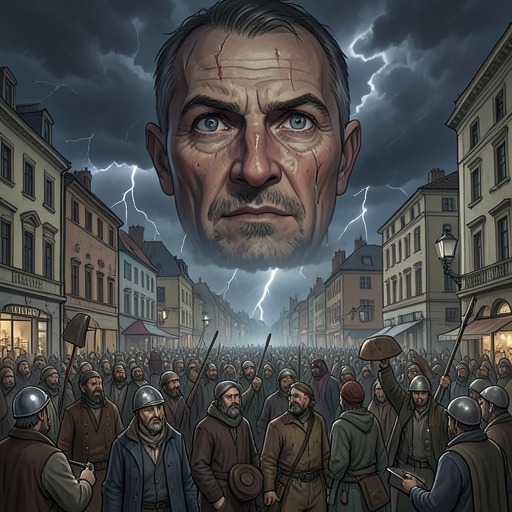
Omens and portents
The Romance of the Three KingdomsOmens and portents are a recurring narrative language for reading political change: a fallen banner warns of an ambush, celestial signs foretell a birth or a ruler’s rise, and storms interrupt ceremonies of burial and succession. The signs carry force not simply because they occur, but because characters interpret them and act on those interpretations. Across these episodes, the narrative both lends supernatural weight to historical turns and shows how claims about Heaven can support, challenge, or unsettle political authority.
Signs as warnings and promises
On the march against Xuande, Cao Cao sees his standard pole break in the wind and regards the accident as an omen. He consults Xun Wenruo, whose reading predicts a night attack. Cao Cao takes the warning seriously and sets a trap; when Xuande and Zhang Fei attack, they find the camp nearly empty and are themselves ambushed. Here the sign functions as a practical warning within the action: its political or supernatural meaning is less important than the decision it prompts and the reversal it enables.
At Xinye, the birth of Liu Shan is surrounded by auspicious signs. A white crane lands on the roof and sings on the night he is born, while Lady Gan dreams that she has swallowed the stars of the Northern Dipper. The account connects these signs to the child’s conception and arrival, presenting his birth as marked by celestial promise. Unlike Cao Cao’s banner, which anticipates immediate military danger, the crane and dream frame a birth as part of a larger horizon of dynastic significance.
A different kind of promise appears in the account of Cao Cao’s arrival near Cangting after his victory at Guandu. Local elders recall that, in the reign of Emperor Huan, a yellow star appeared above their village. An astrologer had predicted that a worthy man would come fifty years later; the villagers now identify Cao Cao with that prophecy, citing his victory over Yuan Shao and his reputation for benevolence. Moved by their explanation, Cao Cao orders his men to protect the villagers and threatens execution for anyone who steals from them. The prophecy thus becomes more than retrospective praise: it is tied to a concrete order and to the people’s hope that his rule will bring relief from Yuan Shao’s taxes.
Portents, authority, and the Mandate of Heaven
The discovery of the Jade Seal in the ruins of Luoyang gives celestial signs a direct connection to sovereignty. After Sun Jian orders the damaged city cleared and its imperial tombs sealed, he watches a pale mist veil a constellation and mourns that the imperial star is no longer bright. A soldier then points out five strange lights coming from a well. Inside, they find a woman’s body with an embroidered pouch; the pouch contains a small box holding the seal, carved with five intertwined dragons and inscribed with words declaring the recipient’s heavenly mandate and long life. Cheng Pu identifies it as the emperors’ seal and recounts its history, including the ancient damage to one corner and its repair with gold. He interprets Sun Jian’s discovery as evidence that Sun Jian is destined to rule and urges him to return southeast to prepare for kingship. The object’s recovery is therefore both a material discovery and a contested political message, given a personal meaning by an adviser.
The burial of Dong Zhuo at Meiwu offers a more punitive image of Heaven’s judgment. As the rebel leaders attempt to bury his coffin, a violent storm floods the site and carries the coffin out of the ground. They try again, but it is washed out a second time, and a third attempt ends in the same way. The account presents the repeated failure and destruction of the burial as Heaven making its anger plain. Unlike the omen interpreted by Cao Cao’s adviser, this episode supplies its own emphatic explanation: the storm is narrated as condemnation of Dong Zhuo rather than as an ambiguous sign awaiting a human reader.
Prophecy also appears as a political resource before its meaning is clear. When four men turn aside to visit a sage, Liu Gui argues that the Master’s knowledge of the Way may provide guidance. The sage initially ignores them, then writes eight lines, beginning with the paired images of dragon and phoenix and saying that they fly to the Western Riverlands. The passage establishes the presence of a cryptic, written forecast, but the supplied account does not explain its full meaning. Its authority rests on the expectation that an enigmatic utterance may disclose a future that ordinary judgment cannot yet see.
Wonders and the limits of interpretation
The narrative’s supernatural signs can be spectacular without persuading every witness. Sun Ce orders Yu to be tested during a drought: Yu mounts an altar and promises three feet of rain by noon, even as he says his own time is up. Sun Ce orders a pyre lit if the promise fails. Just before noon, rain falls heavily enough to reach the promised depth, and Yu stops it after it becomes excessive. The crowd responds with reverence, but Sun Ce dismisses the result as chance and orders Yu’s execution. The same event therefore produces opposing readings: for the people, it confirms Yu’s power; for Sun Ce, it does not justify belief or change his decision. The narrative then extends the conflict beyond the public demonstration: Yu’s body disappears, and Sun Ce later sees him again, but still refuses to pray at the temple. The episode makes the interpretation of a portent part of the political and moral action, not a neutral conclusion shared by all.
The Bronze Bird Tower likewise begins with a sign given an auspicious political reading. After a bronze bird statue is discovered, Xun You remarks that such a miraculous appearance has traditionally been favorable. Cao Cao welcomes it as a sign of his rise and orders a tower built at the site. On Cao Zhi’s advice, the project becomes three towers: Jade Dragon, Golden Phoenix, and the central Bronze Bird. Cao Cao declares that he will spend his later years there. The omen is thus converted into a lasting architectural undertaking and an expression of expectation about his own future.
The variety of these episodes matters. Some signs guide immediate decisions; others frame births, victories, or political ambitions; still others are rejected by people who witness them. The narrative does not make every omen equally verifiable: the written prophecy remains unexplained in its immediate setting, while the rain is observed but interpreted differently. Omens therefore create a tension between the apparent presence of a larger order and the human act of assigning that order a meaning.
Dynastic transfer and ominous ritual
When Hua Xin argues that Heaven has transferred the mandate from the Han to Wei, he brings forward astrologers to cite auspicious signs as proof. The Han emperor rejects their interpretation, refusing to accept that the signs settle the legitimacy of his surrender. Wang Lang then presses the political case that dynasties and ruling families inevitably end, turning dynastic decline into an argument for yielding power. The scene distinguishes the occurrence of signs from the claims made in their name: the astrologers present them as evidence, but the emperor’s refusal exposes that this evidence does not compel assent.
After the emperor hands over the jade seal of authority and Cao Pi begins his reign as emperor of Wei, the new ruler kneels to worship Heaven and Earth. A violent storm disrupts the ceremony: wind scatters dust and stones, darkness covers the sky, and the ritual lanterns are blown over. Cao Pi collapses and is carried away; the account says he remains incapable of action for several days, never fully recovers, and comes to believe the palace is haunted. He orders a new palace built at Luoyang. The storm that follows the formal transfer of authority sharply contrasts with the auspicious signs invoked to justify it. The abdication establishes Wei politically, but the interrupted rite leaves the new emperor’s claim shadowed by an apparent sign of heavenly displeasure.
Across these episodes, omens neither function as detached decoration nor produce a single, stable system of interpretation. A banner’s fall can help avert a trap; a star can be made to identify a future ruler; a storm can be read as Heaven’s judgment or can interrupt a ceremony whose political outcome has already been secured. The signs lend the struggles over power a cosmic register, while the competing interpretations reveal how much depends on who speaks for Heaven—and whether events appear to confirm that claim.