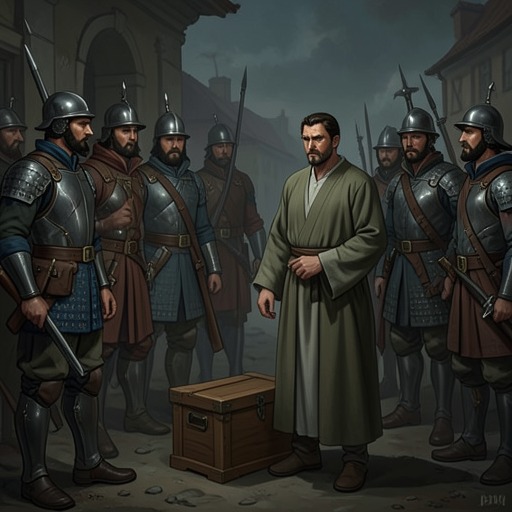
Pang De’s coffin
The Romance of the Three KingdomsPang De’s coffin is a literal preparation for death and a public declaration of loyalty. Made after Cao Cao reappoints Pang De to command despite doubts about his allegiance, it accompanies him on campaign against Guan Yu: Pang De tells his household and soldiers that he will either return in it or use it to carry Guan Yu’s head to Cao Cao. The coffin thus turns private resolve into a visible pledge, setting the terms of a confrontation in which neither commander can claim an easy victory.
Background and the Question of Loyalty
Pang De volunteers to serve with Yu Jin in the campaign against Guan Yu, and Cao Cao raises seven armies for the operation. Yet Pang De’s appointment is challenged by commanders who point to his former service under Ma Chao and to the fact that his brother is with the Shu army. They question whether he can be trusted in a fight against the side with which those connections are associated.
When Yu Jin brings the doubts to Cao Cao, Cao Cao summons Pang De and asks him to give up his commission. Pang De is hurt and asks why he should be dropped when he expects to prove his loyalty the next day. Cao Cao distinguishes his own judgment from the suspicions of others: he says he has no personal objection, but that the other commanders doubt Pang De because of Ma Chao and his brother.
Pang De answers by separating past ties from present allegiance. He says he has not forgotten Cao Cao’s generosity when he surrendered, and that no service could repay it; he adds that he and his brother fell out long ago, and describes Ma Chao as brave but foolish. Moved by his account, Cao Cao restores him to command. He also explains that, although he has always believed Pang De loyal, that loyalty must be demonstrated to the others. The coffin is Pang De’s answer to a suspicion that words alone cannot settle.
The Coffin as a Pledge
After returning home, Pang De has a coffin made and invites friends to a banquet to see it. They are surprised that he has chosen so ominous an object immediately before going to war and ask why he has had it made. Pang De explains that he is going to fight Guan Yu: if he does not kill Guan Yu, Guan Yu will kill him, and the coffin represents the extent of his determination. Rather than conceal the prospect of death, he makes it the centerpiece of a deliberate, public statement.
Pang De then speaks privately with his wife. He tells her he may die and asks her to raise their son so that the boy can avenge his father. The account links the coffin’s military meaning to this family instruction: the object is not just a boast made before his peers but a sign that Pang De has considered what his death would mean at home. His words also give the pledge a future beyond the battle, by naming his son as the person who might continue the reckoning if Pang De does not return.
He gathers his five hundred men and gives them the same stark choice. They will either bring him home in the coffin, or he will use it to bring Guan Yu’s head back to Cao Cao. The coffin therefore serves as a shared standard for the expedition, making victory and death the two outcomes by which Pang De’s determination is to be measured. He sets out with the coffin carried before him, so that his declaration travels visibly with the army rather than remaining a private intention.
The Coffin in the Encounter with Guan Yu
The approaching seven armies and the report of Pang De’s coffin reach Guan Yu, whose anger is apparent in his response. His son Guan Ping offers to meet Pang De first, arguing that Guan Yu should not have to fight someone he regards as beneath him. On the field, Pang De displays a black standard bearing his title, with the coffins standing upright beside it. The object has moved from Pang De’s home into the public space of battle: it is part of the challenge he presents to the opposing force.
Guan Ping rides out and fights Pang De for thirty rounds before the two withdraw exhausted. When Guan Yu comes to the front, Pang De says that he has the commission of the king of Wei to take Guan Yu’s head to Cao Cao, and points to his coffin as evidence of his seriousness. Guan Yu answers with contempt and attacks. The coffin is not used to threaten Guan Yu by itself; its force comes from the explicit pledge attached to it and from the fact that Pang De has carried that pledge into the encounter.
The two commanders fight for more than a hundred rounds without either prevailing. Returning to their respective sides, both acknowledge that they have met an equal. The coffin’s promise of a decisive outcome therefore stands in contrast to this immediate result: Pang De has made death or Guan Yu’s defeat the measure of his commitment, but their first direct contest ends without a victor.
Meaning and Narrative Function
The episode gives the coffin several connected roles. It records the seriousness with which Pang De faces the possibility of death; it provides a tangible answer to doubts about his loyalty; and it becomes an emblem visible to friends, family, soldiers, and opponents. Its meaning develops through a sequence of audiences: Cao Cao and his commanders question Pang De’s allegiance, his guests see the coffin before battle, his wife hears what his death might require of her, his five hundred soldiers receive the pledge, and Guan Yu encounters the object on the field.
The coffin also sharpens the story’s contrast between a declaration and its outcome. Pang De announces that one of the two men must die, and the object appears to make that expectation concrete. Yet their prolonged fight ends in mutual recognition rather than immediate victory. The coffin remains a symbol of Pang De’s resolve and willingness to accept the cost of his campaign; the evidence of this encounter does not make it a guarantee that his stated aim will be achieved.