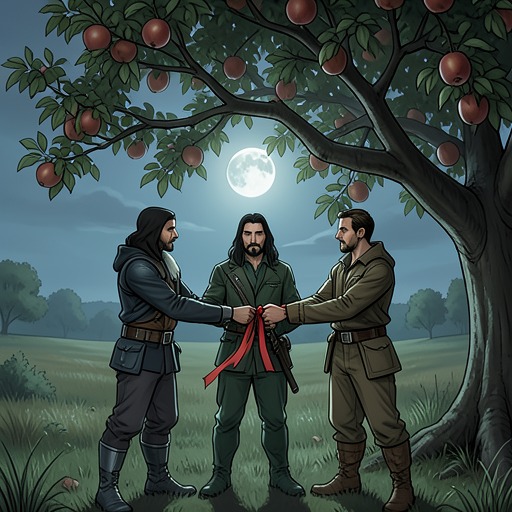
Peach Orchard Brotherhood
The Romance of the Three KingdomsThe Peach Orchard Brotherhood is the sworn alliance of Xuande, Guan Yu, and Zhang Fei, founded through a ceremony in Zhang Fei’s orchard. Its pledge joins private brotherhood to a public purpose: defending the people, serving the Han, and standing together through danger. The brotherhood sets the pattern for their early military partnership, while its promises continue to shape decisions long after the three men have been separated.
Formation and Founding Oath
The three meet at an inn after the call to arms brings them toward the local governor’s aid. Xuande is seeking worthy allies; Zhang Fei is a forceful local man, while Guan Yu arrives as a traveler who has spent five or six years away from home after killing a bully who terrorized his community. Their different routes converge in a shared willingness to take up arms. Zhang Fei invites the others to his manor, where he proposes a ceremony in the flowering peach orchard behind his house.
The next day, the three prepare offerings, including a black bull and a white horse, and make their vow amid incense smoke. The oath binds men from separate families to stand by one another, defend the people, and share their fate. Its terms make the alliance more than a battlefield arrangement: allegiance is sworn before Heaven and Earth, and failure to uphold its duties is placed under judgment by both Heaven and the people.
Brotherhood and Early Organization
After the ceremony, the three establish an order within their new family: Xuande is the elder brother, Guan Yu the second, and Zhang Fei the youngest. They share the prepared meat and wine with roughly three hundred local recruits who join the feast in the orchard. The gathering turns a private vow into a community of followers, giving the brotherhood an immediate military and social base.
The preparations that follow are practical as well as symbolic. The men gather weapons and horses and have armor made. Xuande commissions two double-edged swords; Guan Yu receives a curved sword called Cold Wonder, and Zhang Fei orders a long spear. Their numbers grow to about five hundred young men. Together, they report for duty to Liu Yan, whose call to arms had brought them together, and soon face an attack by a Yellow Headband force of about fifty thousand in the Zhuo district. The orchard vow thus leads directly into collective service and armed action.
Duties Under Pressure
The oath’s force becomes especially clear when Guan Yu is surrounded after Xuande’s defeat. Zhang Liao argues that an attempt to die rather than submit would violate the brotherhood’s promise: Guan Yu had sworn to die alongside his brothers, yet Xuande might still survive and need his help. Zhang Liao also points to Guan Yu’s responsibility for Xuande’s family and to their pledge to protect the Han dynasty. He urges submission as the course that would let Guan Yu keep those obligations, remain alive, and protect the women entrusted to him.
This appeal presents the brotherhood not as a demand for a dramatic shared death at any cost, but as a continuing set of responsibilities. Loyalty requires Guan Yu to consider what his brothers and their household may need after the immediate crisis. The oath’s language of shared fate is therefore interpreted through practical service: surviving can be more faithful than seeking death.
Enduring Significance
The Brotherhood’s pledge accompanies the three through a fractured political world in which alliances are often shaped by rivalry, divided loyalties, and struggles for territory. When Cao Cao worries that Xuande and Lü Bu might combine against him, his adviser proposes setting them against one another; the scheme exploits political uncertainty, but Xuande reassures Lü Bu that he will not carry out the secret order to kill him. That episode underscores the difference between imposed political maneuvering and the personal obligations established in the orchard.
The brotherhood also supplies a measure against which later conduct can be judged. It joins the defense of ordinary people to loyalty among its members and service to the Han, making the three men’s bond at once familial, military, and political. Its most durable effect is not simply that the brothers begin their campaign together, but that the original vow continues to define what faithful action means when circumstance pulls them apart.