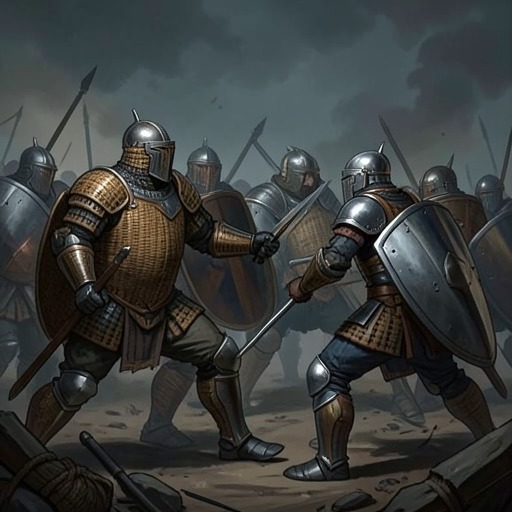
Serpent Winding valley
The Romance of the Three KingdomsSerpent Winding valley is the site of Kong Ming’s devastating ambush against Wutugu’s army during the southern campaign. Its winding, seemingly empty terrain becomes the mechanism of the trap: a sequence of feigned retreats draws the pursuing force deep into the valley, where blocked exits and fire destroy the army. The victory captures Meng Huo again, but the mass death also exposes the moral cost of winning by annihilation.
Terrain and the plan
Kong Ming’s plan depends on making the valley appear safe. He assigns Wei Yan to retreat repeatedly, abandoning camps and drawing the attacking forces toward the valley over a period of two weeks. White flags mark each successive camp. Wutugu has been warned by Meng Huo to avoid valleys thick with trees and shrubs, but the routes they encounter appear empty of danger. The strategy uses that caution against him: the valley’s bare sides persuade Wutugu that no ambush is waiting.
The preparations extend beyond the retreat. Kong Ming assigns Ma Dai ten black carriages and a thousand bamboo poles, and orders Zhao Zilong to control the route leading toward Sanjiang. He also places surrendered soldiers in a role that will later help bring Meng Huo into the trap. The valley is therefore not simply a place of concealment; it is the center of a coordinated operation whose separate parts depend on controlling the approach, the exits, and what the pursuing army believes it sees.
The ambush and destruction
On the sixteenth day, Wutugu enters the valley in pursuit of Wei Yan. The pursuing soldiers pass wagons that appear abandoned, interpreting them as evidence that the opposing force fled too quickly to take its supplies. They press on until tree trunks block the far end and rocks fall from above, obstructing the route. As the soldiers try to clear the blockage, blazing wagons appear in front of them.
The wagons they passed earlier are then set alight, sealing the way back. Kong Ming’s forces ignite fuses connected to landmines buried in the ground, while flaming brands are thrown toward selected points on the slopes and valley floor. The resulting explosions and fire engulf the confined force. The oil-soaked rattan armor, which might have offered protection in other circumstances, catches fire and makes escape impossible. Wutugu and thirty thousand of his men die in the valley.
Kong Ming watches from the clifftop and weeps at what he has ordered. He says that although the attack serves the Han, having to command it will shorten his life. His officers are affected by both the sight and his words; the account frames the victory not as a clean triumph but as a military success shadowed by the destruction required to achieve it.
Meng Huo’s capture and the valley’s aftermath
The plan also brings Meng Huo back to the valley. A thousand men who had earlier been captured arrive at his camp claiming that Wutugu has trapped Kong Ming and that Meng Huo’s help is urgently needed. When Meng Huo and his party enter, they realize the danger and try to escape, but Zhang Ni, Ma Zhong, and the men who lured them there capture them. Meng Huo briefly breaks free before Kong Ming blocks his path in his carriage; Ma Dai then seizes him.
Once the captives are brought before him, Kong Ming explains the mechanism of the operation: Wei Yan’s staged retreats drew the army in, Ma Dai prepared the black wagons, and the bamboo poles were used in the arrangements for the buried mines and fuses. The burning wagons blocked the route, leaving fire as the means by which the rattan-armored army could be destroyed. Kong Ming says he despises himself for using these tricks and that the extermination of the tribes will remain a terrible burden. He nevertheless has Meng Huo fed separately and released, telling him to go and gather another army.
Narrative significance
The valley’s role turns on a sharp contrast between tactical control and human cost. Its apparently open slopes encourage Wutugu to advance, while its winding passage allows the ambush to close around his force. The same design that gives Kong Ming a decisive victory leaves him confronting the deaths of thirty thousand men, rather than celebrating without qualification.
The episode also distinguishes defeating an army from securing lasting submission. Meng Huo is captured, but Kong Ming releases him once more, preserving the possibility of another contest. Serpent Winding valley thus marks both the extreme reach of Kong Ming’s stratagems and the limit he articulates in response to them: the operation succeeds militarily, yet its consequences weigh on him as a moral burden.