Shu Han’s surrender to Wei
The Romance of the Three KingdomsShu Han’s surrender to Wei brings the kingdom founded in the name of restoring the Han to its end. The decision follows the fall of Mianzhu and the deaths of Zhuge Zhan and Zhuge Shang: with panic spreading through Chengdu and Wei advancing, the ruler accepts surrender as the means to spare the people and preserve what can still be protected. The victory that once promised a renewed Han inheritance thus closes not with a final battlefield triumph, but with an abdication of resistance, a delivered seal, and a prince’s refusal to live under the new order.
Causes and the choice facing Chengdu
The news from Mianzhu reaches the Shu capital as a crisis of both military defense and political confidence. People are fleeing in expectation of siege, conquest, or occupation. Advisers propose that the ruler escape south, take refuge among the Man tribes, and later attempt a return. Others suggest an alliance with Wu. Qiao Zhou rejects both courses: he regards the tribes as unreliable and argues that seeking shelter under Wu could only postpone submission, perhaps forcing Shu to surrender twice if Wei subsequently conquered its rival.
Qiao Zhou instead urges the ruler to submit directly to Wei. He argues that no emperor in their history has taken refuge in another country and that surrender could secure the ruler a territory in which to dwell and govern. From there, he says, the former ruler might continue to serve the ancestral shrine and protect ordinary people. His case presents capitulation not as victory, but as a way to limit the damage of defeat and preserve a remnant of public and dynastic duty.
The ruler cannot decide immediately. He withdraws in distress, remains uncertain the following morning, and is helped toward a decision when Qiao Zhou submits a memorial supporting surrender. This deliberation gives the fall a political dimension beyond the military advance: the kingdom’s fate turns on what obligations remain when continued resistance appears unlikely to save either the state or its inhabitants.
Resistance within the court
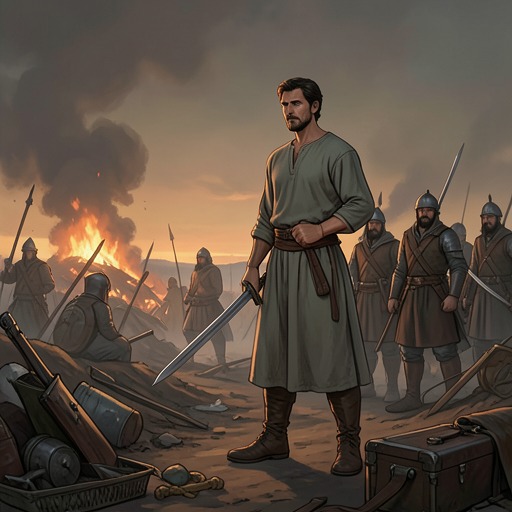
Liu Chen, the ruler’s son, is the sole forceful opponent of surrender. He condemns Qiao Zhou as a coward and argues that Shu still has Jiang Wei, who might fight his way through. His appeal is not simply to the possibility of another military success: he refuses to accept that the ruler should hand away his inheritance while any means of resistance remains.
The ruler rebukes Liu Chen as a shallow, warlike youth who would increase the bloodshed. When the prince insists that he will not live to see his patrimony surrendered, the ruler orders him out of the hall and proceeds with the surrender document. Their conflict sets two understandings of duty against one another. Liu Chen treats refusal and resistance as the only honorable response to dispossession; his father treats submission as the course that might preserve the people and protect the ancestral shrine.
Liu Chen cannot reconcile himself to the decision. After the envoys return from Deng Ai’s camp, the ruler sends instructions for Jiang Wei to surrender as well. Liu Chen takes up his sword and returns to the palace. When Lady Cui asks what has happened, he explains that he will not bow to Wei and intends to kill himself so that he can face Xuande in the afterlife. She asks to die first. Their exchange makes the political surrender intimate and irreversible: the lost kingdom is also a household and a lineage, and the prince answers its transfer with a final act of personal refusal.
The act of surrender
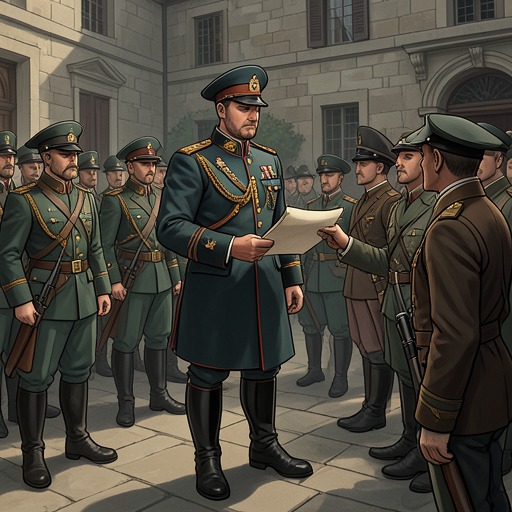
The surrender is made tangible when envoys arrive at Deng Ai’s camp carrying both the document and the seal of authority. They are treated well and return to report what has happened. The ruler then orders Jiang Wei to submit, extending the decision from the court to the remaining Shu command. The transfer is therefore not merely a declaration made in Chengdu: the written instrument and seal are handed over to the advancing Wei forces, and the order reaches the general still associated with continued resistance.
The surrender also reverses the political claim on which Shu Han was founded. After Cao Pi’s establishment of Wei, Kong Ming had argued that Xuande, as a descendant of the House of Liu, should take the throne and continue the Han lineage. Xuande initially recoiled from the proposal as rebellious; Kong Ming answered that Cao Pi had usurped the Han and that reclaiming rule was Xuande’s proper duty. That earlier appeal to lineage and restoration gives the later capitulation its particular weight: the state that claimed to continue the Han now yields its authority to Wei.
Wei’s entry and the end of the Han
Wei troops enter Chengdu in triumph. The people cheer and scatter flowers on the ground; the former Shu ruler is permitted to keep his palace, and the population is assured of good governance. Envoys go to Jiang Wei to secure his surrender, while messengers carry news of the victory to Chang’an. The account also notes that Deng Ai cannot prevent Huang Hao from escaping by bribing those around him, a surviving instance of personal escape amid the transfer of power.
The entry’s celebration and its final judgment stand in sharp contrast. The inhabitants’ relief and the assurance of orderly rule describe the immediate settlement, but the narration declares, “This is the end of the Han.” The loss is thus framed both as Shu Han’s political extinction and as the end of the larger dynastic inheritance that its rulers had claimed to preserve. Its conclusion gathers together the book’s competing grounds of legitimacy—Han descent, the will of Heaven, public welfare, and the right of conquest—without allowing the surviving symbols or claims to undo the fact of surrender.