Shu's invasion of Wu
The Romance of the Three KingdomsShu’s invasion of Wu begins as an act of dynastic and personal retribution: after Guan Yu’s death, Liu Bei declares that the oath sworn at the Peach Orchard obliges him to attack Sun Quan. The campaign pits that bond of sworn brotherhood against the argument that Cao Pi’s usurpation of the Han throne makes Wei the true public enemy. Liu Bei chooses revenge, raises a force said to number 750,000, and advances into Wu; his decision leaves the campaign framed from the outset by a conflict between private obligation, political legitimacy, and strategic risk.
Causes and competing obligations
The immediate cause is Guan Yu’s death and Liu Bei’s conviction that the brothers’ Peach Orchard oath requires vengeance. On the day after proclaiming himself emperor, Liu Bei announces that he will attack Sun Quan. Zhao Zilong objects that Cao Pi, having usurped the imperial throne, is the real enemy. In Zhao Zilong’s view, attacking Wu risks allowing Wei to strike while Shu’s forces are overextended. He distinguishes a personal grievance from a matter of public honor and duty.
Liu Bei rejects that distinction as decisive. He answers that the empire means little to him if he does not avenge his brother. His response makes the invasion more than a territorial campaign: it is an attempt to fulfill a sworn relationship, even when advisers argue that this commitment endangers the state. The narrative places the duty to Guan Yu beside the claim of loyalty to the Han, without allowing either obligation to erase the other.
The decision and mobilization
Liu Bei’s resolve draws Zhang Fei into the campaign. After Guan Yu’s death, Zhang Fei grieves and becomes volatile; his appointment as supreme commander for the revenge attack briefly steadies him. He travels from Langzhong to see Liu Bei, troubled that the court favors first attacking Wei. When Zhang Fei insists that he will go regardless of the cost, Liu Bei agrees to join him. The two plan to depart from their respective bases and meet at Jiangzhou, where their forces will combine.
Before they part, Liu Bei warns Zhang Fei about his conduct when drunk: beating men and then adding them to his personal escort, he cautions, could lead to disaster. He urges Zhang Fei to be more tolerant and compassionate. The warning exposes a practical danger inside the campaign’s most intimate alliance: the commander’s anger, sharpened by grief, threatens the discipline on which a large expedition depends.
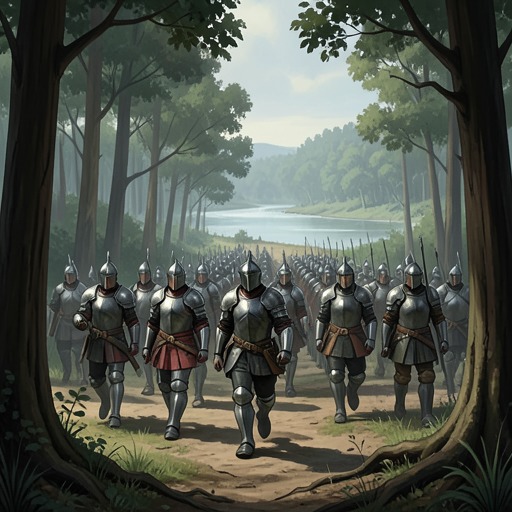
Despite protests from others, Liu Bei proceeds. In late summer of AD 221, he sets out with a combined force of 750,000 men. The scale of the mobilization gives material weight to his declaration of duty, while also making Zhao Zilong’s warning about the danger of an overstretched army newly consequential.
Zhang Fei’s death and the march
At Langzhong, Zhang Fei orders his troops to be ready within three days and directs them to wear white, the color of mourning. Fan Jiang and Zhang Da report that they cannot prepare in so little time. Zhang Fei responds with a severe threat and orders them punished. The episode shows how the campaign’s grief and urgency become military orders: mourning is made visible in the army’s clothing, while Zhang Fei’s haste and anger turn preparation into a crisis of command.
Fan Jiang and Zhang Da kill Zhang Fei and take his head to Sun Quan. His death deepens the invasion’s original grievance even as it deprives Liu Bei of one of the brothers whose oath he means to avenge. Liu Bei’s army continues toward Wu, and he instructs Guan Xing and Zhang Bao, the sons of Guan Yu and Zhang Fei, to treat one another as brothers and avenge their fathers together. The instruction attempts to carry the old sworn brotherhood into the next generation, making familial loyalty part of the advancing army’s cohesion.
Wu’s response and the strategic contest
Sun Quan faces the invading force after accepting the title of king from Cao Pi. His submission is intended in part to deflect Shu’s attack, but it does not prevent the campaign, and help from Wei does not arrive as the Shu army approaches. Wu’s officials are alarmed by the scale of the threat. Zhuge Jin goes to meet Liu Bei and argues that Sun Quan had previously sought alliance, that the attack on Guan Yu was Lü Meng’s independent action, and that Wu is prepared to restore Jingzhou so the two states can unite against Cao Pi. Liu Bei initially refuses to receive him, but Huang Quan persuades him to grant an audience. The appeal offers a political alternative to revenge, though the invasion is already under way.
Sun Quan appoints Lu Xun, a scholar rather than a celebrated warrior, to command Wu’s defense. Martial advisers mock the appointment, but Sun Quan gives Lu Xun full authority. Lu Xun refuses to be drawn into an early attack, even when officers urge him to rescue Sun Huan, who is trapped at Yiling. Liu Bei, meanwhile, establishes forty camps along a front extending hundreds of miles. He laughs at the appointment of a young commander, despite being reminded that Lu Xun had masterminded the capture of Jingzhou, and presses forward with revenge as his stated purpose.
Lu Xun continues to hold his forces back as the summer heat bears down and Shu’s supply lines stretch. He judges that fatigue and shortages will weaken the invading army. Liu Bei also recognizes the danger of the season and moves most of his troops into the woods, leaving ten thousand weaker soldiers on the plain and keeping eight thousand in reserve for an ambush. His plan is for the exposed troops to retreat if attacked, drawing Wu’s forces toward the concealed reserve. Ma Liang makes a map of the dispositions and sends it to Kong Ming, who is guarding against a possible Wei invasion from the east. The campaign thus develops from a declaration of vengeance into a contest over endurance, supply, concealment, and the choice of when to fight.
Significance and outcome in the campaign’s opening
The invasion makes the costs of conflicting loyalties visible before its military course is settled. Liu Bei treats revenge for Guan Yu as an obligation rooted in the Peach Orchard oath; Zhao Zilong treats war against Wei as the higher public duty; Zhuge Jin offers restoration of alliance as an alternative; and Sun Quan turns to Lu Xun’s patience rather than immediate aggression. These positions address not only whom to fight but what kind of obligation should govern the state.
The early campaign also overturns Liu Bei’s assumption that a young, scholarly commander will be easy to defeat. Lu Xun’s refusal to attack allows season, distance, and stretched supply lines to become weapons, while Liu Bei’s own deployment shows that he too understands the risks of terrain and exposure. The invasion’s opening therefore sets personal vengeance against the practical conditions of war: a vast army may express resolve, but its reach and numbers also make its dependence on supply, discipline, and timing harder to escape.