Sima Yi
The Romance of the Three KingdomsSima Yi is introduced through a succession of calculated judgments: he sees through Sun Quan’s attempt to redirect Xuande’s anger toward Cao Cao, anticipates Meng Da’s rebellion, and becomes the commander Wei recalls when its position is threatened. His career is defined by a hard contest with Kong Ming, in which neither side can rely on force alone; timing, intelligence, supply, and the interpretation of apparent retreats repeatedly decide what armies can accomplish. Yet Sima Yi is more than a battlefield opponent. His survival depends on recognizing danger inside the court as well as beyond its walls, and the later move against Cao Shuang shows that the strategist’s reach extends from military command to control of the state.
Strategic Judgment and Early Appearances
Sima Yi’s judgment is first made visible in the aftermath of Guan Yu’s death. Sun Quan sends Guan Yu’s head to Cao Cao as part of a scheme intended to make Xuande believe Cao Cao had ordered the killing, turning Shu’s likely response away from Wu. Sima Yi identifies the transfer as an effort to shift danger from the south onto Cao Cao. He explains that Xuande and his brothers had sworn to live and die together, so Sun Quan feared Xuande’s retribution and hoped to divert it northward.
Sima Yi proposes a countermeasure that redirects blame once more: Cao Cao should place Guan Yu’s head on a wooden body, grant him full military honours, and provide a formal burial. The ceremony would make Sun Quan, rather than Cao Cao, appear responsible, encouraging Xuande to attack Wu while Wei waited to exploit whichever side weakened. Cao Cao accepts the recommendation. When he opens the box and addresses the preserved head, its sudden movement frightens him; he then orders an especially grand ceremony. The episode places Sima Yi’s strategic calculation beside the story’s supernatural signs, but his counsel is practical and political: the handling of the dead can influence where the living direct their war.
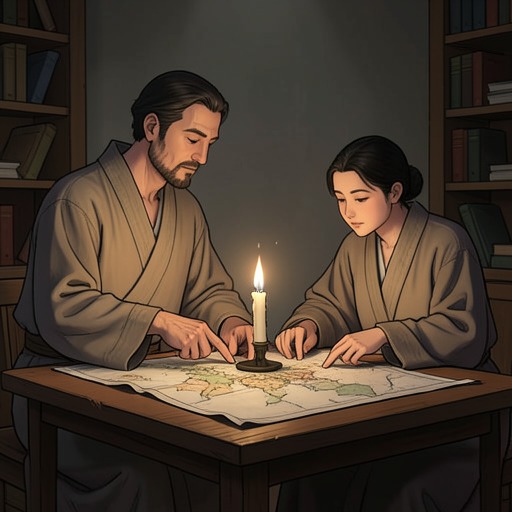
His capacity to read danger also appears in the account of Cao Cao’s final illness. As Cao Cao summons Cao Hong, Chen Qun, Jia Xu, and Sima Yi to discuss succession, he rejects their reassurances that he will recover and turns to the question of who can succeed him. He names his eldest son, Cao Pi, as the only son fit to take over, and asks those present to support him. Sima Yi is thus among the officials entrusted with the transition at the deathbed, before the later contest over Wei’s command and court becomes central to his story.
A Rivalry of Timing and Intelligence
After Xuande’s death, Cao Pi is eager to exploit the disruption in Shu and attack. Sima Yi argues for a five-army invasion, designed to make Kong Ming defend several fronts at once. The proposed forces would approach from different directions, including the east, the south, Wu, and the region near Hanzhong, with Cao Zhen’s regular army as the final prong. Cao Pi agrees, and messengers are sent. The plan shows Sima Yi thinking in terms of pressure distributed across a theatre of war: the objective is not simply to defeat one Shu army, but to stretch its commander until no single position can be adequately defended.
The campaign against Meng Da reveals the same preference for speed and deception. When Meng Da considers rebelling against Wei and taking Jincheng, Xincheng, and Shangyong before marching on Luoyang, Kong Ming warns him that Sima Yi will move too quickly for his preparations to succeed. Meng Da dismisses the warning, believing Sima Yi is too far away to act within a month. Sima Yi, however, does not wait for permission to respond. He sends Meng Da a message that presents him as still loyal to Wei and suggests that he is marching toward Chang’an, allowing Meng Da to believe the way is clear.
Sima Yi’s forces arrive before Meng Da is ready. Meng Da attacks Xu Huang at the gate, but the surrounding army closes in. When troops from Jincheng and Shangyong appear, Meng Da initially takes them for allies; they have in fact turned against him. The revolt ends in Meng Da’s defeat and death, while Sima Yi enters the city as a victor. Afterward he returns to Chang’an, where Cao Rui apologizes for having previously followed bad advice and demoted him. Sima Yi is restored to command and asks that Zhang He serve as his vanguard as they set out against Kong Ming.
The Jieting Setback and the Contest with Kong Ming
The campaign does not give Sima Yi an unbroken succession of victories. Kong Ming sends Ma Su to defend Jieting, with Wang Ping assigned to oversee him. Ma Su chooses a hilltop position despite Wang Ping’s advice to hold the main road. Sima Yi is encouraged by the news that the inexperienced Ma Su is in command, and his army cuts the Shu force off from water. The isolated troops begin to desert; Ma Su eventually attempts to fight his way out, but the losses and the fall of Jieting force the Shu army to withdraw. Sima Yi’s success follows from an opponent’s failure to follow sound defensive advice, not simply from the size of his force.
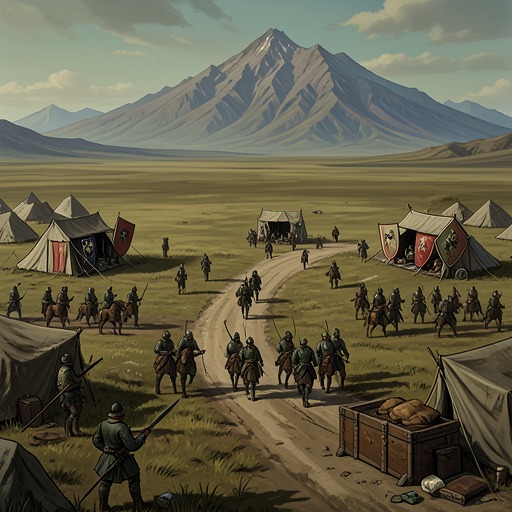
Kong Ming’s retreats and feints, however, prevent that advantage from settling the wider contest. On another occasion, Sima Yi asks the Wei ruler for a larger army to destroy the Shu force at Hanzhong after recognizing that Kong Ming has repeatedly outmaneuvered him. Later, when Kong Ming’s army appears to retreat, Wei commanders press Sima Yi to pursue. He holds back for three days while spies watch the Shu movement, suspecting a trap, but gives way to his commanders’ demand for action. Kong Ming has prepared further traps behind the apparent retreat, and the Wei army suffers a crushing defeat, including the loss of Sima Yi’s own camp. The episode makes caution both his strength and his predicament: he can identify danger, but the pressure of restless subordinates can push him toward the very attack he distrusts.
The conflict becomes more overtly theatrical when Kong Ming challenges Sima Yi through competing military formations. Kong Ming’s Eight Trigrams formation draws the Wei force into a maze and defeats it; he captures three leading commanders, then releases them with a message that Sima Yi should study military matters more carefully. He returns the officers’ weapons but sends the soldiers back in a humiliating state. Sima Yi responds by committing his whole force, only for Kong Ming to anticipate the assault and scatter the Wei army with a rear attack led by Guan Xing. The account says that six or seven out of every ten Wei soldiers die in the battle. Sima Yi withdraws to the south side of the Wei River and does not appear again in that episode.
Kong Ming’s repeated success does not erase Sima Yi’s capacity to learn or to contain losses. In a later confrontation, Sima Yi warns his commanders against treating courage and appetite for battle as substitutes for judgment. Their unauthorized ventures, he says, have cost many men and horses and left large stores of weapons in enemy hands; he threatens military punishment for disobedience. His response recasts the rivalry as a problem of command discipline as well as tactical skill. Against Kong Ming, reckless eagerness is not merely ineffective: it supplies the opponent with opportunities.
Court Politics and the Return to Command
Sima Yi’s position within Wei remains vulnerable even after military success. When Meng Da’s rebellion threatens Wei, Cao Rui restores him and gives him responsibility for the army and the defence of the state. Sima Yi’s swift victory earns him renewed trust, but that restoration follows a period in which the ruler had listened to advisers who recommended his demotion. His standing therefore depends not only on what he accomplishes in the field, but also on whether the court recognizes the value of his judgment in time.
The story’s larger political frame makes his military role consequential. The Three Kingdoms emerge as rival states from the breakdown of Han rule, while Xuande’s claim to rule is presented through his Han lineage, benevolence, and the language of Heaven’s will. Kong Ming urges Xuande to accept the throne by arguing that Cao Cao has accumulated power while the rightful ruler has been displaced. After Cao Pi receives the Han emperor’s abdication and founds Wei, officials in Chengdu urge Xuande to continue the Han line by becoming emperor himself. These claims frame the conflict in which Sima Yi serves: Wei and Shu are not only competing armies but rival political claims formed in the aftermath of the Han’s collapse.
The transfer of authority from Han to Wei is itself narrated through ritual and signs. In the abdication announcement, the emperor says that the Han era has ended and fortune has passed to the Cao family, invoking the precedent of Yao’s abdication. Cao Pi accepts the jade seal, but a violent storm disrupts his subsequent sacrifice to Heaven and Earth. This pattern of political argument accompanied by portents does not give Sima Yi a direct part in the ceremony in the supplied episodes; it does establish the contested legitimacy surrounding the regime whose armies he commands. His actions unfold in a world where military victory, court recognition, dynastic descent, and Heaven’s apparent favour all compete to define authority.
From Battlefield Rival to Court Power
Sima Yi’s final appearance in the supplied account shifts the focus decisively from war against Shu to conflict within Wei. When Cao Fang and Cao Shuang leave the capital to perform sacrifices at Cao Rui’s tomb, one official warns that the court will be exposed in their absence. Cao Shuang dismisses the concern, asking who would lead a revolt. The answer is Sima Yi. He summons his old comrades in arms and his two sons, then sets out against Cao Shuang.
The scene echoes the qualities that have marked his military career without presenting the outcome of this move. Sima Yi waits until the ruler and his leading minister are away, recognizes an opening others have discounted, and acts with a prepared group rather than relying on a public challenge. Earlier, the same habits let him move against Meng Da before the rebel could finish preparing; here, the target is not an enemy commander in a distant city but the political order at the centre of Wei. The account ends as Sima Yi begins the operation, leaving the immediate result beyond the supplied evidence.
Sima Yi’s narrative role therefore rests on a double tension. He is repeatedly measured against Kong Ming, whose deceptions and formations can turn Sima Yi’s caution into hesitation or his commanders’ impatience into defeat. At the same time, Sima Yi remains a formidable reader of opportunity, able to recover power after court disgrace and to strike before an adversary is ready. His final move suggests that the skills used to contest territory may also remake the command structure at home; the story presents the opening of that political action, but not its conclusion.