Sun Ce
The Romance of the Three KingdomsSun Ce is the military leader whose rapid southern conquests help establish one of the three kingdoms emerging from the collapse of Han China. Son of Sun Jian, he transforms a contingent borrowed from Yuan Shu into an independent base of power, expands through victories and alliances, and leaves the south to his younger brother Sun Quan. His ascent is marked by forceful action and concern for the people under his army’s control; his early death, following a revenge attack and a series of supernatural encounters, turns that ascent into a story of both political succession and personal consequence.
Identity and Rise
Sun Ce enters the story as Sun Jian’s eldest son, asking to accompany his father on the campaign against Liu Biao. Sun Jian agrees, and Sun Ce joins the war. After Sun Jian is killed, his body is held in the city, and an envoy negotiates its return in exchange for the release of Huang Zu and the withdrawal of the invading troops. The death leaves Sun Ce with the loss of his father and a continuing desire to avenge him.
Years later, Sun Ce is a rising leader in his own right, but still dependent on the troops he originally received from Yuan Shu. At a celebration hosted by Yuan Shu, whose praise of him does not prevent Sun Ce from feeling patronized, he is encouraged by Zhu Zhi and Lü Fan to assert his independence. Sun Ce then persuades Yuan Shu to lend him three thousand soldiers and five hundred cavalry, presenting the Imperial Seal as a token of trust. He explains that he needs the force both to avenge his father and to protect his mother and family, then departs with the troops while leaving the seal behind.
The arrangement is politically useful but unstable. Yuan Shu wants the seal and accepts it while pretending to regard it as unimportant; Sun Ce, meanwhile, uses the loan to set out on a path of conquest. When he later strengthens his position, he asks Yuan Shu to return the seal. Yuan Shu refuses, resenting Sun Ce’s independence and believing that Sun Ce owes him for the original assistance. Their conflict makes the seal more than collateral: it becomes a sign of the unresolved power struggle between patron and former dependent.
Conquest and Government in the South
Sun Ce’s campaign gathers force through both military success and personal trust. When Taishi Ci is captured, Sun Ce receives him as a hero rather than treating him merely as a defeated enemy. Taishi Ci is moved by this reception and offers to bring over Liu Yao’s demoralized, divided troops. Sun Ce trusts him, and Taishi Ci recruits thousands of men to join Sun Ce’s army. The episode shows how Sun Ce’s expansion can turn a battlefield opponent into a source of new strength.
As the army moves south, its conduct helps secure local support. People initially fear the advancing troops, but see that the soldiers do not steal from them or harm ordinary people. In response, residents bring food and drink to the camp. The account sets this popular welcome against the disorder of the conspirators, bandits, and other armed groups competing to seize territory. Sun Ce answers those challengers with swift military action, with Taishi Ci assisting him, and captures cities including Jiaxing, Wucheng, and Wujun.
The defense of Xuancheng brings Sun Ce’s family and command responsibilities into sharper focus. His brother Sun Quan and Sun Quan’s companion Zhou Tai are attacked at night by mountain robbers. Zhou Tai, caught unprepared, fights and rescues Sun Quan, but is left gravely wounded. Sun Ce seeks a skilled physician for him and summons Hua Tuo, whose medicines restore Zhou Tai within a month. Angry at the attack, Sun Ce then campaigns against the robbers and eliminates them. He follows this victory by consolidating his hold on important places and reporting his successes to the court.
Power, Rivalry, and Succession
By the time of the events leading to his death, Sun Ce rules the south and is strong enough to concern Cao Cao. Cao Cao judges that direct confrontation would be unwise and seeks to bind Sun Ce to him through a marriage between Cao Ren’s daughter and Sun Ce’s brother Sun Kuang. The proposed family tie is a political response to Sun Ce’s growing power, not a resolution of the rivalry.
That rivalry sharpens after Sun Ce petitions the emperor for a high-ranking post and Cao Cao refuses. Sun Ce threatens to attack the capital. Xu Gong, one of Sun Ce’s governors, secretly warns Cao Cao of the danger, but the messenger carrying the letter is captured. Sun Ce executes the messenger and then orders Xu Gong’s death. The episode creates the conditions for revenge: Xu Gong’s loyal followers later attack Sun Ce while he is hunting.
Sun Ce fights back after the attack, but is seriously wounded before his men reach him. A healer’s disciple tells him that the poisoned wound requires a hundred days of rest. Sun Ce manages twenty days before news that Cao Cao’s adviser Guo Jia has dismissed him as foolish, poorly prepared, and lacking foresight provokes him to resume plans for a campaign against the capital. His response makes his impatience consequential: despite the warning about his wound, he rises from his rest and turns again toward action.
Yu Ji and the Turning Point
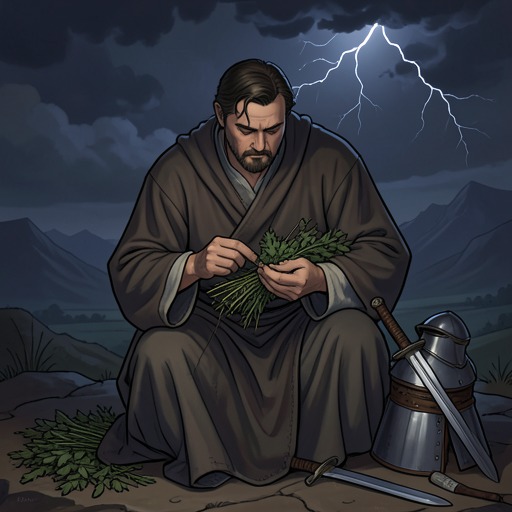
Sun Ce’s confrontation with Yu Ji gives the account of his final decline a supernatural dimension. At Yu Ji’s trial, Yu Ji says that he will summon rain for the benefit of the people, while also saying that he believes his own time has come. Sun Ce orders him burned if he fails. Before noon, rain arrives in such abundance that water reaches three feet, and Yu Ji calls for it to stop. The assembled people respond with awe, but Sun Ce dismisses the event as coincidence and orders Yu Ji beheaded. He also orders the body left in the marketplace as a warning.
The next morning, after a stormy night, the body has disappeared, and Sun Ce sees Yu Ji walking in front of the main hall. His mother urges him to repent, but he refuses to accept her interpretation of the events. He eventually agrees to visit a temple and burn incense, though he will not pray. There Yu Ji appears in the incense smoke and again at the gate. Sun Ce throws his sword at the apparition, but it strikes and kills the soldier who had beheaded Yu Ji. Sun Ce then orders the temple burned; the spirit appears amid the flames, and the repeated encounters leave him terrified. When he looks in a mirror, he sees Yu Ji’s face instead of his own, collapses, and finds that his earlier wounds have reopened.
The narrative links this collapse to Sun Ce’s earlier choices without making the supernatural episode a political victory for any rival. The man who repeatedly met danger by acting quickly cannot recover from the wound once his confidence and his health give way together. His mother’s appeal, his refusal to pray, the execution, and the continued appearances form a chain that culminates in his recognition that he is dying.
Death and Narrative Significance
Knowing that death is near, Sun Ce calls for Zhang Zhao and Sun Quan and transfers the seal of office to his younger brother, naming him as heir. He gives his family a practical division of responsibility: his mother and Sun Quan are to consult Zhang Zhao about internal matters, while Zhou Yu is to be asked about external affairs. Zhou Yu is not present when Sun Ce makes these arrangements. Having set his affairs in order, Sun Ce dies at twenty-six.
His death shifts the south’s leadership to Sun Quan and makes Sun Ce’s own rise part of a larger dynastic transition. The story presents him as the founder of a regional power built from military expansion, recruited allegiance, and popular support, but also as a ruler whose power does not protect him from revenge or death. His epithet, “Little Ruler,” is recalled after his passing; the contrast between that title and his brief life gives his political achievement an abrupt, unfinished quality. He leaves behind not an empire personally consolidated to its end, but an established southern base and a brother prepared to inherit its authority.