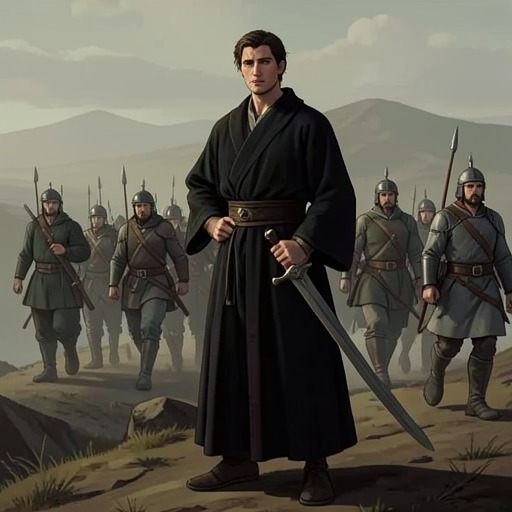
Sun Ce's Conquest of Jiangdong
The Romance of the Three KingdomsSun Ce’s Conquest of Jiangdong turns a campaign for revenge and family security into the foundation of a new regional power. Sun Ce advances against Liu Yao, meets Taishi Ci in a celebrated duel, and then makes the captured warrior an ally whose influence helps convert an enemy army into reinforcements. As Sun Ce’s forces move south, their battlefield successes are accompanied by a reputation for leaving ordinary people unharmed, giving the campaign both military momentum and local support.
Background and advance against Liu Yao
The campaign begins amid Sun Ce’s concern for his family, who are under Liu Yao’s control, and his determination to avenge his father’s murder. Liu Yao, an imperial kinsman and prefect, hears that Sun Ce is marching with an army and prepares to defend himself. He sends troops to guard the river crossing at Niuzhu, but they are defeated with heavy losses, allowing Sun Ce to advance and confront Liu Yao’s main force.
Liu Yao’s response to the danger is shaped by suspicion as well as military caution. When Sun Ce appears exposed near the opposing camp, Liu Yao interprets the approach as a possible lure, reasoning that Sun Ce may be trying to draw his soldiers into an ambush. Taishi Ci, however, is eager to fight and disregards Liu Yao’s pleas to hold back. The contrast sets up a campaign in which bold action and the reading of an opponent’s intentions repeatedly determine what happens next.
The duel and Taishi Ci’s change of allegiance
Taishi Ci rides out with only one other, comparatively minor commander to challenge Sun Ce. The two fight for fifty rounds without either gaining the advantage. Taishi Ci then pretends to flee and draws Sun Ce away from his twelve guards; the fight resumes with increasing desperation, and both men are eventually knocked from their horses. They continue struggling on the ground until soldiers from both sides arrive and separate them. The encounter leaves their rivalry personal as well as military, but neither is able to claim a decisive victory.
Their relationship changes after Taishi Ci is captured during the fighting between the armies and brought before Sun Ce. Instead of treating him merely as a defeated opponent, Sun Ce greets him as a true hero and asks whether Taishi Ci would have killed him had he won their earlier encounter. Taishi Ci answers that he does not know. Sun Ce laughs and invites him to dine. The exchange gives respect, rather than force alone, a central place in the change of sides: moved by Sun Ce’s treatment, Taishi Ci offers to bring over Liu Yao’s disheartened and divided troops.
Sun Ce accepts the offer and entrusts Taishi Ci with the task. Taishi Ci then recruits thousands of the opposing soldiers to join Sun Ce. The episode transforms an individual duel into a strategic gain: a former adversary’s standing among Liu Yao’s troops becomes a means of enlarging Sun Ce’s force and weakening the opposition from within.
Conquest and the conduct of Sun Ce’s army
As Sun Ce’s army moves across the river into the south, its arrival initially spreads panic and disorder. That first impression changes when local people observe that the soldiers do not steal from them or harm ordinary inhabitants. The people respond by bringing food and drink to the camp. Their support gives the advancing army provisions and illustrates how restraint toward civilians can turn a frightening military presence into a force that local communities are willing to sustain.
Farther south, Sun Ce faces conspirators, thugs, rebels, and bandits seeking to exploit the campaign to seize territory for themselves. His response is consistently swift and severe, and the army wins battle after battle, with Taishi Ci now assisting him. Among the captured cities are Jiaxing, Wucheng, and Wujun. The victories extend Sun Ce’s hold over strategically important places while distinguishing his organized campaign from the competing armed groups attempting to appropriate its gains.
Defense of Sun Quan and consolidation
While Sun Ce is campaigning, his brother Sun Quan and their companion Zhou Tai are guarding Xuancheng. Robbers based in the mountains launch a sudden nighttime attack. Zhou Tai is caught unprepared but fights with exceptional courage and helps rescue Sun Quan. Badly wounded, he is brought to Sun Ce’s camp, where Sun Ce shows deep concern for his recovery and seeks the best available physician. Hua Tuo is recommended, examines Zhou Tai, and treats him with herbal remedies and medicines; Zhou Tai recovers within a month.
The attack on Sun Quan and Zhou Tai prompts a new phase of the campaign. Enraged, Sun Ce launches a swift operation that destroys the mountain robbers. He then strengthens his hold on key places, reports his successes to the imperial court, makes contact with Cao Cao, and demands that Yuan Shu return the imperial seal. The campaign therefore ends not only with territorial expansion but with Sun Ce consolidating his position and addressing the political and military arrangements surrounding his rise.
Political and narrative significance
The campaign makes Sun Ce’s power legible through a sequence of connected gains: defeating Liu Yao’s forces, turning Taishi Ci into a trusted ally, winning support through disciplined conduct, and suppressing rival armed groups. Its decisive reversal is the conversion of a bitter feud into cooperation. The former opponents’ respect for one another produces a concrete military consequence when Taishi Ci brings thousands of soldiers to Sun Ce’s side.
The narrative also places local rule and imperial politics alongside battlefield action. Sun Ce’s concern for his family helps motivate his advance, the people’s response to his army supplies evidence of its conduct, and his later communication with the court and demand for the seal show the campaign’s reach beyond the captured cities. Taken together, these developments establish Sun Ce as more than a successful commander: he is building a durable base of power through both force and the allegiance his actions secure.