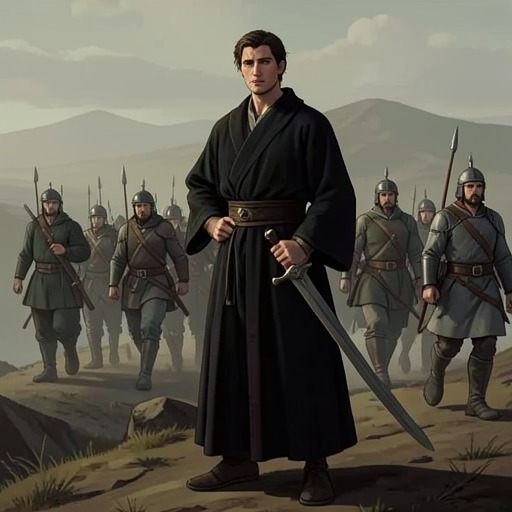
Sun Jian's Jingzhou Campaign and Death
The Romance of the Three KingdomsSun Jian's Jingzhou Campaign and Death is the reversal that ends Sun Jian’s rise as a battlefield leader: after overcoming Liu Biao’s river defenses and laying siege to Xiangyang, he is killed in an ambush at thirty-seven. His death turns a campaign of apparent momentum into a struggle over the return of his body and the withdrawal of his forces, while placing Sun Ce at the head of the family’s military future.
Causes and Objectives
The campaign grows from a failed attempt by Yuan Shu to obtain horses and grain. His brother, Yuan Shao, has ordered that he receive no assistance, and Liu Biao also refuses his requests. Frustrated, Yuan Shu proposes cooperation to Sun Jian: Sun Jian will take Jingzhou, while Yuan Shu moves against Jizhou. Their agreement gives Sun Jian a political opening as well as a military objective, but it also binds his expedition to the rivalry between the brothers and the existing enmity between Sun Jian and Liu Biao.
When word of the plan reaches Liu Biao, he prepares to defend his territory, relying on the Yellow River as a natural barrier. Sun Ce, Sun Jian’s eldest son, asks to accompany the expedition. His request is accepted, and the campaign becomes his first entry into war alongside his father.
Crossing the River and Siege of Xiangyang
Huang Zu, Liu Biao’s frontline general, stations archers along the river. For three days, Sun Jian’s boats approach under a hail of arrows, while the soldiers shelter behind their shields rather than returning fire. They recover arrows lodged in the shields and boats; on the fourth day, when Huang Zu’s archers have exhausted their supply, Sun Jian’s men fire back with the collected ammunition. They land and engage Huang Zu’s troops, who cannot hold against the advance. Huang Zu panics, abandons his horse and helmet, and escapes by hiding among ordinary soldiers.
Sun Jian’s victory carries his control as far as the Han River. Huang Zu retreats to Liu Biao and advises that their forces cannot stop the advance. Sun Jian then lays siege to Xiangyang, appearing to have the momentum to press deeper into Liu Biao’s territory. The river crossing has shown how patience and the enemy’s depleted resources can turn a defensive advantage against its owner; the siege, however, brings the campaign to a halt through an unexpected ambush rather than a direct reversal on the battlefield.
Portents and the Ambush
Before the fatal encounter, the narrative marks the siege with two signs. A storm snaps the pole of Sun Jian’s banner, which is treated as an ill omen. Inside Xiangyang, Liu Biao hears that a star has fallen behind the enemy lines, a portent interpreted as predicting the death of a great general—Sun Jian. The signs frame the coming loss as more than a tactical misfortune, though the immediate cause is a deliberately prepared trap.
Liu Biao’s side agrees to send a letter urging Yuan Shao to join in eliminating Sun Jian. Lü Gong volunteers to carry it and receives five hundred soldiers to help him escape. He is also instructed to use them to ambush pursuers on a nearby hill: his men are to pile up stones and, if the ambush succeeds, signal the besieged army to come out and attack. If he gets away, he is to continue to Yuan Shao with the letter.
At night, the east gate opens quietly and Lü Gong slips out with his force. Sun Jian detects the movement and pursues with only thirty horsemen. He rides directly into the prepared ambush; stones strike him, and one kills him. The scale of his pursuit—thirty riders against a force positioned to attack from above—sets the campaign’s decisive reversal in stark contrast to the careful river strategy that had earlier secured his advance.
Death, Negotiation, and Withdrawal
Sun Jian is thirty-seven. His thirty companions are all killed as well. Lü Gong signals the city, and Liu Biao’s troops pour out. The ensuing battle shifts back and forth; Lü Gong is killed, Huang Zu is captured and taken to the besiegers’ camp, and by daybreak both sides withdraw. Sun Jian’s death has not produced an immediate, uncomplicated victory for either side: the fight leaves Liu Biao’s general in enemy hands, but Sun Jian’s army has lost its commander and must secure his body.
Sun Ce learns that his father has been killed and that his body has been captured inside Xiangyang. Huan Jie is chosen as envoy to negotiate with Liu Biao, offering Huang Zu’s return in exchange for Sun Jian’s body. Liu Biao agrees, but makes the exchange conditional on the invading troops withdrawing and promising never to attack again. As the envoy prepares to return, one of Liu Biao’s advisers argues for killing him, believing that this would allow Liu Biao’s forces to destroy their enemy. The account thus places the negotiated settlement under immediate pressure from a proposal to abandon it, but the recorded condition is the withdrawal and pledge.
Significance
The campaign’s arc runs from a pact formed out of Yuan Shu’s frustrated ambitions, through a resourceful victory over Huang Zu, to the death of Sun Jian at the walls of Xiangyang. Its central reversal is not a loss of territory described in battle, but the removal of the commander whose successes had carried his troops across the river and to the city. The omens anticipate that reversal, while the ambush supplies its concrete mechanism.
Sun Jian’s death also changes the position of the next generation. Sun Ce is present when the expedition begins and becomes the person who must respond when his father’s body is held by Liu Biao. The exchange negotiation makes succession a matter of immediate military and political consequence: recovering the body requires accepting withdrawal and a promise not to renew the attack. In the larger account of the Three Kingdoms, Sun Jian is one of the three leaders whose fortunes contribute to the emergence of separate kingdoms; here, that later significance is grounded in a campaign that ends not with the expected capture of Xiangyang, but with his death and the transfer of responsibility to his son.