The ruin of Luoyang
The Romance of the Three KingdomsThe ruin of Luoyang is the capital left devastated when Dong Zhuo ordered its destruction and moved the court west. Palaces and ancestral shrines were burned, imperial tombs were opened, and the people were forced from their homes; when the emperor later returned, the city offered neither a functioning seat of government nor adequate food. Luoyang’s transformation from imperial center into a landscape of ruins makes the collapse of Han authority concrete: power has moved, but its former home remains as evidence of what that movement cost.
Destruction and Displacement
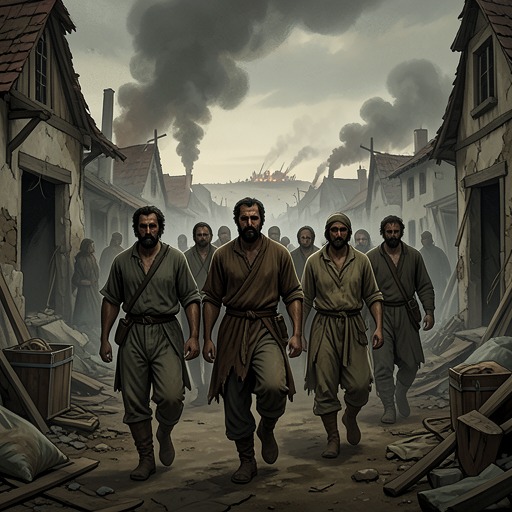
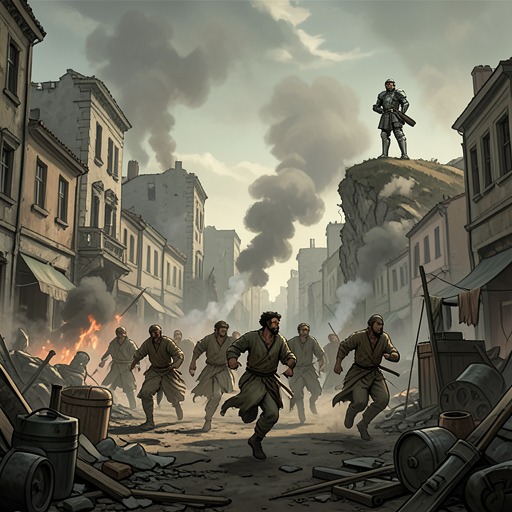
The ruin began as part of Dong Zhuo’s withdrawal from Luoyang. A proposal to seize the wealth of people associated with Yuan Shao led to an assault by five thousand troops: thousands of nobles, merchants, and members of their families were killed, and the rest of the city’s inhabitants were driven on the long march toward Chang’an. Many died along the way. The displacement was not incidental to the destruction of the capital; it was one of its means and consequences, as the city’s population was forcibly removed while soldiers looted and abused those they encountered.
Before leaving, Dong Zhuo ordered the whole city burned, including its palaces and ancestral shrines. The imperial tombs were broken open, and the treasures of emperors and empresses scattered; soldiers also entered the tombs of the wealthy and noble. The order therefore reached beyond the buildings required for ordinary life. It attacked the dynastic past embodied in the city’s ceremonial and funerary sites, turning the seat of imperial rule into a place where both civic structures and inherited symbols of authority had been violated.
When Xuande and his brothers-in-arms broke through the pass and Sun Jian rode toward Luoyang, the ruin was registered through absence: for hundreds of miles they saw desecration, with no animals or people to be seen or heard. This encounter makes the city and its approaches a measure of the withdrawal’s reach. The capital’s emptiness is not presented as a simple consequence of battle; it follows the destruction, forced migration, and pillage that had stripped the region of its ordinary inhabitants.
The Emperor’s Return to an Uninhabitable Capital
The emperor eventually returned to Luoyang after the court’s dangerous flight and the defeat of the White Wave forces. The city he found was no longer a functioning capital. Palaces and halls had been burned down; weeds covered the streets, brambles spread over the ruins, and collapsed roofs and crumbling walls marked what remained of the courtly buildings. Only one building was partly intact. The emperor lived there, while the court held its meetings among the overgrown remains around it. The distinction between residence and government had become almost nominal: court ritual continued, but without the architecture that had once given it a setting.
The physical damage was accompanied by famine. The few hundred families still in Luoyang survived on bark and roots, and some people lay down beside the ruins of their homes and died. The capital’s return to imperial hands did not restore its capacity to support either a court or a population. Its surviving residents faced privation, while the ruler’s presence in the one partly standing building could not reverse the devastation surrounding him.
The story makes this scarcity part of the political crisis, rather than treating the city’s ruined appearance as background alone. With the emperor back in Luoyang but exposed to danger, Yang Biao proposed summoning Cao Cao because he commanded the strongest army. Before Cao Cao could reach the capital, rumors that Li Jue and Guo Si were advancing caused the court to set out again. The emperor returned to the palace when Cao Cao’s troops appeared, and Cao Cao’s forces soon routed the rebels. The episode leaves the ruined city caught between threatened flight and renewed military protection: its imperial status persists, but its security depends on whoever can bring armed power to it.
Political and Narrative Significance
The ruin of Luoyang gives the novel’s account of Han collapse a visible center. Its destruction accompanies the relocation of power to Chang’an, while the emperor’s later return exposes the gap between recovering the old capital and restoring the government it once housed. Burned halls, an overgrown court, and widespread hunger turn political breakdown into an everyday condition for the people who remain. The city’s fate also shows that a change in the court’s location is not a clean transfer: inhabitants are displaced, communal and dynastic sites are destroyed, and the surviving population bears the consequences long after the army has moved on.
The book’s framing places this devastation within a story whose historical events form a basis for a later epic retelling, shaped by oral storytelling, drama, poetry, and a novelist whose identity remains debated. In that larger account, Luoyang’s ruin is more than a stage for military action. It helps make the collapse of the Han dynasty legible as both a contest for power and a disaster imposed on ordinary people. The image of an emperor meeting among overgrown ruins sharpens that contrast: the court remains, but the material world that once sustained its authority has been reduced to fragments.