Tianming
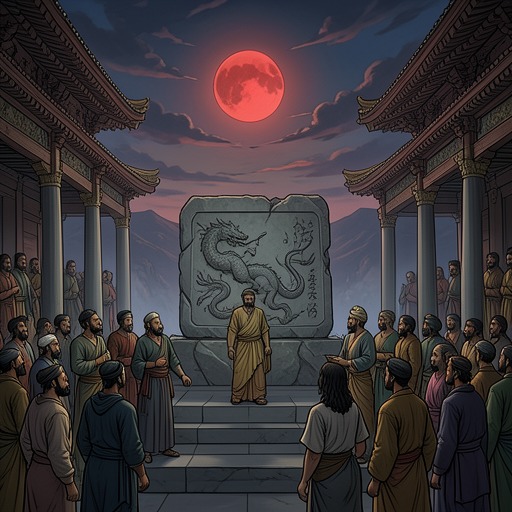
The Romance of the Three KingdomsThe Mandate of Heaven is the novel’s contested principle of political legitimacy: rulers and their advisers invoke Heaven to explain dynastic change, authorize action, or challenge a rival’s right to rule. Its signs are not self-interpreting. A lost imperial seal, a storm at a funeral, a prophecy, and an abdication ceremony each acquire political meaning through the people who interpret them—and their meanings may affirm or unsettle the authority they are meant to support.
Legitimacy and dynastic change
The account of the Three Kingdoms begins with the Han’s weakening and the emergence of three leaders who carve kingdoms from its declining empire: Xuande, Cao Cao, and Sun Quan. In that setting, the Mandate supplies a language for explaining why rule passes from one house to another. But the principle does not simply make victory equivalent to rightful rule. It is entangled with rival claims about dynastic descent, virtuous conduct, popular welfare, and control of the imperial court.
When Dong Zhuo proposes to depose the young Emperor Shao and enthrone Prince Xie, he presents the decision as a matter of the emperor’s fitness to meet the responsibilities inherited from his ancestors. The court proclamation contrasts the former emperor’s supposed lack of gravitas with Xie’s virtue and wisdom, and invokes distress in Heaven and Earth as evidence that the change is warranted. The claim converts a seizure of power into a judgment about the dynasty’s moral and cosmic condition. Yet the move is enforced by Dong Zhuo’s military dominance: one opponent is killed, the former emperor and his family are confined, and the nine-year-old Xian takes the throne while Dong Zhuo becomes prime minister. The language of heavenly and ancestral legitimacy accompanies coercive political change rather than preventing it.
The seal as an inherited sign
The imperial seal gives the Mandate a tangible form. After Dong Zhuo’s departure has left Luoyang devastated, Sun Jian orders the fires extinguished, the palaces cleared, the imperial tombs sealed, and offerings made to the ancestors. As he mourns the ruined capital and the dimming imperial star, a soldier draws attention to lights coming from a well. There Sun Jian’s men find a woman’s body with an embroidered pouch; inside are a small box and a jade seal carved with five intertwined dragons. One corner is broken and repaired with gold, and its inscription declares, “Receive the Mandate of Heaven: now you will have long life and eternal prosperity.”
Cheng Pu identifies it as the emperors’ seal and recounts its passage through earlier rulers and upheavals. His account traces the jade from an ancient discovery and imperial carving through the founding of the Han, the turmoil associated with Wang Mang, and its disappearance during the crisis of the Ten Imperial Attendants. Because the seal has reappeared in Sun Jian’s possession, Cheng Pu interprets the discovery as evidence that Sun Jian is destined to rule and urges him to leave the north and prepare for kingship in the southeast.
Sun Jian agrees to conceal his discovery and depart with his army. But the seal’s symbolic promise immediately creates political risk: Yuan Shao has heard of it and confronts him, explicitly treating Sun Jian’s claim of illness as a cover for possessing the treasure. Sun Jian refuses to acknowledge finding the seal and rides away with his forces. The episode makes possession of the imperial object consequential without showing it automatically conferring rule. It can suggest Heaven’s favor, but it also provokes suspicion and conflict among human claimants.
Omens, ambition, and political interpretation
The Mandate is repeatedly asserted through signs whose meaning depends on interpretation. At a banquet, Wang Yun speaks to Dong Zhuo about those who lose virtue being succeeded by those guided by virtue. Dong Zhuo receives the suggestion that Heaven might grant him the Mandate as grounds for thinking that he could become emperor. Wang Yun’s apparent recognition of that prospect is part of a plan against him, not neutral confirmation of his legitimacy. The episode shows how the vocabulary of Heaven can flatter ambition while also serving a political scheme.
A similar gap between appearance and knowledge shapes Dong Zhuo’s response to a forged decree. Li Su tells him that the emperor, recovered from illness, intends to discuss abdication in Dong Zhuo’s favor. Dong Zhuo links this news to a dream in which a dragon coils around him and sets out to accept what he understands as an auspicious opening. His mother instead regards her persistent ill feeling as a bad omen and warns him. The contrast is pointed: the same political prospect is welcomed by Dong Zhuo as confirmation and met by his mother with apprehension. Neither the dream nor the warning, by itself, settles the question of rightful rule.
After Dong Zhuo’s death, the attempt to bury him becomes another scene in which natural events receive political meaning. Li Jue and Guo Si seek control of the court and have Dong Zhuo buried at Meiwu with imperial rites, using a wooden effigy because so little of his body remains. Each of three burial attempts is disrupted by a thunderstorm and flood, which washes the coffin out of the ground; lightning and water leave nothing of him. The narrative interprets these repeated failures as Heaven’s anger. Unlike a claimant’s convenient prediction, the burial sequence presents the signs as a judgment on the deceased ruler, linking the disorder of nature to the violence of his rule.
Prophetic language also frames Xuande’s prospective rise. When Zhang Ren and his companions visit a mountain sage, they are initially ignored; the sage eventually writes eight lines beginning with the images of dragon and phoenix and their flight toward the western rivers. In a later political argument, Kong Ming tells Xuande that Cao Cao holds the emperor and the allegiance of many nobles, while Sun Quan’s family has ruled the south for three generations and enjoys popular support. He identifies Jingzhou as the place where the future will be decided and says Heaven has decreed it for Xuande. These are not identical kinds of claim: the sage’s enigmatic writing presents a prophecy, whereas Kong Ming turns a strategic assessment into an argument about Heaven’s will.
Abdication and the disputed transfer of power
The transfer from Han to Wei brings the Mandate’s competing justifications into the open. When Cao Pi’s advisers press the Han emperor to abdicate, astrologers interpret auspicious signs as proof that Heaven has withdrawn its mandate from the Han and given it to Wei. The emperor rejects their reading. Wang Lang then argues that every dynasty and ruling family eventually declines and presses the emperor to yield rather than resist. The exchange places portent, dynastic history, and political pressure beside one another: the decision is presented as cosmically ordained, yet it is also obtained through a court controlled by Cao Pi’s side.
The abdication announcement declares that the Han’s era has ended and fortune has moved to the Cao family. It appeals to signs from Heaven, the people’s wishes, Cao Cao’s military victories, and Cao Pi’s virtue; it also invokes the precedent of Yao, who did not favor his own son, as a model for transferring the empire beyond one’s family. Sima Yi advises Cao Pi first to refuse the throne and later to refuse again, staging acceptance as reluctance rather than seizure. At the Altar of Abdication, the emperor hands over the jade seal of authority before officials and soldiers, and Cao Pi begins his reign as emperor of Wei. The ritual gives the transfer public and dynastic form, but the narrative’s account of managed refusals makes clear that the ceremony is also carefully arranged.
The signs do not simply endorse the new regime. As Cao Pi begins the customary worship of Heaven and Earth, a violent storm scatters dust and stones, darkens the sky, and overturns the altar’s lanterns. He collapses and is carried away; afterward, he remains unable to act for several days and never fully recovers, believing the palace haunted and ordering a new one at Luoyang. The storm arrives at the moment when the new emperor performs a rite of heavenly recognition, sharply complicating the legitimacy asserted by the abdication. The transfer is legally and ceremonially complete, but the omen leaves its cosmic approval unsettled.
A claim renewed in the Han’s name
News of the Wei dynasty and rumors about the former emperor’s fate reach Xuande in Chengdu. As the reports make him unwell, Kong Ming takes over day-to-day administration and proposes that Xuande be crowned emperor in order to oppose Wei’s new ruler and continue the Han line. His argument combines descent from the founder of the Han with a political duty to reclaim authority from Cao Pi, whom he describes as having usurped the throne. Xuande is horrified at first, treating the proposal as rebellion and disloyalty; Kong Ming insists that accepting the title would instead fulfill Xuande’s obligation to the Liu house.
Earlier, when Kong Ming urges Xuande to become emperor after the victories in Hanzhong, he frames the decision differently but consistently: Xuande’s benevolence has brought peace to the region, he controls Shu, and the Will of Heaven and the people now favor his elevation. Xuande worries that, despite his Han lineage, he would be seen as a rebel. Kong Ming answers that a country divided among adventurers needs a true emperor and that refusing the title could cost Xuande popular support. In both arguments, hereditary connection alone is not enough: Kong Ming joins it to public benefit and the restoration of political order.
The Mandate therefore remains a contested standard rather than a single, settled verdict. Dong Zhuo’s deposition of an emperor, Sun Jian’s possession of the seal, the storm-washed burial at Meiwu, and the Han-to-Wei abdication all place signs and rituals beside acts of force. Xuande’s rival claim adds Han descent, benevolent rule, and popular welfare to the case for legitimate authority. Across these episodes, Heaven’s will is politically powerful precisely because people must interpret it, and those interpretations can authorize a transfer of power even as other signs expose its instability.