Tiger Cage Pass
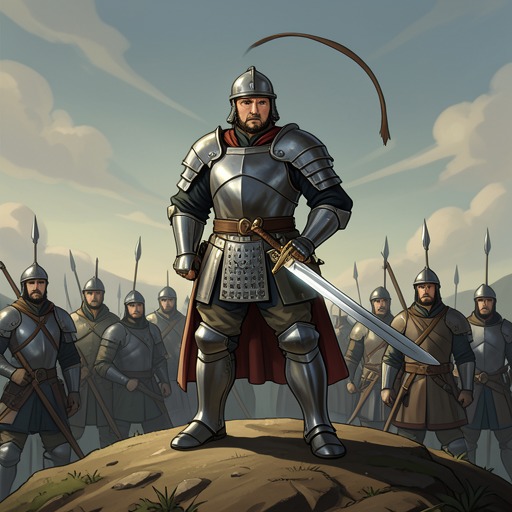
The Romance of the Three KingdomsTiger Cage Pass is the fortified gateway between the coalition forces and Dong Zhuo’s position near the capital. In the early campaign against the tyrant, it gives the conflict a decisive physical focus: armies converge on the pass, Lü Bu contests the approach, and Xuande, Guan Yu, and Zhang Fei turn a challenge between champions into an attack aimed at Dong Zhuo himself. The pass is not merely a backdrop; its defenses determine who can advance, and its capture marks the coalition’s battlefield success without ending the larger political struggle.
Strategic Setting
Dong Zhuo sends two hundred thousand troops against the forces led by Yuan Shao, both to confront the coalition and to guard Tiger Cage Pass, about fifty miles from Luoyang. The scale of the deployment makes the pass a defensive barrier as well as a route toward the capital. Whoever can force the approach may threaten Dong Zhuo’s position, but the defenders can use the terrain and fortifications to halt an advance.
The campaign unfolds amid a struggle over the collapsing Han order. Cao Cao later describes the northern warlord Cao Cao as a powerful opponent who commands a vast army and controls the emperor; Kong Ming’s assessment places him beyond Xuande’s direct reach. That wider contest gives the pass an early, specific importance: it is one of the first places where resistance to Dong Zhuo takes organized military form, before the competing forces and claims to rule develop further.
The Contest at the Pass
Dong Zhuo’s chief warrior, Lü Bu, rides out before the pass to challenge the coalition. His elaborate equipment and celebrated horse Red Hare signal the formidable role he occupies in the fighting. One challenger after another is defeated; Gongsun Zan survives only by retreating, with Lü Bu in pursuit.
Zhang Fei intervenes, drawing Lü Bu away from Gongsun Zan. The two fight for fifty rounds without either gaining the upper hand. Guan Yu then joins his sworn brother, and the two continue the contest, but Lü Bu remains undefeated. The encounter establishes the pass as the stage for a defining measure of martial strength: even two of the coalition’s most capable fighters cannot simply overwhelm its defender.
Lü Bu eventually feints and withdraws, with Xuande, Guan Yu, and Zhang Fei pursuing him. Their movement helps precipitate a wider advance: the rebel troops surge forward, Lü Bu’s men retreat toward the pass, and the brothers’ army follows. Seeing Dong Zhuo’s large blue canopy beyond the fighting, Zhang Fei urges the three to bypass Lü Bu and strike at the man he regards as the source of the crisis.
Assault and Outcome
The attempt to reach Dong Zhuo is checked at the pass. Zhang Fei’s rapid charge brings him to its defenses, but a barrage of missiles prevents him from advancing farther. The coalition nonetheless wins the battle, and its lords congratulate Zhang Fei for his part in the success. The outcome is therefore twofold: the brothers cannot reach Dong Zhuo, but the coalition defeats the opposing force in the engagement.
That distinction matters to the campaign’s movement. The pass has served its immediate defensive purpose by stopping Zhang Fei’s direct assault, yet the battle does not end with the coalition’s defeat. The forces continue their advance, and the narrative soon describes Xuande and his brothers breaking through the pass while Sun Jian rides toward Luoyang. The passage from a blocked charge to a successful breakthrough makes the fortification a point of transition rather than a final barrier.
Narrative and Political Significance
The episode links military prowess to political purpose. Lü Bu’s resistance turns the pass into a test of the coalition’s fighting strength, while Zhang Fei’s proposed charge toward Dong Zhuo makes clear that the brothers’ objective is not simply to win an exchange of blows. Their effort to strike at the ruler behind the conflict is thwarted at the fortification, dramatizing the difference between defeating an army and removing the political cause of war.
The larger consequences deepen that contrast. Dong Zhuo later orders the destruction of Luoyang and the forced movement of its people toward Chang’an; the coalition’s passage through Tiger Cage Pass does not prevent those actions. The pass thus belongs to an early moment when opposition to Dong Zhuo has gathered force but has not yet secured the safety of the capital or restored stable rule. Its story combines a celebrated combat, a strategically checked assault, and a coalition victory whose limits remain visible in what follows.