Wuchao
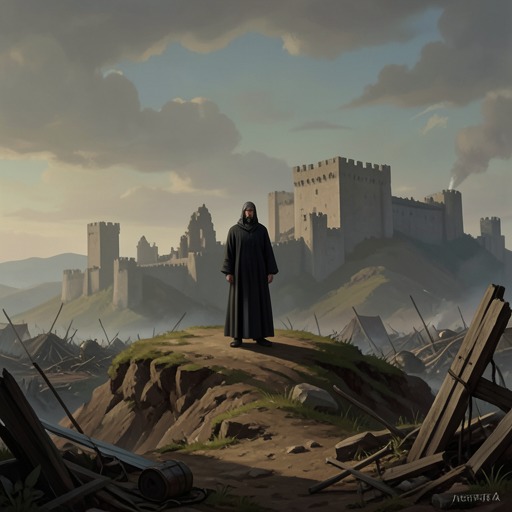
The Romance of the Three KingdomsWuchao is Yuan Shao’s vital grain depot during the campaign against Cao Cao at Guandu. Its destruction in a night raid converts a contest strained by dwindling provisions into a decisive crisis for Yuan Shao: without the stores there, his much larger army loses the supplies on which its continued resistance depends.
Strategic Importance
Yuan Shao brings a force many times larger than Cao Cao’s to Guandu, but the imbalance in numbers does not remove the problem of sustaining a long campaign. The armies remain locked in a stalemate for months, and food grows scarce on both sides. After Cao Cao’s men destroy a grain convoy, Yuan Shao becomes especially concerned about Wuchao and sends twenty thousand troops under Chunyu Qiong to guard it. The depot’s importance makes the choice of commander consequential: Chunyu Qiong is described as an alcoholic, and he arrives already drunk.
The contest for information compounds the danger. Yuan Shao’s men capture a messenger carrying a letter that exposes Cao Cao’s shortage of food. Xu You, formerly Cao Cao’s friend and now an adviser to Yuan Shao, urges an immediate attack on both Cao Cao’s capital at Xuchang and his camp. Yuan Shao distrusts the letter and does not act on the opportunity. When Xu You defects to Cao Cao, he redirects the knowledge of Cao Cao’s weakness toward Wuchao, identifying Yuan Shao’s supplies and their poorly prepared commander as the vulnerable point.
The Night Raid
Xu You advises Cao Cao to lead an elite force to Wuchao in disguise, passing as Jiang Qi, who has supposedly been assigned to protect the stores. Cao Cao follows the plan, dressing his men in the enemy’s armor and colors. They reach the depot at night and attack while Chunyu Qiong is asleep and intoxicated. The defenders are overcome, and the entire grain supply is burned.
Cao Cao also turns the attack into a warning to Yuan Shao: Chunyu Qiong is captured, mutilated, and sent back tied to his horse. The episode’s central reversal is not simply the loss of a guarded location but the destruction of the provisions that sustain Yuan Shao’s army. The raid makes the weakness of an overwhelming force plain: numbers cannot compensate for a supply base in flames.
Aftermath and Narrative Significance
Yuan Shao responds to the disaster with a confused division of forces. Zhang He offers to move against Wuchao, but Yuan Shao instead orders an attack on Cao Cao’s camp at Guandu, while Jiang Qi is sent with the larger force to recover the grain. Cao Cao’s men defeat Jiang Qi, and Cao Cao sends Yuan Shao a false report claiming that Jiang Qi has succeeded. Believing the supplies secure, Yuan Shao concentrates on Guandu. Cao Cao then attacks Zhang He’s force from the rear while his men engage from the front, trapping the enemy in a pincer movement.
Zhang He becomes disillusioned by Yuan Shao’s refusal to heed his advice. Slandered within Yuan Shao’s camp as a suspected collaborator, and with no secure return there, he transfers his allegiance to Cao Cao. Wuchao’s fall thus has consequences beyond the immediate loss of grain: it helps trigger a chain of defeats, exposes the cost of Yuan Shao’s mistrust and indecision, and contributes to the transfer of one of his leading commanders to the opposing side. The depot’s role gives the campaign a concrete strategic hinge, linking supply, intelligence, deception, and command decisions to the collapse of Yuan Shao’s advantage.