Wutugu
The Romance of the Three KingdomsWutugu, chieftain of the Wugu tribe, enters the southern campaign as the commander of an army whose distinctive rattan armour seems to make it invincible. Meng Huo turns to him as a final ally against Kong Ming, but the very protection that gives Wutugu’s soldiers their advantage becomes the means of their destruction: Kong Ming’s valley trap sets the oil-treated armour alight, killing Wutugu and all thirty thousand of his men. His brief appearance turns a contest of military strength into a decisive demonstration of how an enemy’s apparent advantage can be reversed.
Identity and Alliance
After Meng Huo has been captured and released repeatedly, he gathers only about a thousand men. He is told that the Wugu tribe may be his last hope and travels hundreds of miles to seek Wutugu’s help. Wutugu agrees, and roughly thirty thousand warriors answer the call. Their alliance brings a much larger force into the campaign against Kong Ming, and Wutugu’s command gives Meng Huo a new opponent to place between himself and defeat.
The Wugu people are described as living in caves rather than houses. Wutugu himself is identified by the account as a formidable chieftain, whose unusual diet and physical size contribute to the larger-than-life presentation of the tribe’s leader. These details distinguish his people from the forces previously encountered and prepare for the army’s unusual equipment to become central to the battle.
Rattan Armour and First Encounter
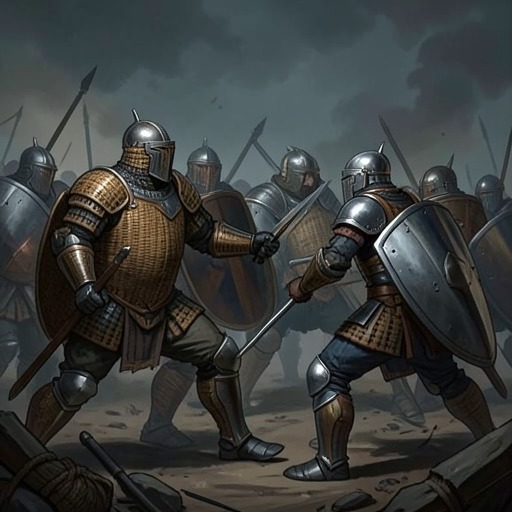
The Wugu warriors’ strength rests on armour made from rattan repeatedly soaked in oil, as many as ten times. The treatment makes it resistant to arrows and swords, while its buoyancy also allows the soldiers to cross rivers easily. The armour is not merely a visual marker of Wutugu’s army: it determines the terms of the encounter. When Kong Ming’s troops first meet them near Peach Blossom river, the Shu soldiers cannot penetrate the protection and retreat. The Wugu force does not press its advantage, instead returning to its camp.
The encounter briefly makes Wutugu’s army appear beyond the reach of ordinary tactics. Kong Ming’s advisers recommend withdrawing, arguing that the desolate territory offers little reward for the struggle. Kong Ming refuses to abandon the campaign and reconnoitres the surrounding terrain himself. He finds a winding valley, later identified as Serpent Winding valley, and recognizes that the landscape offers a way to turn the army’s apparent invulnerability against it.
The Valley Trap
Kong Ming’s plan uses a feigned series of defeats to draw Wutugu into the valley. Meng Huo and Wutugu repeatedly attack Wei Yan’s camps, which are abandoned in succession. Guided by white flags, Wei Yan withdraws from one camp to the next, leading the pursuing army deeper into the chosen route. Meng Huo has warned Wutugu to avoid valleys thick with trees and shrubs, and Wutugu is cautious when they encounter such places. The route that finally ensnares him appears comparatively bare, giving him no reason to expect an ambush from its sides.
On the sixteenth day, Wutugu rides a white elephant into Serpent Winding valley. His wolf-fur helmet is decorated with the sun and moon; his cloak is adorned with gold and pearls. When he spots Wei Yan, he curses him and pursues him again, intent on killing him. The Wugu soldiers pass wagons that appear to have been abandoned by a fleeing enemy, then continue until huge tree trunks block the far end of the valley. Rocks fall from above and obstruct the road behind them. As Wutugu’s men try to clear the barriers, blazing wagons appear and block their way forward; the earlier wagons are also set alight, cutting off the retreat.
When the trapped soldiers realize that the carts contain gunpowder, Wutugu attempts to lead them up the bare slopes, where the lack of brush seems to offer an escape from the flames. Burning brands are thrown down onto selected points, igniting fuses and mines buried in the ground. The explosion and fire consume the valley. The oil-treated rattan, which had turned aside arrows and swords and floated across rivers, now catches fire. Wutugu dies with the thirty thousand warriors who followed him; none of them escapes the trap.
Defeat and Narrative Significance
Kong Ming watches the outcome from the clifftop and weeps at the scale of the deaths. The scene presents his victory as strategically decisive but also as a terrible cost, not a bloodless triumph. Wutugu’s defeat removes the Wugu army—the force that had seemed impervious to attack—from Meng Huo’s resistance and closes the campaign’s final military challenge in this account.
Wutugu’s role is concentrated in the reversal built into his armour. Its painstaking treatment gives the Wugu fighters a clear advantage against conventional weapons, but the same oil that protects the rattan makes it combustible. The trap does not overcome the armour on its own terms; it changes the conditions of battle until the armour becomes a liability. Wutugu’s downfall therefore turns a striking military innovation into an emblem of vulnerability: a defence can be formidable in one setting and fatal in another.