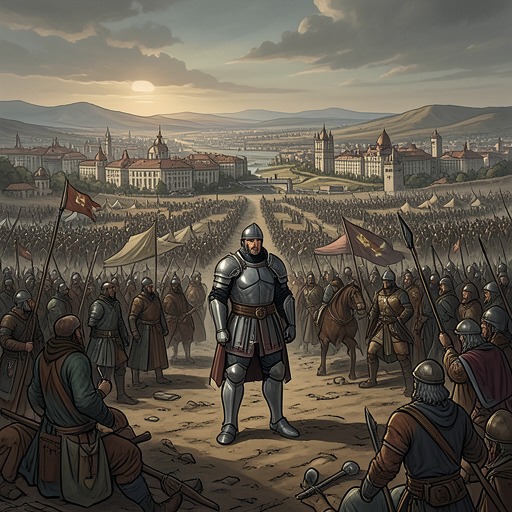
Xiangyang
The Romance of the Three KingdomsXiangyang is the fortified center of Liu Biao’s power in Jingzhou and the setting for a decisive reversal in Sun Jian’s campaign against him. Its defenses briefly fail before Sun Jian’s advancing force, but the siege becomes fatal to the attacker: portents prompt a plan to draw Sun Jian into an ambush, where he is killed. Later, Xiangyang’s political household is bound up with the conflict over Liu Biao’s succession, as his son Liu Qi is kept from visiting his dying father and Liu Biao dies without seeing him.
Stronghold and Strategic Setting
Xiangyang is presented as the city Liu Biao must hold against Sun Jian’s advance. Huang Zu, Liu Biao’s frontline general, commands its river defenses, placing archers along the waterway. Sun Jian’s boats approach under a sustained exchange: for three days, his soldiers shelter behind shields while Liu Biao’s archers expend their arrows. On the fourth day, Sun Jian’s men return the salvaged arrows against defenders who have run out, then land and defeat Huang Zu’s forces.
The victory gives Sun Jian control of the land up to the Han River, while Huang Zu escapes and reports to Liu Biao that the defenders cannot stop him. Sun Jian then lays siege to Xiangyang. The city’s position makes it more than a backdrop: control of its river approaches and surrounding territory shapes the military contest, while its walls mark the point at which Sun Jian’s rapid advance is finally checked.
Portents and Sun Jian’s Death
As the siege begins, the narrative sets battlefield confidence against warnings of impending disaster. A storm breaks the pole of Sun Jian’s banner, which is treated as a bad omen. Within Xiangyang, Liu Biao is told that a star has fallen behind the enemy lines and that this foretells the death of a great general—identified as Sun Jian. The portents become the rationale for a plan to eliminate the besieger rather than confront his superior force directly.
A letter is to be carried to Yuan Shao, urging cooperation against Sun Jian. Lü Gong volunteers for the mission and receives five hundred soldiers, with instructions to establish an ambush on a nearby hill. His men are to pile stones there and signal the city if they succeed, so that the besieged troops can emerge and attack; if no one stops him, Lü Gong is to continue to Yuan Shao with the letter. At night, he and his troops slip out through the east gate.
Sun Jian hears their departure and pursues them with only thirty horsemen. He rides directly into the ambush, where a falling stone kills him instantly. The account states that he is thirty-seven years old and that all thirty of his followers are killed. Lü Gong signals Xiangyang, and Liu Biao’s troops pour out of the city. The ensuing battle swings between the forces: Lü Gong is killed, Huang Zu is captured and taken to Sun Jian’s camp, and both sides withdraw as day breaks. The intended ambush thus succeeds in killing Sun Jian but does not settle the larger conflict without further negotiation.
The Body, the Bargain, and the Aftermath
Sun Jian’s son Sun Ce learns that his father has been killed and that the body has been taken into Xiangyang. An envoy, Huan Jie, is sent to negotiate with Liu Biao, offering to return Huang Zu in exchange for Sun Jian’s body. Liu Biao agrees on the condition that the invading army withdraw and promise not to attack again. The proposed exchange links the city’s military defense to a negotiation over the dead and the captured: each side holds something the other wants.
Before the envoy can return, one of Liu Biao’s advisers urges that the messenger be killed, arguing that the enemy could instead be wiped out. The account establishes the pressure on the agreement but does not, in the supplied passage, relate the resolution of this intervention. Xiangyang’s role in the campaign is therefore both martial and diplomatic: it is the besieged city from which the ambush is launched, and the place where Sun Jian’s body is held while terms are discussed.
Xiangyang and Liu Biao’s Household
Xiangyang’s political significance extends beyond the siege. Liu Biao’s household becomes a site of succession conflict, and Liu Qi’s relationship with his father is shaped by the machinations of the court. When Liu Biao asks Xuande whether his eldest son should be sent to Jiangxia, Xuande supports the proposal, allowing Liu Qi to escape the court’s schemes. Later, Liu Qi returns in hopes of seeing his ill father, but Cai Mao tells him that he has abandoned his post and should go back to Jiangxia. Liu Qi waits outside the gate, hoping to be admitted, then leaves in grief.
Inside the city, Liu Biao waits for his son, but Liu Qi does not arrive and nobody tells Liu Biao why. The account presents the separation as a final blow that fatally weakens Liu Biao; he dies in part from a broken heart. The city that had served as a defended military center is thus also the setting for an intimate political failure: control of access to its gate separates father and son at the moment when their meeting matters most.